
I was 9 years old when I attended my first professional lacrosse match. In mid-game, a player in possession of the ball stuck his hand out to stop the opponent player. One of the spectators shouted, “That’s a ward.” I looked at him confused and asked, ”What is a ward in lacrosse?”
Warding in literal terms means “to protect or guard”. In lacrosse, a “ward” refers to an illegal action where a player uses their free hand, arm, or any part of the body to hold, push, or control an opponent player’s crosse or body, thereby gaining an unfair advantage. This act, known as “warding” is illegal and may result in a turnover.
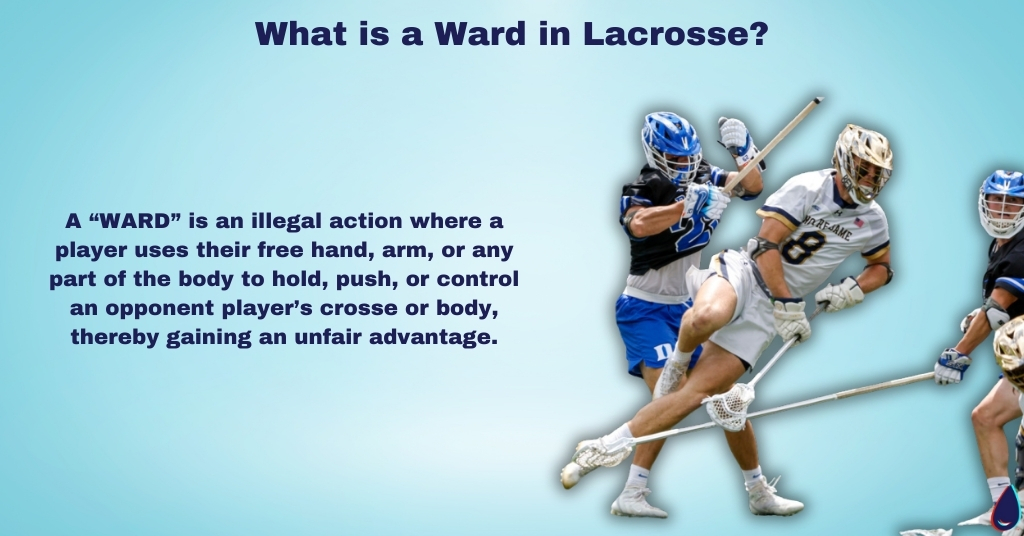
In this article, I will explain in detail what a ward is in lacrosse, warding techniques, rules and regulations, the difference between warding for men and women, and legal and illegal warding.
What Is A Ward In Lacrosse?
Warding in lacrosse is when a player tries to create a space by using freehand to shove, nudge, or even slightly boop a player out of their space. A “ward” happens when a player uses their free hand, arm, or body to push, hold, or control an opponent, creating an unfair advantage. It’s an illegal move that usually leads to a turnover.
It’s like saying, “Back off” in lacrosse. But it’s illegal! A ward in lacrosse will earn you a turnover.
So, in short, warding in lacrosse = a technical foul.
Why Is Warding Illegal in Lacrosse?
Simple: It keeps the game fair. Lacrosse is a contact sport, it’s not wrestling.
When players ward, it gives them an unfair edge, disrupting the balance between offense and defense. Warding slows the flow, and nobody wants to watch a sluggish game. Also, unchecked warding can lead to fatal injuries.
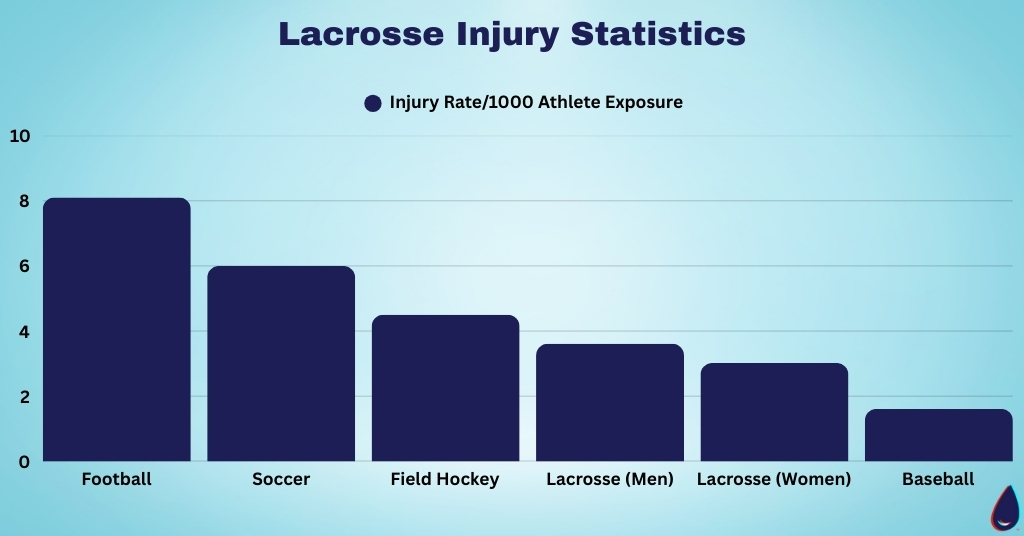
As per statistics, the following is a comparison table of injuries in lacrosse and other sports.
Legal vs. Illegal Warding
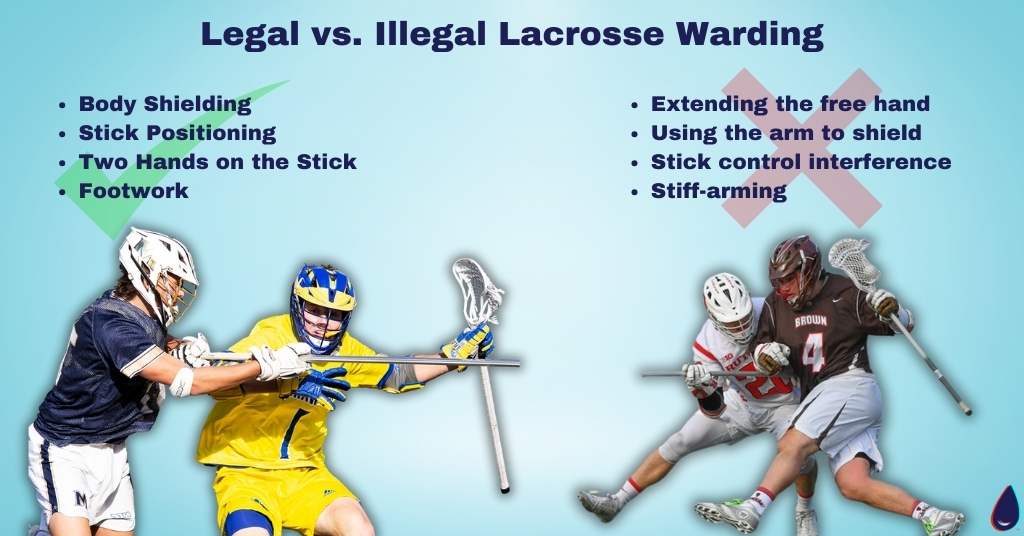
If you are still confused about what a ward is and whether there is a difference between illegal and legal warding in lacrosse, I have mentioned a few scenarios below that will help you understand the concept better.
| Scenario | Legal or Illegal? | Explanation |
| Using your shoulder to protect the ball | Legal | This is called body shielding. Using your torso or shoulder to block the defender is allowed. |
| Extending your free arm to push a defender | Illegal | Extending your non-stick arm to push or control the defender’s stick or body is warding. |
| Keeping two hands on your stick while maneuvering | Legal | Maintaining two hands on your stick while moving protects possession without fouling. |
| Cradling with one hand and using the free hand to control the defender | Illegal | Using the free hand to interfere with or push a defender’s body/stick is an automatic foul. |
How to Avoid Warding: Legal Techniques
Alright, so we now know that you can not stop the opponent with your hand or arm to guard the ball, so I have gathered some local warding techniques for you without costing you the ball possession.
| Legal Move | What It Means |
| Body Shielding | Use your body like a human wall to guard the ball. |
| Two Hands on the Stick | Keep both hands on your stick; no extra hands involved! |
| Stick Positioning | Angle your stick to keep it away from pesky defenders. |
| Footwork | Dance around defenders (well, sort of) to maintain space. |
So yes, you can stop your opponent from invading your personal space but not with your hand or arm.
WALOA Training Video 1 Warding
Rules and Regulations Across Different Leagues
Lacrosse regulations vary across different leagues. Players need to learn these distinctions before they get into the field.
NCAA Lacrosse Regulations
According to the NCAA rulebook, it is considered a foul if a player uses their free hand or arm to create separation from a defender, often resulting in a change of ball possession.
Extending the arm away from the body to create space is a central element in identifying a warding-off foul.
NFHS Lacrosse Rules
For high school lacrosse, governed by the NFHS (National Federation of State High School Associations), the rules are similar to NCAA with a slight difference in the application of penalties.
The NFHS rulebook specifies that using two hands is required when cradling, and any use of a free hand in warding off is strictly prohibited.
Illegal actions, such as stiff arms or extending the arm, are penalized to maintain fair play.
Men’s vs. Women’s Lacrosse: Differences in Warding Rules
I have mentioned before in several other articles how the rules differ slightly when it comes to lacrosse women, and the same deal goes here too.
| Men’s Lacrosse | Women’s Lacrosse |
| No freehand contact with the defender. | Same rule, but women’s lacrosse emphasizes even less contact. |
| More physical overall, but warding is still illegal. | Greater focus on positioning and stick control. |
Both men’s and women’s lacrosse say “no” to warding, but women’s lacrosse likes to keep things relying more on technique and control than physicality.
Read More: Is it Harder to Score in Men’s Lacrosse or Women’s?
Gray Areas in Warding
Warding can sometimes be a gray area. A player can legally use their arm if it’s stationary and inside their body frame. That means using your elbow tucked close to absorbing contact is fine, but the moment you extend or actively push, the whistle comes out.
In the video below, you’ll see an example of a ward in lacrosse.
- Passive arm use = Okay
- Active push = Penalty
Some advanced players will subtly “brace” contact using their tucked-in elbow to keep defenders at bay without crossing the line into illegal warding.
Can Warding Ever Be Legal?
Technically, the perception of warding can vary depending on what level the game is being played.
- Youth leagues: Stricter interpretation of warding.
- High-level games: Slightly more leniency on body contact.
Either way, I would suggest you stay clean and stay legal as strong warding may lead to fatal injuries despite body protection.
Read More: Rules of Lacrosse
Common Mistakes To Avoid
We have all been there; you panic, you push, and you do things that you won’t normally do. But here are common mistakes to avoid if you are a player:
- Do not sneakily push the opponent, thinking the ref won’t notice. Trust me, they will.
- Don’t drop a hand off your stick when pressure kicks in.
- Do not be overconfident thinking that I will just create space real quick. No, you won’t.
Also Read: What are the Offsides in Lacrosse
People Also Ask
What Does A Ward Mean In Lacrosse?
A ward in lacrosse is when a player uses their free hand or arm to push or control a defender, which is considered a foul and results in a turnover.
What Is The Hardest Position In Lacrosse?
Goalie is often seen as the hardest position in lacrosse due to fast reaction times, physical risk, and constant mental pressure to protect the goal.
What Is A Ward In League?
In lacrosse leagues, a ward is an illegal move where an offensive player pushes a defender using their free arm or hand to create space.
What Is A Ward In Girls Lacrosse?
A ward in girls’ lacrosse occurs when a player uses her free hand to push or control a defender, which is illegal and penalized similarly to men’s lacrosse.
Can Warding Ever Be Legal In Lacrosse?
Warding is generally illegal, but passive arm use within your body frame, like bracing contact with a tucked-in elbow, may be allowed.
So, what is a ward in lacrosse? It’s that tempting but illegal move where you push defenders using your free hand, arm, or any part of the body to gain an unfair advantage over your opponent.
Remember: warding = turnover = lost opportunity.