
I may receive a commission if you purchase products through the links on this page at no additional cost to you. This helps me keep this site free but doesn’t affect my opinions in any way.
While defensemen and long stick middies (LSMs) can technically use any head, there are some specifically designed for these hard-hitting positions that can give players an advantage.
This guide goes over the best defensive lacrosse heads and explains what you should look for when choosing one.
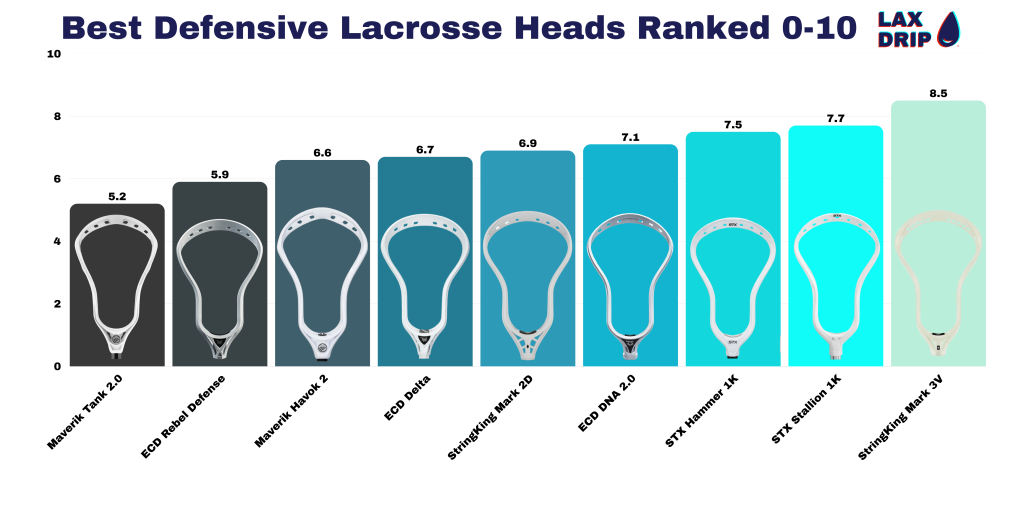
Defensemen need stiff and durable heads that can withstand 60 minutes of hard checks, shot deflections, and ground ball scrums. Many defensive players also prefer wider heads that give them more surface area to intercept passes and check opponents’ sticks.
7 Best Defensive Lacrosse Heads
To find the best defensive lacrosse heads, I started out by considering 16 of the top options on the market.
After researching their weight, face shape, stiffness, and other factors, as well as reading customer reviews, I was able to narrow by list down to 7.
Below you will find the best lacrosse heads for defensemen and LSMs including what each is best for.
Best Defense Lacrosse Heads:
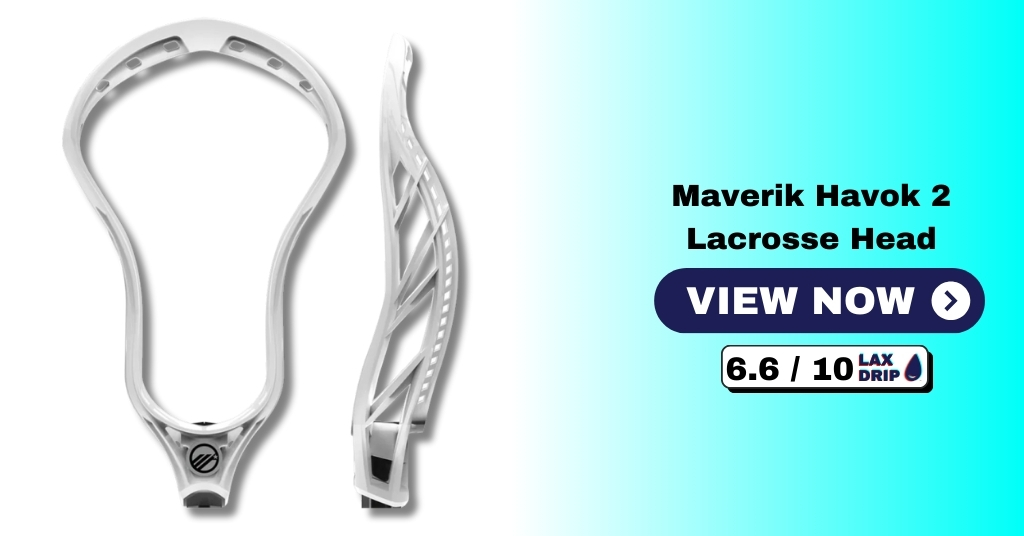
| Weight | 5.2 oz |
| Ideal Pocket | Mid-high |
| Stiffness | Extremely Stiff |
| # String Holes | 20 Sidewall Holes | 06 Top Holes |
| Year Released | 2023 |
The Havok 2.0 is perfect for throwing hard checks as a defender. Maverik designed it with Duratough material that doesn’t warp on impact. Although it’s lighter than the original, weighing 5.2 oz, it’s noticeably stiffer than its predecessor.
Moreover, the pinched sidewall and 04 strut design created a tighter throat, which helped me win more ground balls without losing control. It reduced unwanted flex when landing slap checks.
It has 20 sidewall holes, enough for pocket customization. The top holes are wide enough for double loops, and the lower ones allow pocket depth adjustment for clean release.
I strung a mid-high pocket, which improved my catching, and sending outlets on the run felt smoother. However, the face shape is not wide enough to scoop the ball on the run. Hence, I don’t recommend it to beginners.
Regardless, the pointed ground control scoop enhanced groundball pickups. It smoothly directs the ball into the pocket.
Pros
- Extremely stiff yet lightweight
- Narrow throat improves groundball control
- Durable Duratough Material built
Cons
- Not suitable for beginners
- Not ideal for wide scooping angles
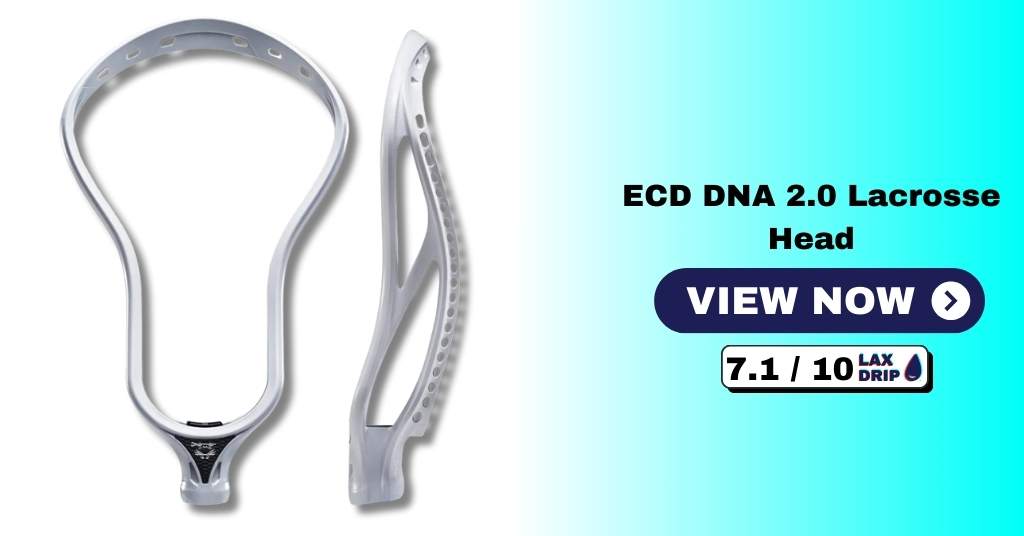
| Weight | 5.5 oz |
| Ideal Pocket | Mid |
| Stiffness | Extremely Stiff |
| # String Holes | 20 Sidewall holes | 06 Top Holes |
| Year Released | 2024 |
ECD DNA 2.0 is the most reliable defensive head on my list. Ryan Drenner also used it for a whole season. The Flexform material is durable and weather-resistant. It weighs 5.5 oz, half an ounce less than the original.
Besides, I liked how easily its rounded scoop shape caught the ground ball after disrupting the opponent. I strung a mid pocket using the added sidewall holes, which gave me a tight channel and great hold for fast outlets.
Moreover, its shorter throat adds stability while cradling and gives me a controlled feel. However, if you prefer a wider face for intercepting passes, opt for a more traditional defensive head like the ECD Delta.
Nevertheless, the pinched sidewalls are stiff, balanced, and built to take a beating without losing shape. I could easily throw impactful checks, and this head doesn’t even warp while battling difficult situations.
Pros
- Flexform plastic doesn't lose its shape
- Rounded scoop for easy groundballs
- Curved scoop offers quick release
Cons
- Limited face area for intercepting passes
- Heavy
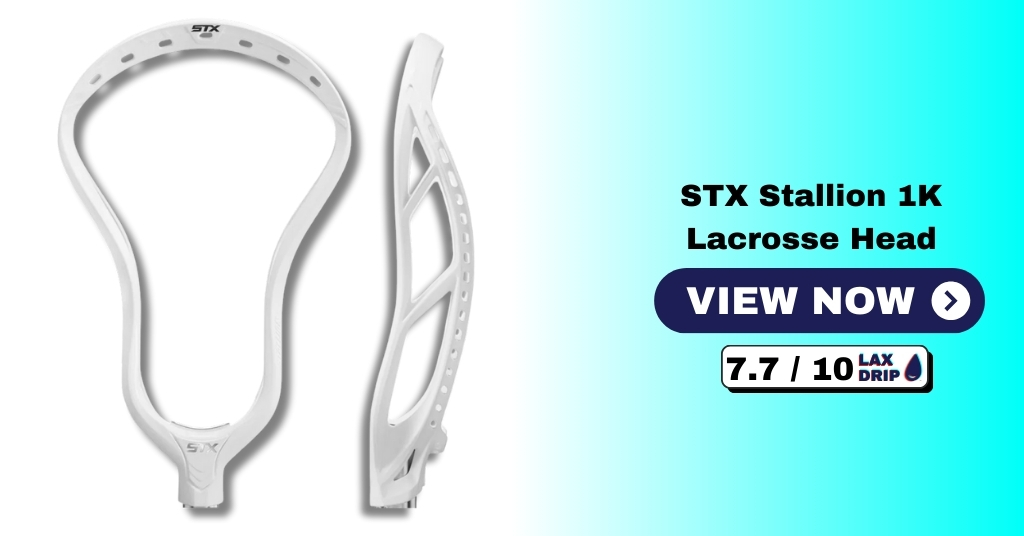
| Weight | 4.84 oz |
| Ideal Pocket | Mid-high |
| Stiffness | Above average |
| # String Holes | 16 Sidewall Holes | 07 Top Holes |
| Year Released | 2023 |
I have been using the Stallion series for different positions, and 2023’s 1K is worth investing in for D-middies. At 4.84 oz, it’s still lightweight, especially for how solid it felt. I was impressed with the durability and strength-to-weight ratio, although it looks chunky.
It has a classic two-strut sidewall design, and the C-channel along the back rail adds stiffness for impactful checking. Yet, there is minimal flex in the middle for easy cradling in traffic.
Besides, it has a wider face shape. Hence, I effortlessly scooped groundballs, even from an awkward angle. Still, it’s structured enough to push out quick outlet passes after a turnover.
Furthermore, 16 sidewall holes are enough to get a clean channel with a decent hold and a smooth release. However, it didn’t give me variable options for pocket customization. Thus, if you don’t prefer a mid-high pocket, opt for Maverik Havok 2.
Pros
- Lightweight and sturdy
- Wider face shape for smooth pick-up
- Balanced flex for control in traffic
Cons
- Limited stringing options
- Not as stiff as elite defensive heads
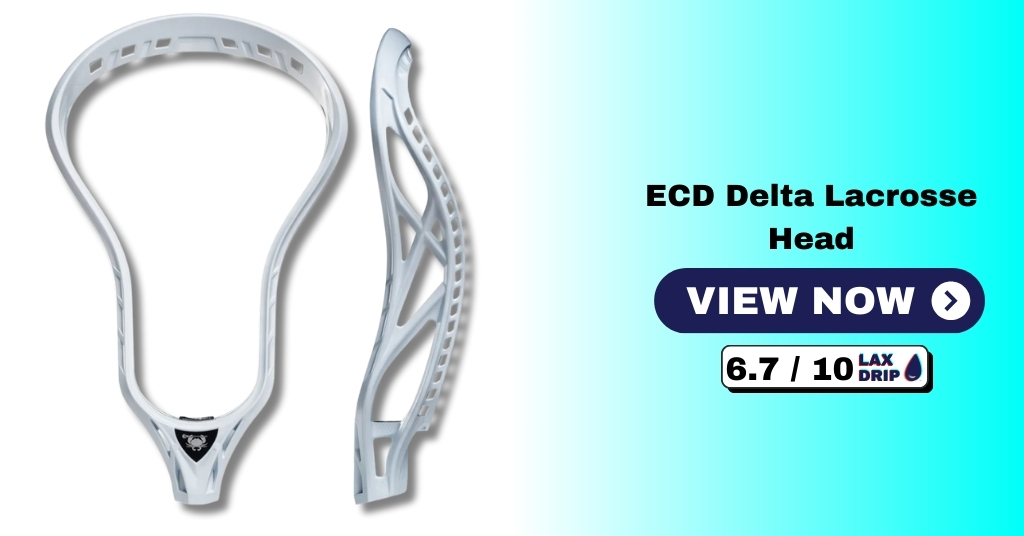
| Weight | 5.6 oz |
| Ideal Pocket | Mid-high |
| Stiffness | Extremely Stiff |
| # String Holes | 18 Sidewall Holes | 06 Top Holes |
| Year Released | 2024 |
I have been using the ECD Delta for over a year, and it hasn’t lost stiffness. Despite weighing 5.6 oz, it doesn’t feel heavy, and the X-strut design resists warping while throwing hard checks.
Besides, its wide face profile and pinched side rails provided exceptional shooting and passing accuracy. The larger surface area also enables me to intercept passes from variable angles. Its shorter and narrower throat profile also helps maintain possession against opponents’ checks.
The Delta’s slightly curved scoop with flat edges easily funnels the ball into the pocket, even on the run. I cleanly picked up ground balls without slowing down, even though I checked the ball loose near the crease.
Moreover, its mid-high pocket held the ball tightly while cradling it in traffic. Initially, the pocket felt stiffer and frequently popped the ball out, but the issue resolved after the break-in period. Thus, if you prefer a flexible head, go for Stallion 1k.
Pros
- Stiff sidewalls to deliver strong checks
- Pinched design for better control
- Rounded scoop for easier groundball pick-up
Cons
- Long Break-in period
- Extremely stiff
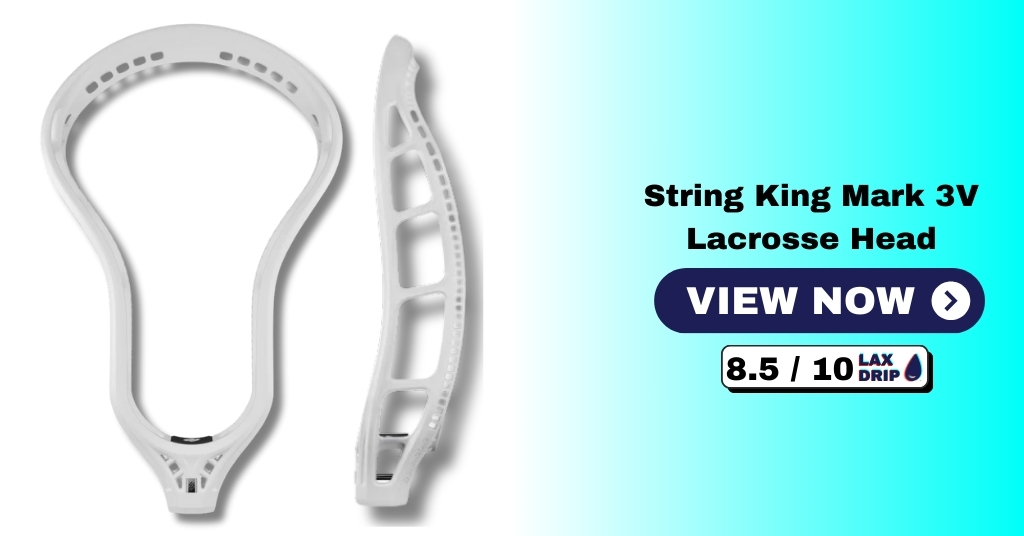
| Weight | 4.5 oz |
| Ideal Pocket | Mid pocket |
| Stiffness | Moderately stiff |
| # String Holes | 32 Sidewall Holes | 8 Top Holes |
| Year Released | 2024 |
I delivered impactful checks with Mark 3V for six months, and it didn’t warp even in summer. Its widely spaced sidewalls with multiple struts are extremely rigid. The ultra-stiff plastic absorbed the impact when I threw hard poke checks or jammed my hands during a slide.
The pinched sidewalls and shorter throat give me exceptional control when clearing. I smoothly cradled through pressure without the ball rattling out. It’s not a pure defensive head, but it gives me the confidence to push upfield in transition or after a clean takeaway.
Moreover, its wider face effortlessly picks up ground balls during fast breaks. Even with a lot of traffic, I could scoop on the run without stabbing or missing.
I also loved the rounded scoop. Although the ultra-stiff plastic makes defensive clamps difficult, the curved scoop is perfect for winning the ball.
At 4.5 oz, it’s lightweight, making it suitable for elite D-middies and aggressive LSMs. Yet, I would not suggest it to beginners looking for a more forgiving head.
Pros
- Durable and weather-resistant
- New ultra-strong plastic built
- Secure cradling
- You can get it strung in any position
Cons
- Not suitable for beginner d-pole players
- Slight rattle on impact
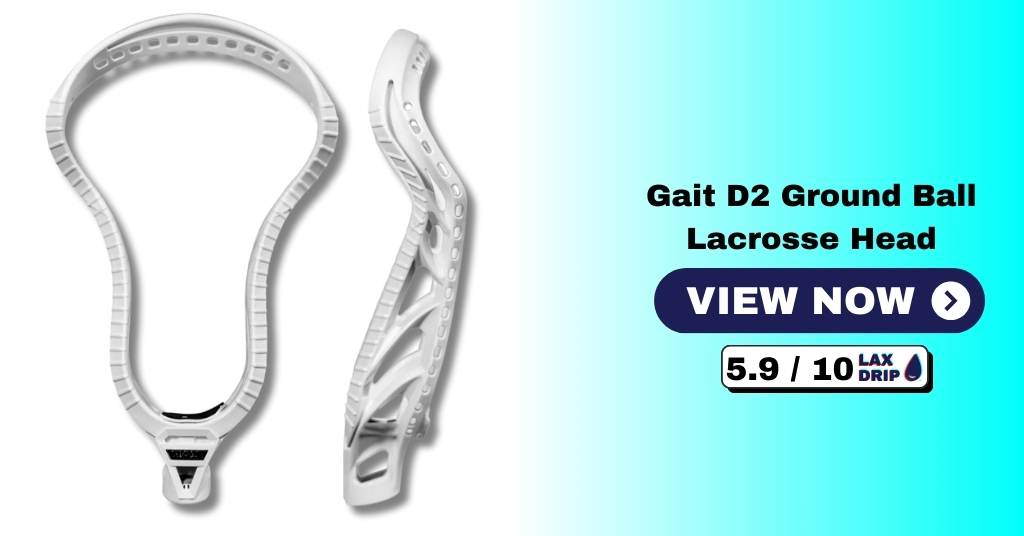
| Weight | 5.5 oz |
| Ideal Pocket | Mid-high |
| Stiffness | Above average |
| # String Holes | 18 Sidewall Holes |11 Top Holes |
| Year Released | 2024 |
Gait D2 is the newest defensive lacrosse head on my list, and it has a better shape than the Gait D. Although it doesn’t have the sharp can-opener hooks that got the original Gait D banned, it easily dislodges the opponent.
Similarly, it has several ridges along the inner sidewalls and a unique cutout under the scoop. Hence, it felt stiffer when absorbing impact. Otherwise, its face profile is wide and angular, perfect for knocking down passes or scooping on the run.
Moreover, the flares near the scoop open it up just enough for ground balls without feeling sloppy. Still, the throat is longer and more squared-off than most heads I have used. It affected my hand placement, resulting in lower shooting speed and reduced torque while checking.
Regardless, I strung a mid-high pocket using its unevenly spaced mid-high pocket. It gave me consistent holds and easy outlets. The offset and aggressive return shape let the ball sit high and tight despite lacking the traditional D-heads deep channel.
Pros
- Air scoop easily funnels the ball into the pocket
- Stiff side walls don't warp
- Weather-resistant and durable built
Cons
- Minimal flex at scoop cutout
- Doesn't create a traditional D head channel
7) STX Hammer 1K
Best Features: Stiffness & Durability
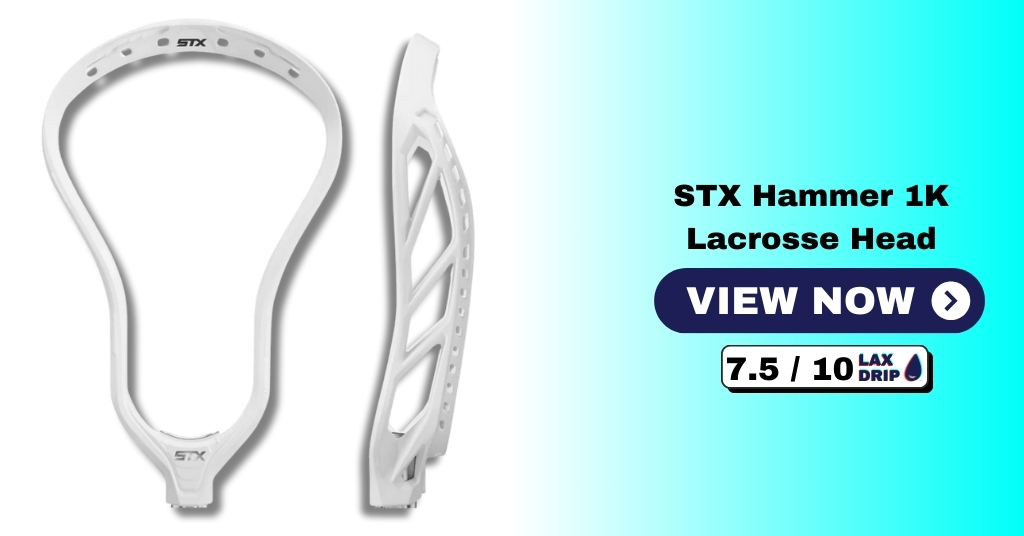
| Weight | 5.2 oz |
| Ideal Pocket | Mid/high to high |
| Stiffness | Above average |
| # String Holes | Above average |
| Year Released | 2017 |
STX’s newest defensive lacrosse head—the Hammer 1K—comes in as the best option on this list due to its unmatched stiffness and durability.
It improved upon our previously top-ranked defense head in the Hammer 900 with its increased stiffness and shape retention thanks to improved EnduraForm plastic.
It also doesn’t seem like it will have any of the same issues with breaking frequently that the older Hammer Omega had.
The STX Hammer 1K has a nice face shape for both defensemen and LSMs. It is pretty pinched towards the throat but gradually widens towards the scoop, giving it good ball control but still being wide for intercepting passes and laying checks.
As far as the offset goes, it is pretty high up on the head, making it great for a mid/high to high pocket, which is typically the preference for defensemen.
The Hammer 1K also has STX amazing Speed Scoop that is specifically designed to perform better on long poles. This makes ground balls a breeze and the InnerLock technology makes stringing easier and keeps your strings tighter.
The biggest downside is that there are only 15 sidewall holes on each side. While I haven’t ran into any issues with stringing it, if you prefer more sidewall holes, you may want to look elsewhere.
Overall, the new STX Hammer 1K is a great option for any D player—including close defenders and LSMs. It should hold up well for even the hardest of checkers and perform well in transition.
Pros
- Very stiff
- Durable
- Great scoop
- Nice face shape
Cons
- Fewer sidewall holes than competitors
Buying Options
*Video is for the older STX Hammer 1K
8) StringKing Mark 2D
Best Features: Scoop & Weight
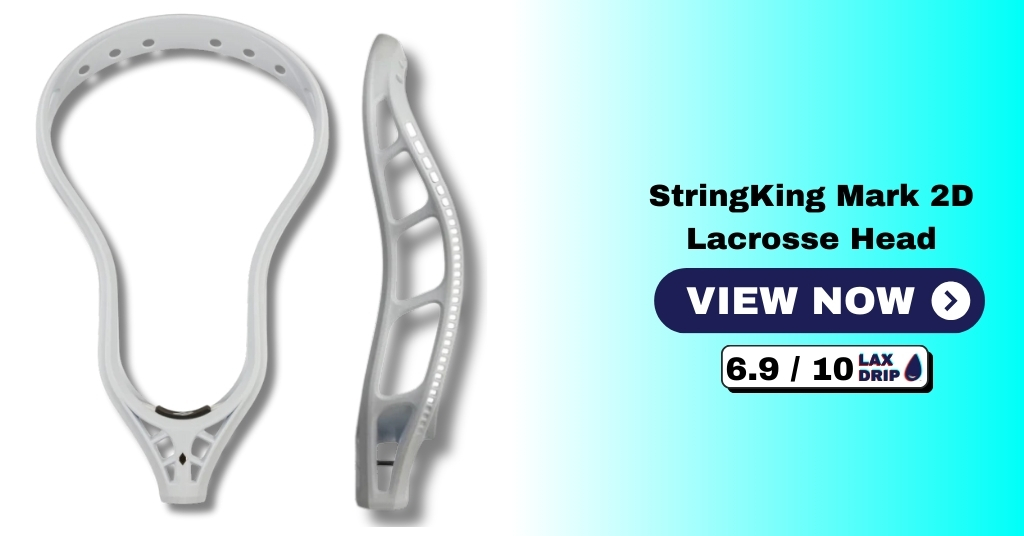
| Weight | 5.2 oz |
| Ideal Pocket | Mid/high to high |
| Stiffness | Above average |
| # String Holes | Above average |
| Year Released | 2017 |
The StringKing Mark 2D checks in as a very close second on our list of the best lacrosse heads for defense—and for very good reason.
It is the lightest head to make this list at an impressive 5.2 oz. Even better, unlike many other light heads, it has above-average stiffness and durability.
We’ve found that the scoop on the Mark 2D is great for ground balls. Its sharp angle, along with the dramatic forward cant shape of the head, allow you to easily scoop balls even when your butt end is still high in the air.
The head shape and numerous stringing holes make it easy to string a high pocket with good hold and smooth release. Like most other StringKing heads, the Mark 2D strings up beautifully and the range of pocket options is limitless.
The Mark 2D also has a locking bolt mechanism in the throat that helps secure your head more than just a traditional screw helping to eliminate head rattle and movement during checks.
Overall, this is a great head for both defensemen and LSMs due to its light weight, stiffness, face shape, and scoop design.
Pros
- Very light
- Above-average stiffness
- Great scoop design & head shape for ground balls
- Tons of stringing holes
Cons
- Hard to string a low pocket in it
Buying Options
9) Maverik Havok
Best Features: Tight Pinch & Scoop
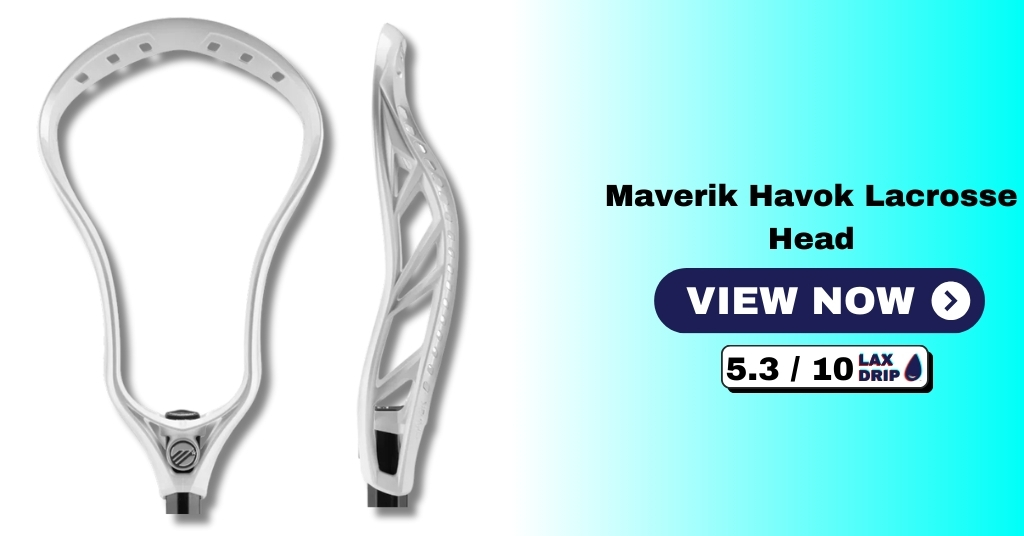
| Weight | 5.25 oz |
| Ideal Pocket | Mid to mid/high |
| Stiffness | Above average |
| # String Holes | Above average |
| Year Released | 2022 |
The original Maverik Havok wasone of the most popular LSM heads on the market and the Havok 2.0 is even better.
The Havok 2.0 has a tighter face shape than the original that still opens up towards the scoop.
We found a Havok 2.0 strung up with a nice mid to mid/high pocket with a tight channel gives great hold and a smooth release.
The Havok 2.0 only weighs 5.25 oz, making it one of the lightest D/LSM heads on the market today. It is 3.25 oz lighter than the original. It also has an extra sidewall strut to help increase the stiffness compared to the first version.
The new version of the Havok also has more stringing holes than the original—something that was a big complaint with the 1.0.
The Havok 2.0 also has the Ground Control scoop that has a sharp angle making it easy to snag ground balls without having to get your butt end close to the ground. The way the top half of the head cants forward also helps with scooping balls.
If you are an LSM, D middie, or defenseman who likes to push transition, the Havok 2.0 is a great option due to its face shape, light weight, and scoop.
More traditional defensive players who prefer a wider, stiffer head may want to look at other alternatives as the STX X20 or Maverik Tank 2.0.
Pros
- Face shape helps give more control in transition
- Great for ground balls
- Very light for a D/LSM head
Cons
- May take getting used to for D players used to wide heads
Buying Options

10) STX X20
Best Features: Wide Face Shape & Light Weight
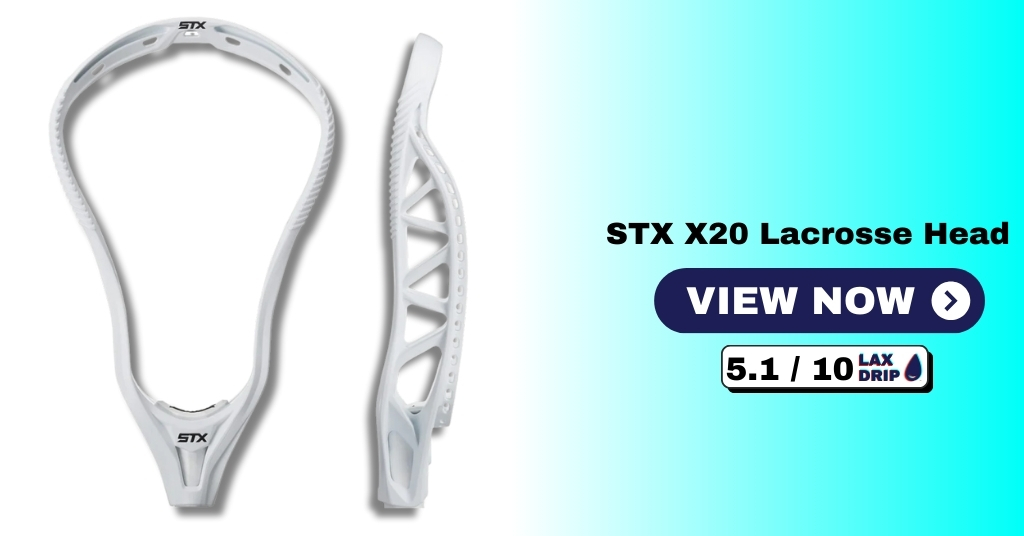
| Weight | 5.2 oz |
| Ideal Pocket | Mid/high to high |
| Stiffness | Above-average |
| # String Holes | Average |
| Year Released | 2020 |
The STX X20 is the newest head in one of the longest-running head lines in the game—the Xcalibur series.
The X20 features the classic wide face shape that the Xcalibur and X10 had. This makes it great for knocking down passes and having more surface area for checks but makes it a bit harder to string and provides less hold.
If you end up going with the X20, we recommend stringing as tight of a channel as possible to account for the wide face shape.
One of the best benefits of the X20 is that it is very stiff even though it only weighs 5.2 oz—making it one of the lightest defense heads available.
It also has STX’s amazing speed scoop which makes picking up groundballs a breeze—especially on a long pole.
Overall, if you are a defenseman who doesn’t carry the ball much that prefers wide heads, the X20 is one of the best options available.
Pros
- Very stiff
- Great scoop
- Good for high pockets
Cons
- Wide face shape provides less control & makes it harder to string
Buying Options
- Unstrung
11) ECD Rebel Defense
Best Features: Tight Pinch & Stiffness
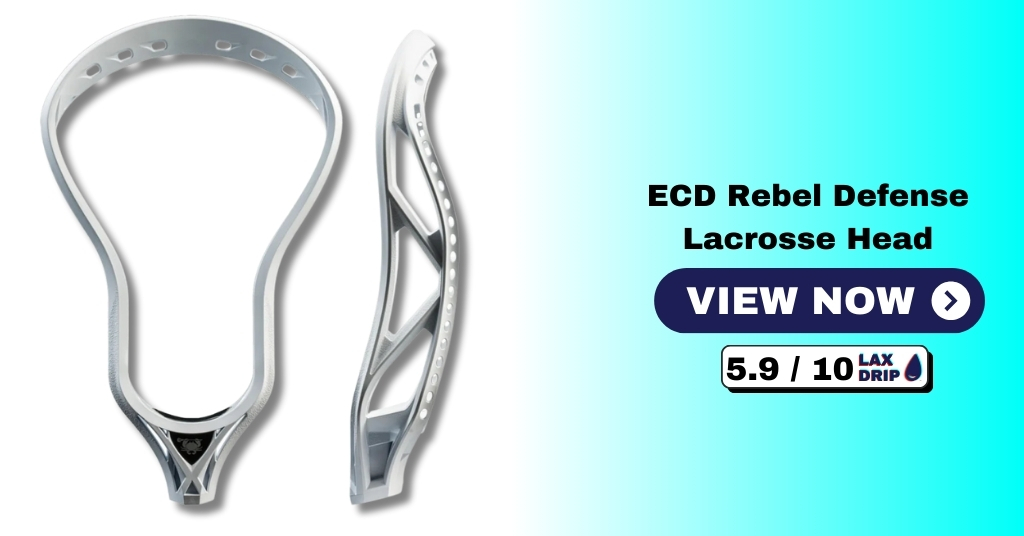
| Weight | 5.6 oz |
| Ideal Pocket | Mid to mid/high |
| Stiffness | High |
| # String Holes | Above average |
| Year Released | 2018 |
The defensive version of the ECD Rebel head line comes in next on our list.
Compared to other D heads, the ECD Rebel Defense has a pretty narrow pinch, making it an especially attractive option for LSMs and defensemen who carry the ball in transition a lot.
It also is very stiff while being right in the normal weight range of most D heads.
As with most ECD heads, the Rebel Offense has more stringing holes than most comparable options, making it easy to string whatever your preferred pocket is.
With that being said, the high offset makes mid to mid/high pockets ideal for the Rebel D.
We did find some customers reporting that their Rebel Defenses broke after using them for a while—though this seems to be pretty rare and the head comes with a 6-month warranty.
Overall, if you’re a defensemen or LSM that prefers a head with a narrower pinch, the ECD Rebel Defense is a solid choice.
Pros
- Narrow pinch towards throat
- Great scoop
- Lightweight
- Many stringing holes
Cons
- Some reports of breaking
Buying Options
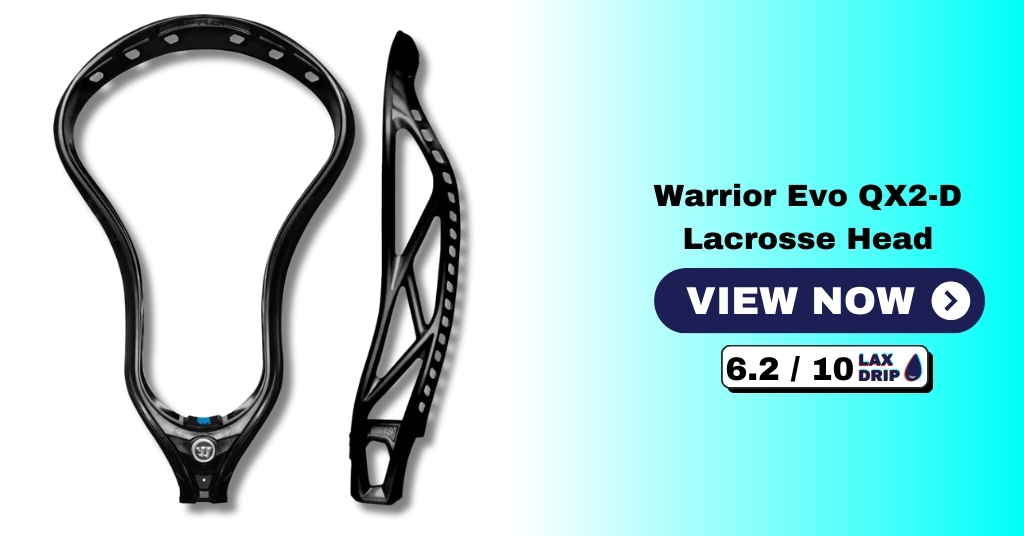
12) Warrior Evo QX2-D
Best Features: Durability & Stiffness
| Weight | N/A |
| Ideal Pocket | Mid/high to high |
| Stiffness | High |
| # String Holes | Average |
| Year Released | 2022 |
Warrior just released the newest heads in its popular Evo QX series, including both an offensive (QX2-O) and defensive head (QX2-D).
Just like the QX2-O is one of our favorite heads for attackmen and middies, the QX2-D is an amazing option for defensemen and LSMs.
The Evo QX2-D has a tighter face shape than the original QX-D, making it a great option for advanced defensemen and LSMs.
It features the new Therma-LOC+ Resin, making it very stiff and durable even in high temperatures. The updated sidewall strut design also makes it stiffer than the original head—which was already very stiff.
This means when you’re out there playing summer ball your head won’t turn into a noodle making it hard to lay checks and scoop the ball.
The max offset is very high up on this head, making it great for those D guys that love mid-to-high or high pockets.
Overall, if you prefer Warrior heads and don’t mind a narrow face shape, the Evo QX2-D is an awesome choice.
Pros
- Therma-LOC+ Resin keeps it stiff in high temperatures
- Narrow face shape
- Removable throat lock
Cons
- Hard to say how it holds up over time since it's so new
Buying Options
- Unstrung
- Strung
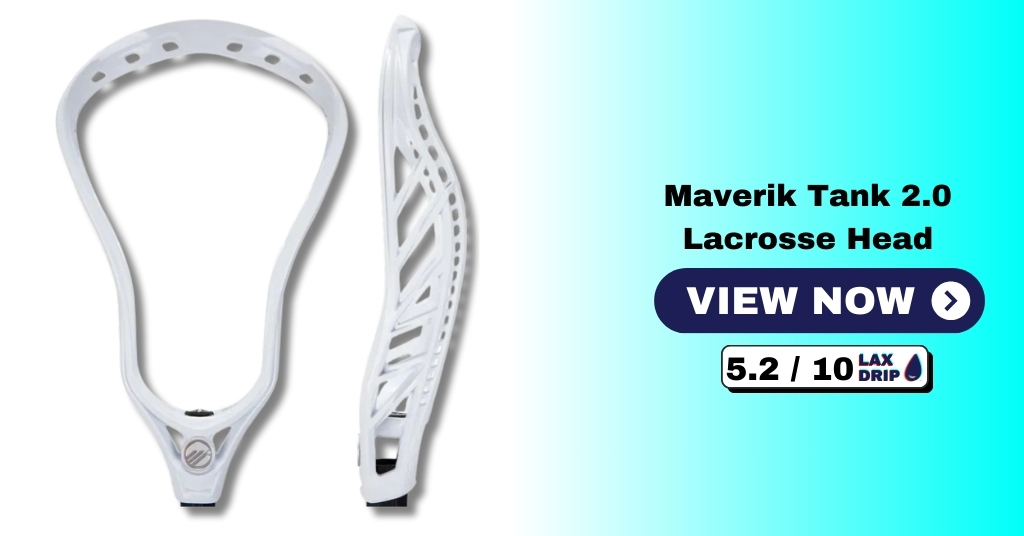
13) Maverik Tank 2.0
Best Features: Wide Face Shape & Stiffness
| Weight | 5.7 oz |
| Ideal Pocket | Mid/high to high |
| Stiffness | High |
| # String Holes | Average |
| Year Released | 2020 |
Maverik released the newest edition of their popular defensive lacrosse head—the Tank 2.0—in late 2020 and it is still one of the top choice of elite college defensemen.
As the name suggests, this head is quite literally a tank. It is super stiff, helping it deliver hard checks without being too heavy. The wide face shape makes intercepting passes easy and gives more area for laying checks.
The Tank 2.0 includes an improved scoop, as well, that makes grabbing GBs a breeze after you check the ball out of someone’s stick.
On the downside, the wide face shape makes it harder to string a narrow channel. This can make it harder to achieve good hold, making carrying the ball in transition potentially difficult.
Like many other defense heads, the Tank 2.0 is designed primarily for a mid-to-high or high pocket. Using a dropped top string is a good way to achieve a tight channel in a high pocket with the Tank 2.0.
If you prefer a wide defense head that will hold up for multiple seasons, you won’t be disappointed with the Maverik Tank 2.0.
Pros
- Very stiff
- Wide face shape (for those that prefer it)
- Good scoop
Cons
- Can be hard to string
- Not great for transition due to wide face
Buying Options
Budget Defense Lacrosse Heads
If the heads above are too expensive, there are some great clearance and cheaper lacrosse heads that you could consider.
STX X10
This is the updated version of one of STX’s most popular defensive heads ever, the XCalibur. Its stiffness, durability, and wide face shape make it an attractive option for traditional long poles.
Brine King II ST
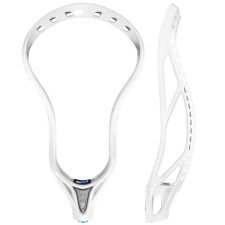
Another great budget defense head is the Brine King II ST—the stiffer version of the popular King II head. It features a narrow pinch compared to many other D heads, making it a good option for LSMs and D middies.
>> View on Battle Lacrosse
Adidas Blockade
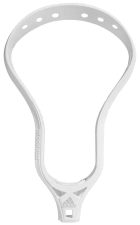
Last on our list of the best cheap defensive lacrosse heads is the Adidas Blockade. Much like the King II ST, it features a narrow face shape helping improve control while still being stiff enough to lay hard checks.
What to Look for in a Lacrosse Head for Defense or LSM
With so many lacrosse heads designed for defense on the market today, it can be difficult to decide which to pick. To help, I’ve listed out 7 things you should consider when choosing which to go with.
1) Stiffness & Durability
First and foremost, you need a strong head that is durable enough to last through thousands of checks. As a defenseman, you need to be confident that your head won’t break, warp, or flex too much when delivering poke and slap checks over the course of the game.
It’s important to consider how heads hold up over the course of an entire season or multiple seasons. Even if a head feels very stiff when it is brand new, it could still become flexible after a lot of use or in hot weather.
Read (or watch) customer reviews to get a sense of the longterm stiffness and durability of the head.
2) Weight
Typically, the heavier a head is, the more durable and stiff it is.
More recently, however, companies have developed advanced plastics that are very light but just as strong (if not stronger) than “traditional” bulky defensive heads.
Assuming the stiffness and durability is equal, most players prefer a lighter head because they can throw faster checks, react faster, and move around the field faster.
Most new defensive heads on the market today weigh around 5.2 oz to 5.6 oz. Any head in this range should feel pretty normal on your d-pole. Once you get into heads over 6 oz, your stick may start to feel top heavy.
3) Face Shape
The next thing to consider when choosing a defensive head is what kind of face shape you want.
In the past, defensemen almost always preferred very wide heads that gave them more area to intercept/deflect passes and for laying checks.
Recently, there has been an influx of defensive heads more geared towards advanced players, LSMs, and D middies. These heads typically have a narrower face shape—especially towards the throat of the head—that allows for better control of the ball.
As you’ll see in the reviews above, there is no one “best” face shape when it comes to defensive heads for lacrosse. My advice is to try out a wide head as well as a more pinched defensive head to see which you are more comfortable with.
4) Scoop
I think having a good scoop is more important for defensemen than any other position.
Why?
Mainly because your head is attached to a long defense shaft that makes it more difficult to achieve a low angle with the ground when scooping.
Whereas attackmen and middies can bend down a few inches to achieve a low enough angle to scoop a ball, defensemen often have a higher angle due to their shaft length.
Having a more angled scoop can help you gobble up ground balls easily without having to bend completely over, which would likely slow you down considerably.
5) Pocket Placement
The design of your head—especially the placement of the offset on it—is the main factor in where your pocket should go.
The part of the stick with the largest offset (or where your head is closest to the ground when holding it horizontally) is where its ideal pocket is.
Most defensive heads have an offset around the top half of the head, leading to mid-to-high pockets.
While this is often beneficial for defensemen since it leads to more hold and whip—which is ideal when using a full-length defense shaft—if you are used to a low or mid/low pocket, you may want to look for a head with an offset closer to the throat.
6) Stringing Holes
Though not as important as the other factors in this list, you should also make sure that the head you choose has a sufficient amount of stringing holes so you can customize your pocket to fit your game.
This is most likely to be a problem with older heads as most new heads developed nowadays do have numerous stringing holes to work with.
7) Strung vs. Unstrung
Lastly, you will have to decide whether you want to buy a head that is strung or unstrung.
I personally always buy unstrung heads because I like to string them myself to fit my preferences.
If you don’t know how to string or don’t know someone that does, however, going with a strung head could be a good option. This is especially true if the site you buy heads from strings them themselves instead of coming with (notoriously bad) factory string jobs.
High School & College Head Rules
NFHS (high school) rules for lacrosse head dimensions started to match NCAA (college) rules starting in 2018. Previously, high school heads could be narrower towards the throat but had to be wider towards the scoop, and vice-versa for college heads.
Now that both organizations have the same set of rules, any head that meets NCAA rules is legal for NFHS as well. Here are the rules for heads:
- Minimum width of 6″ at the widest part of the head
- Minimum width of 3.5″ on front and back of the head at 5″ up from throat of the head
- Minimum width of 3″ at 3″ up from throat of the head
- Minimum width of 3″ at 1.25″ up from throat of the head
The following diagram from Stringers Society makes the rules a little easier to visualize:

If you are buying a head that was released in the past 2 years, you shouldn’t have to worry about it meeting these regulations.
If you are buying a head from 2017 or before, you should check to see if it meets NCAA specs. If it does, it should also meet current NFHS rules. If not, then it is likely illegal for both high school and college since the new NFHS rules went into effect in 2018.
A Note About the Gait D Head
The Gait D head—the head with “hooks”—will no longer be legal starting on January 1, 2023. Gait is working with retailers to allow players to trade in illegal heads. Check out the official Gait site for updates.
>> Read More: Lacrosse Head, Pocket, & Shaft Rules
How We Rate Defense Lacrosse Heads
We take our ratings seriously and only recommend products that we would use ourselves.
To come up with our ratings for each product, we test the product ourselves whenever possible, review product specifications (weight, number of stringing holes, etc.), and read customer reviews/talk to lacrosse players we know that use the product.
When testing heads, we bring them to a field and test for passing, catching, shooting, scooping ground balls, and checking—all with a standard pocket to reduce the number of variables. When it’s not possible to extensively test a product ourselves, we spend extra time talking to real customers who have used the product for a while themselves.
If you ever have any feedback for any of the products listed on this page or have a recommended addition, please contact us and let us know!
People Also Ask
How Do I Get Better at Lacrosse Defense?
Improve your lacrosse defense by using a stiff and durable head, practicing checks and ground ball scrums, and choosing a wider head for better interception and stick checks.
How to Pick a Lacrosse Head?
Choose a lacrosse head based on its stiffness, durability, weight, face shape, scoop design, pocket placement, and the number of stringing holes to suit your playing style.
What Is a Lacrosse Defender?
A lacrosse defender uses a stiff and durable head, often with a wider face, to perform checks, intercept passes, and control ground balls, playing a crucial role in protecting their team’s goal.
What Should I Look for in a Defensive Lacrosse Head?
Look for stiffness, durability, weight, face shape, scoop design, pocket placement, and adequate stringing holes when choosing a defensive lacrosse head.
What Are the Rules for Lacrosse Heads in High School and College?
Lacrosse heads must meet specific width requirements at various points to be legal for high school and college play, with current rules aligning since 2018.
Other Products to Consider Alongside Your New Defense Head
If you opt to go with an unstrung head, you’ll need mesh and strings.
Check out some of our other gear guides that can help you take your game to the next level:
- Best Defense Lacrosse Shafts
- Best Lacrosse Heads
- Best Lacrosse Balls
- Best Lacrosse Rebounders
- Best Lacrosse Helmets
- Best Portable Lacrosse Goals
- Best Lacrosse Nets & Replacement Nets
- Best Lacrosse Backstops
Photo source: Flickr