Your lacrosse head is the single most important piece of equipment when it comes to performance.
Sure, helmets and pads are important for safety, but your lacrosse head helps determine how well you pass, shoot, catch, pick up ground balls, check, and much more.
There are countless lacrosse heads on the market today, making it hard to decide which is the best for you. To help, we’ve created this guide which highlights the best lacrosse heads for a variety of positions as well as 5 other guides that present the best options by position.
To get started, either click one of the links below to see the best heads for that position or keep reading to see our best choices in each:
Best Lacrosse Heads by Position
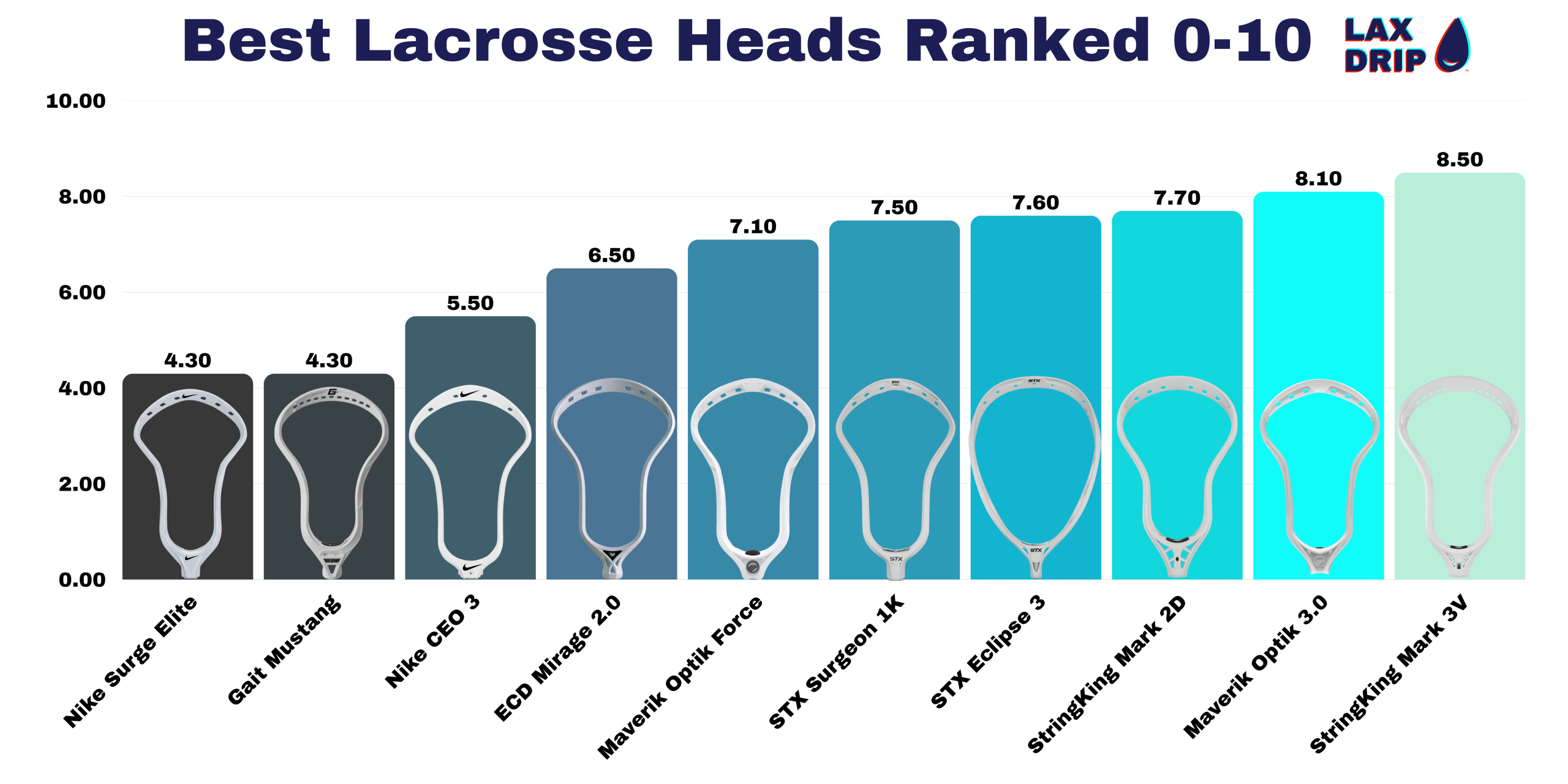
Below you will find our top 3 picks for lacrosse heads by position. As new heads come out, I will update this guide if I think they are worthy of being on this page.
To find the best lacrosse heads, I read countless customer reviews, studied which heads players at the collegiate and professional levels were using, and traveled to my local sporting goods stores to feel the heads in my own hands.
In the reviews below, any references to stiffness, weight, and other metrics are based on heads in that category. For example, the threshold for a head to have “above-average” stiffness is much high for a defensive head than a faceoff head.
Click to jump down to a section:
Attack
1. StringKing Mark 3V Lacrosse Head
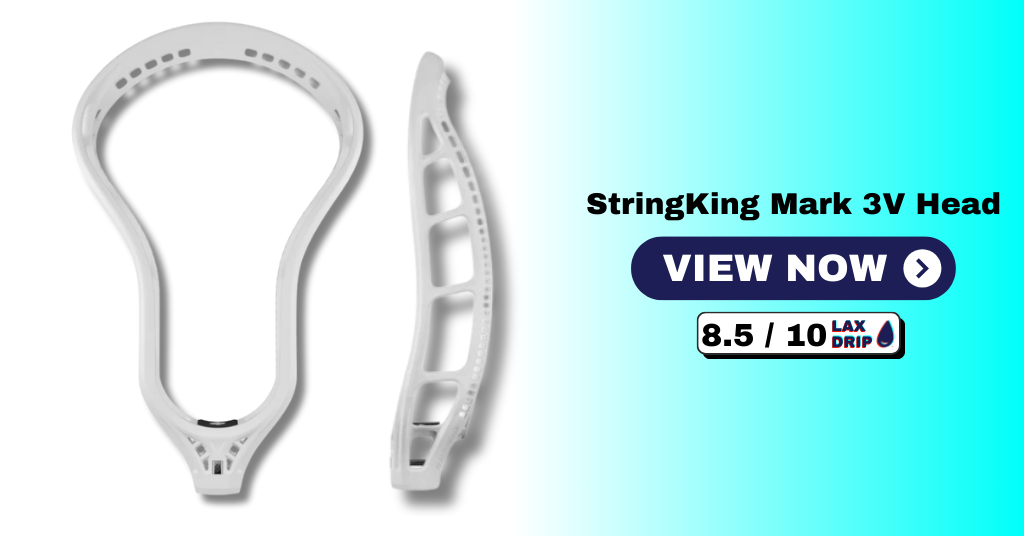
StringKing has once again raised the bar with the release of the Mark 3V lacrosse head, designed specifically for attack players looking for speed and accuracy. Weighing in at just 4.5 ounces, this head combines a lightweight feel with a robust construction that caught my attention right away.
The Mark 3V features a wide face shape and a mid-pocket location, which allows for excellent ball control and quick releases. The average stiffness of the head provides a nice balance between responsiveness and durability, making it suitable for intermediate and advanced players alike.
With eight top string holes and a whopping 32 sidewall holes, customization options are plentiful, allowing players to tailor their setup to their specific preferences.
In terms of shooting performance, the Mark 3V truly shines. I found that it delivered high-speed shots with remarkable accuracy, thanks to its stiff sidewalls that minimize off-center hits. The tapered throat design enhances shot control, making it easier to execute precise passes even under pressure.
I was particularly impressed with how well it performed during fast breaks, where quick releases are crucial.
Catching the ball is also a strong point for the Mark 3V. The slightly flared face helps guide the ball into the pocket effortlessly, providing reliable ball retention during high-speed plays.
While its stiffness can make cradling in tight situations a bit more challenging, I appreciated the security it offered when dodging defenders or transitioning between offense and defense.
Ground ball pickups were smooth and efficient as well. The rounded scoop design works well in crowded areas, allowing me to scoop up balls quickly without losing control. However, it’s worth noting that while the Mark 3V performs admirably in most aspects, its stiffness does limit its effectiveness during face-offs. Players looking for a dedicated face-off head may want to consider alternatives.
Durability is another highlight of this head. Constructed from ultra-strong plastic, the Mark 3V maintains its shape even under extreme conditions and resists flexing or warping over time. This makes it an excellent choice for players who frequently find themselves in high-contact situations.
It’s a good option for attackers who prefer speed and accuracy on the field.
Pros
-
- Durable enough to maintain shape under extreme weather
-
- New ultra-strong plastic build
-
- Good long-distance shooting accuracy
-
- Secure cradling with mid-pocket design
-
- Ample stringing options for customization
Cons
-
- Very stiff to cradle in tight situations
-
- Requires extra strength for clamping
2. Maverik Optik Force Lacrosse Head Review
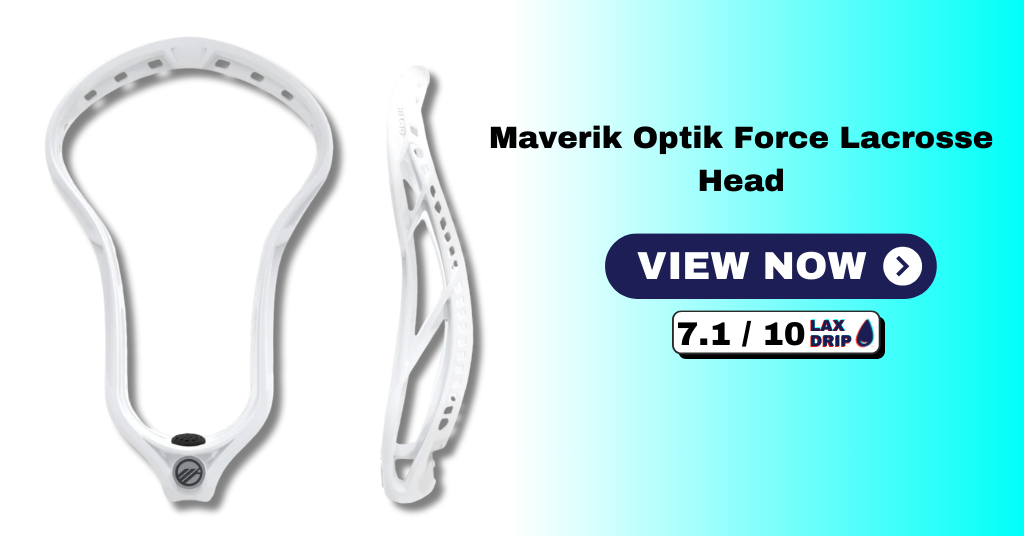
After seeing renowned players like Asher Nolting use Maverik heads, I was excited to try the new Maverik Optik Force lacrosse head, the highly anticipated successor to the Optik 3.0.
Released in 2024, this limited edition head promises to deliver performance and style for attackers and offensive midfielders.
Weighing just 4.85 ounces, the Optik Force is impressively lightweight while maintaining a robust design. Its extremely stiff construction ensures durability without sacrificing handling. The head features a low to mid-low pocket location, which enhances ball control and quick releases.
With six top string holes and 20 sidewall holes, there are plenty of options for customizing the pocket to suit individual preferences.
The shooting accuracy of the Optik Force is remarkable. The mid-low pocket combined with stiff sidewalls allows for precise passes and shots, even from long distances. I found that the shorter throat design improved my hand placement, enabling me to generate power effectively.
While it may not be the fastest head in terms of shooting speed, it compensates with consistent accuracy that kept my shots on target.
Catching the ball was also a strong point for this head. The wide top rail helps direct the ball into the pocket easily, making it reliable for catching on the run. However, I did notice that creating a low pocket could lead to some challenges with ground balls under heavy checks. To address this, I opted for a mid-low pocket setup, which provided better security during gameplay.
Ground ball pickups were smooth thanks to the aggressively angled scoop design. It allowed me to scoop up balls quickly and confidently, even in tight situations. However, the stiffness of the head does make it less effective during face-offs, as it lacks the flexibility needed for clamping down effectively.
It excels in accuracy, durability, and aesthetics, making it an excellent choice for attackers and offensive midfielders who value performance and style on the field.

Pros
-
- Lightweight and extremely stiff
-
- Accurate long-distance shooting
-
- Multiple sidewall holes for customization
-
- Better ground-ball control and cradling
-
- Stylish honeycomb ball stop design
Cons
-
- Requires pocket customization for optimal control
-
- Slightly wider face may not be optimal for some players
3. STX Surgeon 1K Lacrosse Head
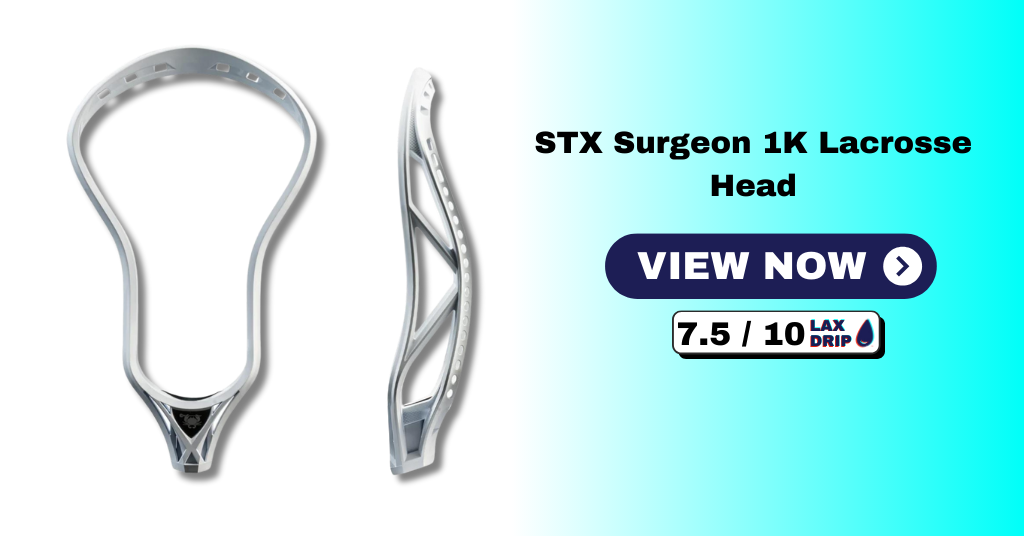
As an attackman who thrives on quick movements and accurate shots, finding the right head is important. I was eager to get my hands on the STX Surgeon 1K weighing at 4.83 oz, and it didn’t disappoint. STX claims it’s their lightest and most durable head to date, and after putting it through the wringer, I am inclined to agree.
The first thing I noticed was the redesigned face shape. It gave me a feeling of enhanced control, making my feeds crisper and my shots more on target. The maximum offset is a game-changer, allowing me to get some power behind my shots without sacrificing accuracy.
And let’s not forget ground balls. The Speed Scoop design made scooping them up a breeze, even in crowded situations. The Surgeon 1K is one of the best attack lacrosse heads for offensive players.
Pros:
-
- Lightweight feel
-
- Enhanced shooting accuracy
-
- Great for ground balls
Cons:
-
- Exclusively for attack-minded players
-
- Higher price point
4. Gait Torq 3 Lacrosse Head
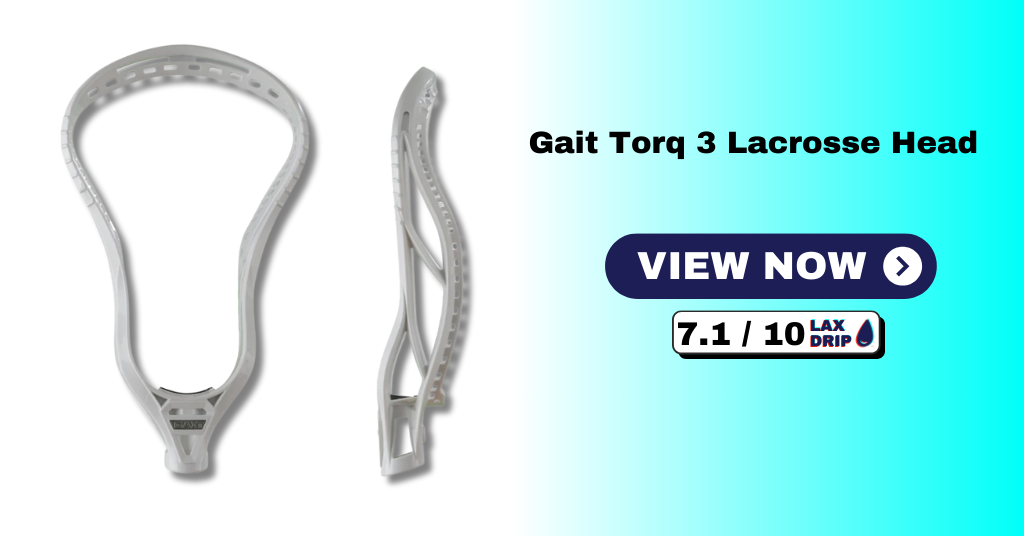
Gait has truly shaken things up with the Torq 3, and the first thing that caught my eye was the noticeably different face shape and overall design compared to the previous model. Weighing in at 4.5 ounces, this head feels incredibly light in hand, making it a dream for offensive players who rely on quickness and agility.
The reduced weight translates to less energy expended during stick handling, allowing for quicker dodges and more deceptive feeds.
I found the wider face profile to be a major advantage, especially when operating around the crease. The immediate release and high-speed shooting capabilities are top-notch. The aggressive shape improves control during fast-paced offensive sequences, minimizing the chances of the ball getting knocked loose.
The moderately angled and parallel sidewalls provided excellent ball retention. Even with constant pressure from defenders, the tighter channel kept the ball secure. During gameplay, I was able to cradle the ball through heavy traffic.
While the lower walls offer minimal flex, which can sometimes result in slight rattling on off-centered hits, the Torq 3’s stiffness strikes a great balance. It’s stiffer than the Torq 2, but with a touch more flex than the Maverik Optik, giving it a durable feel.
Pros:
-
- Lightweight and durable
-
- Well-spaced sidewall holes for pocket customization
-
- Wide face for easy catching
-
- No spread on shots
Cons:
-
- Lower walls offer minimal flex, which can sometimes result in slight rattling on off-centered hits
5. Maverik Kinetik 3.0 Lacrosse Head
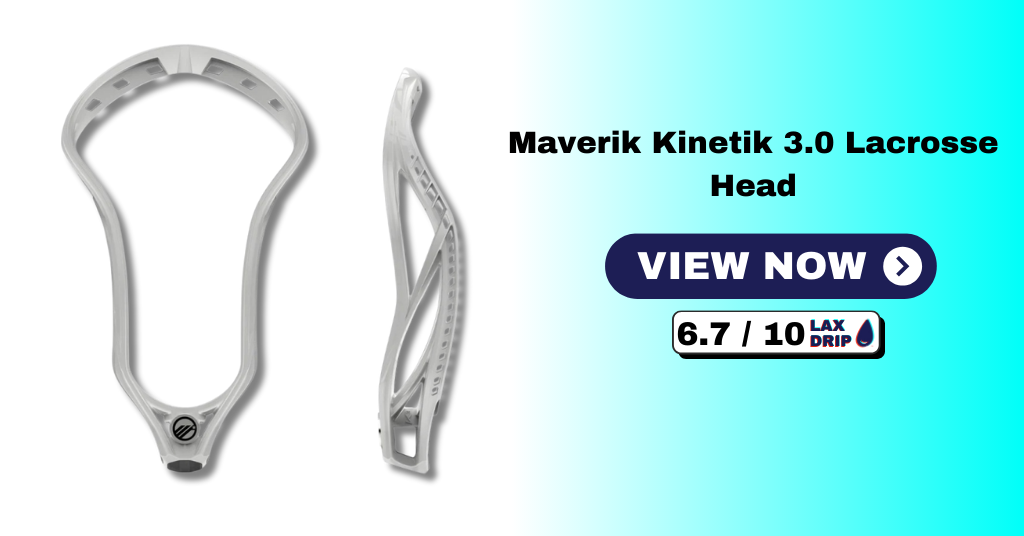
The Maverik Kinetik 3.0 is an exciting upgrade for offensive players, and I couldn’t wait to see how it compared to the Kinetik 2. The first thing I noticed was its slightly narrower face shape, which quickly became one of my favorites.
What truly stands out about this head is its versatility; although it’s marketed for outside shooters, it excels at crease work and quick catch-and-shoot plays as well. The narrow channel keeps the ball snug, giving me the confidence I need when winding up for a shot or faking inside.
Manufactured with Duratuff material, the Kinetik 3.0 is stiff even under extreme conditions. It held up remarkably well in temperatures reaching 106°F. The curved scoop directs the ball smoothly into the pocket when battling for possession around the crease.
Additionally, the Tension Lock feature allowed me to string a well-defined channel for maximum hold, while the shorter throat and dual screw holes kept everything securely in place without any wobble.
Pros:
-
- Narrow profile for better control
-
- Tension lock system for improved stringing
-
- Warp resistant
-
- Durable Duratuff material
Cons:
-
- Less surface area for angled catching
-
- Higher price point
6. ECD Mirage 2.0 Lacrosse Head
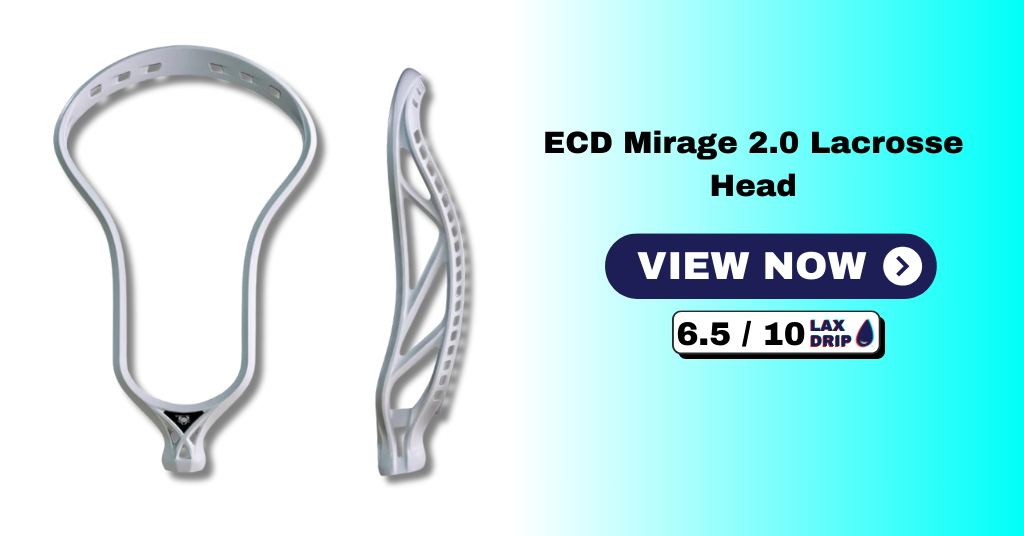
Having used the ECD Mirage 2.0 for over two years, I can say it’s one of the most versatile heads on the market. Even three years post-release, it remains a top pick for attackers and offensive middies alike. The face is nicely pinched, making it perfect for players who need tight ball control in high-pressure situations.
While it does weigh in at 5.0 ounces, which is heavier than many heads, the durability of its high-quality plastic is impressive. I’ve put it through constant practice without significant wear and tear (just a few crease marks to show for it). The deep offset design not only enhances ball retention but also ensures a smooth release for both passing and shooting.
I purchased mine pre-strung and love how effortlessly it generates power for outside shots and step-down cranks. The pocket placement sits higher, giving me better control when shooting on the run.
However, if you prefer a lower pocket for dodging or feeding from X, you might want to consider the Maverik Optik Force instead. Regardless, the stiffness of the top rail and the wider face significantly boost shooting speed while preventing any warping during gameplay.
Pros:
-
- Durable and weather-resistant
-
- Warp resistance
-
- Offers a smooth release
Cons:
-
- Heavier than some alternatives
-
- Fewer sidewall holes for customization
7. Maverik Optik 3.0
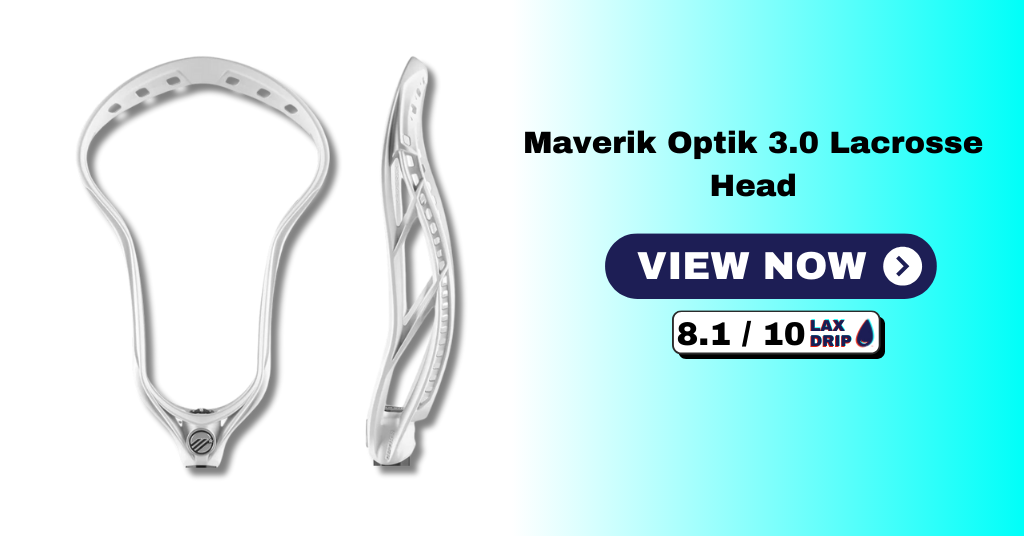
Just recently released in June 2021, the Optik 3.0 is the newest elite attack head in Maverik’s popular Optik line.
Compared to the Optik 2.0—which was previously our highest-rated attack head—the 3.0 has a shorter throat that gives you more control when one-handed cradling, more sidewall holes (20 on each side), and is a bit stiffer.
The Optik 3.0 has a tight pinch throughout most of the head, giving you more control when dodging and accuracy when shooting and passing.
The increased number of stringing holes, along with Maverik’s Tension Lock system, make this head super easy to string.
With a low offset, the Maverik Optik 3.0 is great for low or mid-to-low pockets. If you prefer a mid-to-high pocket, however, you may be better off going with an alternative.
Overall, this is an amazing head for attackmen. It has a great face shape, is stiff, holds its shape well, and the shortened throat gives an advantage for one-handed cradling.
If you are looking to save some money, the Maverik Optik 2.0 is still one of the best attack heads currently available.
Pros:
-
- Lightweight
-
- Stiff & durable
-
- Tight face shape
-
- Shortened throat gives more control when one-handed cradling
Cons:
-
- Not great for mid-to-high pockets
8. STX Surgeon 900
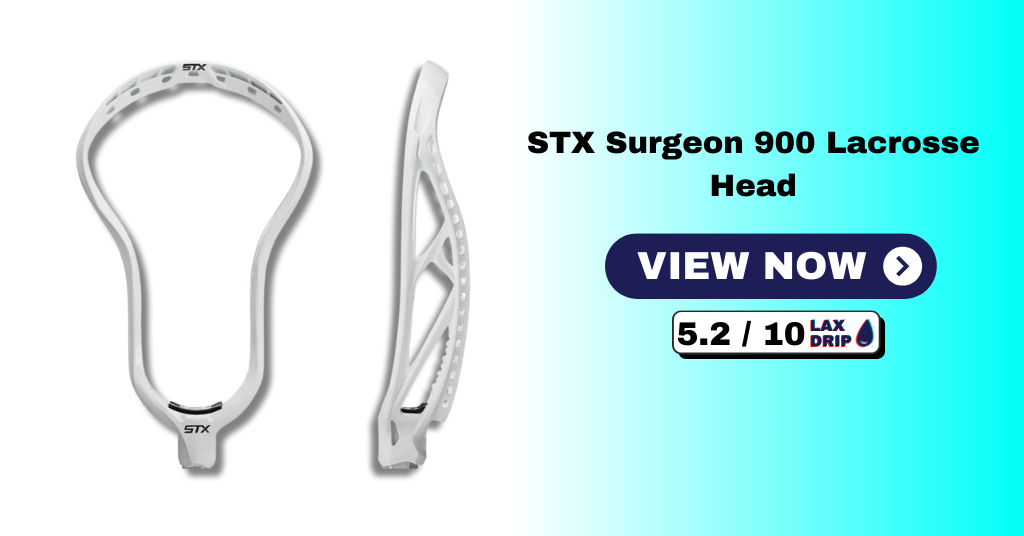
The STX Surgeon 900 checks in next on our list of the best lacrosse heads thanks to its light weight, narrow face shape, and stiff plastic.
It is one of the lightest lacrosse heads ever created, weighing in at only 4.4 oz. It is, however, surprisingly stiff for how light it is—mostly due to STX’s EnduraForm plastic which is one of the best on the market.
With that being said, it’s not quite as stiff as some of the bulkier (and heavier) attack heads such as the ECD Rebel Offense.
Another great thing about the Surgeon 900 is that it has a narrow face shape throughout the head. It has a narrow pinch until about halfway up the head then starts flaring out towards the scoop which is still pretty narrow compared to other heads.
This makes it great for carrying the ball like so many attackmen do—whether that be dodging from X, coming in from the wing, or going down the alley from up top.
The last feature I’d like to touch on is the Speed Scoop that STX used on this head. It is great for picking up ground balls at all angles and slightly hangs over the top string holes, making sure that your strings don’t interfere with scooping.
Pros:
-
- Extremely light
-
- Narrow face shape
-
- Great scoop
Cons:
-
- Not as stiff as some alternatives
9. StringKing Mark 2A
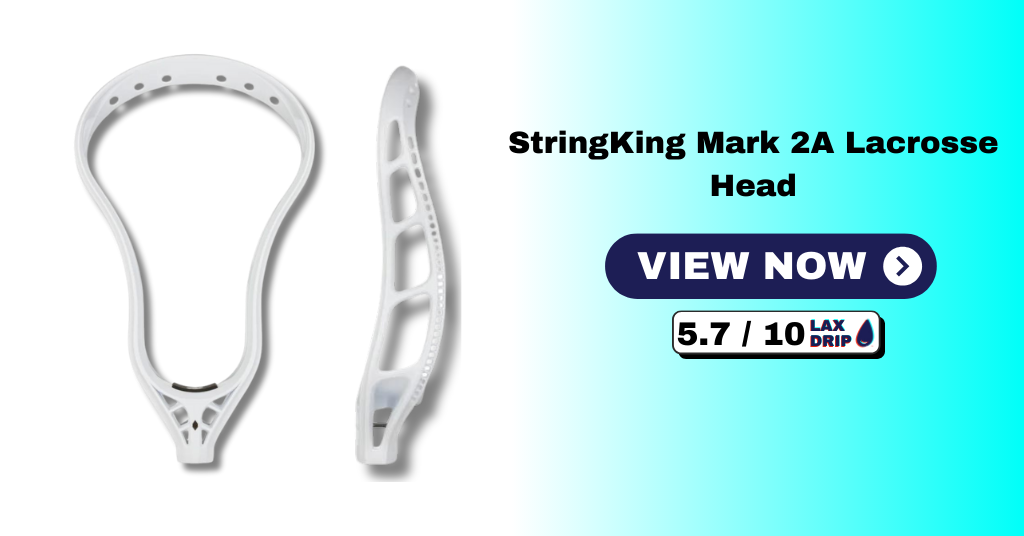
If you prefer an attack head with a slightly wider face shape, the StringKing Mark 2A is a superb option.
It is pinched towards the throat but starts flaring out lower on the head than many other options. This gives it a leg up on catching while sacrifycing some hold depending on your string job.
It has a traditional offset towards the throat making it easy to string those low pockets that are great for one-handed cradling.
Another thing I love about the Mark 2A (like most StringKing heads) is that it has a TON of sidewall holes, letting you customize your pocket to your play style.
It is pretty stiff for being the second-lightest head on this list and should hold up well over the course of a season.
Finally, it has a flat scoop that is good for ground balls and contributes towards a quicker and more accurate release.
Overall, if you are looking for an attack head with great stringing versatility and a great strength-to-weight ratio, the Mark 2A is a solid choice.

Pros:
-
- Many sidewall holes
-
- Great scoop
-
- Very light
-
- Low offset helps w/ one-handed cradling
Cons:
-
- Wider face than alternatives
>> See all of the Best Attack Heads
10. Gait Mustang Lacrosse Head
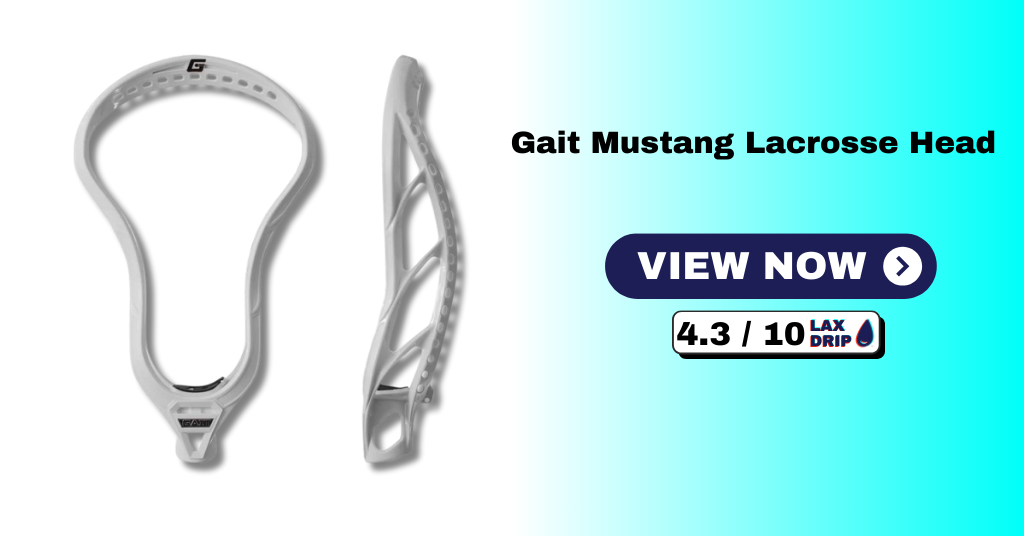
The Gait Mustang is one of the most durable lacrosse heads for attack. After a year of hard games, checks, and face-offs, I am impressed with its durability. It’s incredibly stiff, and that hasn’t changed over time.
Despite the stiff design, its aggressive scoop easily slides the ground balls in the pocket, even in rough conditions. I found the Gait Mustang to be extremely responsive on the field. The six top holes and 18 side holes allowed me to create a mid-high pocket, perfect for offensive middies.
Moreover, the wider face profile and slightly pinched-in side rails provided a sharp shooting accuracy. My shots were speedy and didn’t go off-center. I loved the passing accuracy, as I could easily feed teammates on the run without worrying about the miss.
However, its chunky design makes it a bit heavier. So, if you prefer a lightweight and flexible head, pick the Stringking Mark 2A.
Otherwise, it’s the best lacrosse head for intermediate and advanced mid-fielders and attack players who prefer durability, stiffness, and high-speed shooting.
Pros
-
- Aggressive scoop design for high-speed shooting
-
- Durable and stiff
-
- Many side holes for pocket customization
Cons
-
- Heavy
11. Warrior Burn XP2-O Lacrosse Head
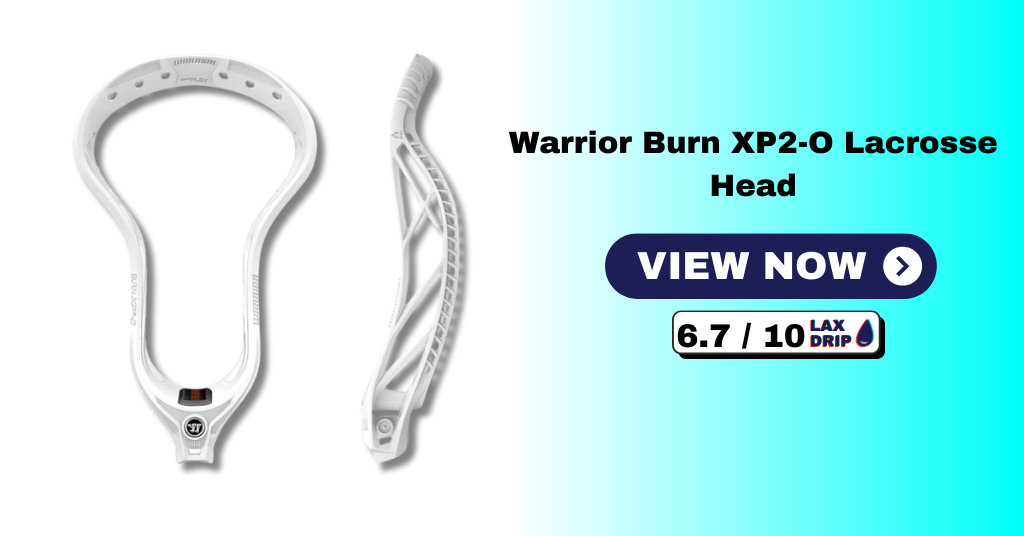
In 2023, I loved the design and feel when I got my new Warrior Burn XP2-O lacrosse head. It has a wider face with a high pinch and flare, perfect for generating power. The face profile gave me much control over my shots and quick releases.
Moreover, It’s super light and responsive, and the balance is spot on. I have gotten some serious power behind my shots with accuracy.
The scoop design is unique, featuring a rounded shape with ridges and added diffusers. While it takes some adjustment, the rounded shape and diffusers make ground ball pickups smoother and protect the top strings from wear and tear.
Using the 20 side holes, I strung up a mid-high pocket, and the ball sat perfectly in the pocket. It has a maximum offset with a nice and deep channel. Thus, I got maximum control while cradling, and the ball didn’t jump out of my pocket after every check.
Moreover, Thermaloc+ material and X-TRUSS technology provide high-grade durability for elite attackers and midfielders. Although it lacks the flexibility for face-off battles, it’s one of the best lacrosse heads.
Pros
-
- SPINE TRACK design for consistent throws
-
- Protecting diffusers and thermaloc+ built
Cons
-
- Slightly expensive
-
- Scoop design may cause trouble for beginners
12. Nike Surge Elite Lacrosse Head
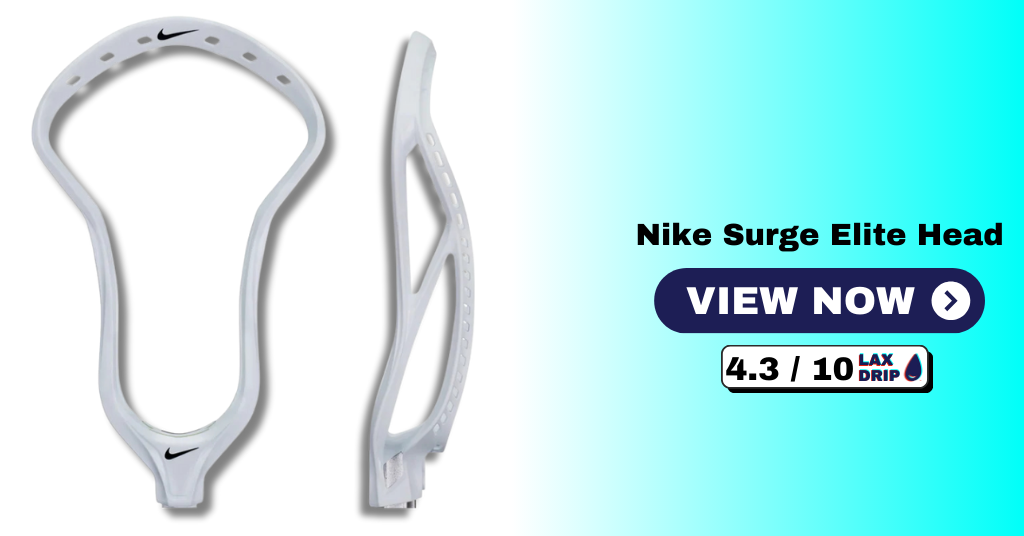
Nike’s design team has never been short of ideas to improve lacrosse heads, and their latest entry, the Surge Elite, is no exception. With the brand’s popularity, it’s no surprise that reviews for the Nike Surge Elite lacrosse head have flooded social media.
Many players have noted its combination of the Lakota 3 face profile and the aggressive scoop of the Vapor Elite. However, the real question remains: how does it perform on the field? After purchasing the Surge Elite, I was eager to find out if it truly delivers for attackers.
Weighing in at just 4.7 ounces, the Surge Elite is designed for both attackers and midfielders. It features a mid-high pocket that promises quick ball release and impressive shooting accuracy. The moderately stiff construction allows for excellent control and durability, which is essential during intense gameplay.
The head boasts six top string holes and 18 sidewall holes, providing ample options for pocket customization to suit individual preferences.
In terms of performance, the Surge Elite excels in shooting accuracy, especially for long-range shots. The angled sidewalls help direct the ball smoothly during passes and shots, ensuring minimal spread.
While its stiffness can be challenging for beginners, experienced players will appreciate its responsiveness and control during high-contact situations. The narrow throat design enhances ball security, making it easier to cradle while dodging defenders.
The durability of the Nike Surge Elite is impressive as well. Constructed with PowerForm material, it resists warping and maintains its shape even after aggressive use. The rounded scoop design allows for smooth ground ball pickups without requiring extreme angle adjustments, making it a reliable choice for players who frequently find themselves in tight spaces.
Despite its strengths, the Surge Elite does have a few drawbacks. The long break-in period may deter some beginners who are used to more flexible heads. Additionally, while it’s suitable for occasional face-offs, serious face-off specialists might prefer a head specifically designed for that purpose.
It’s a solid option for attackers and aggressive midfielders looking for a mix of accuracy, durability, and control on the field.
Pros
-
- Accurate high-speed shooting
-
- Durable PowerForm material construction
-
- Weather resistant
-
- Warp resistant
-
- Plenty of sidewall holes for pocket customization
Cons
-
- Long break-in period
-
- Stiff for beginners
Midfield
1) Maverik Tactik 3.0
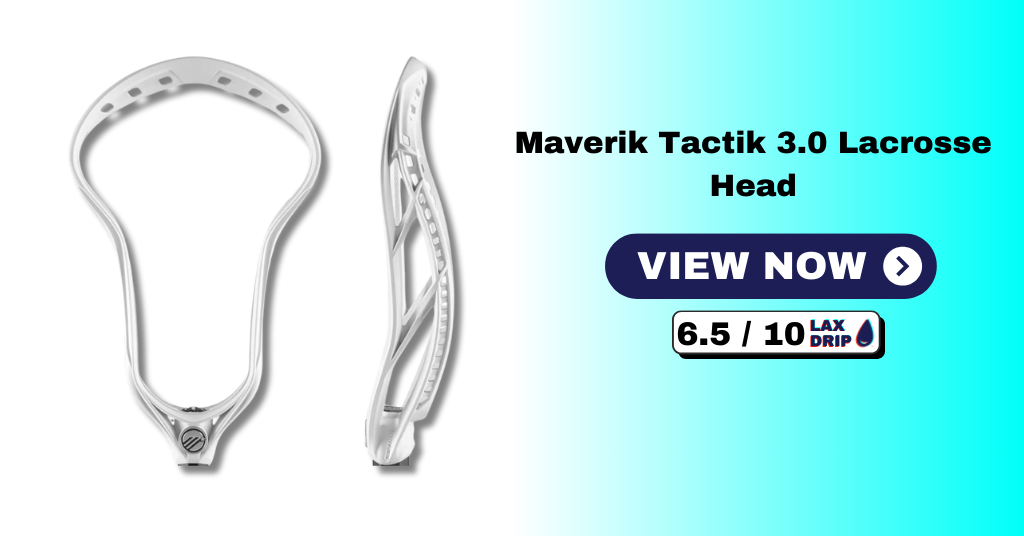
The Maverik Tactik 3.0 comes in as tied for first in our list of the best heads for middies—and for good reason. It’s one of (if not the) best all-around midfielder heads currently available.
The Tacktik 3.0 is light, very stiff, and has a ton of stringing holes that allow you to customize your pocket to your preferences.
The Tactik 3.0 is an upgrade on what was previously rated our top-rated midielder head in the Tactik 2.0.
The 3.0 comes with Maverik’s CoreControl technology that distributes the weight to the most important parts of the head, giving you more control, increasing stiffness, and decreasing weight.
The third version of the Tactik has a level 3 bottom rail that makes it great for a mid/low to mid/high pocket—something that many middies prefer.
It has a great stiffness-to-weight ratio which makes it great for both offense and defense. Also, it has a great scoop that makes ground balls a breeze.
The Tactik 3.0’s face shape is more pinched than the Tactik 2.0’s face shape. It is tighter towards the throat but opens up towards the midpoint of the head like the old version did.
Overall, the Tactik 3.0 is a great choice for midfielders and I think you’ll be very happy with this head from Maverik if it’s what you decide to go with.
Pros:
-
- Very stiff
-
- Relatively light
-
- A ton of sidewall holes
-
- Great scoop
Cons:
-
- Sidewall holes are a bit small
2) STX Stallion 1K
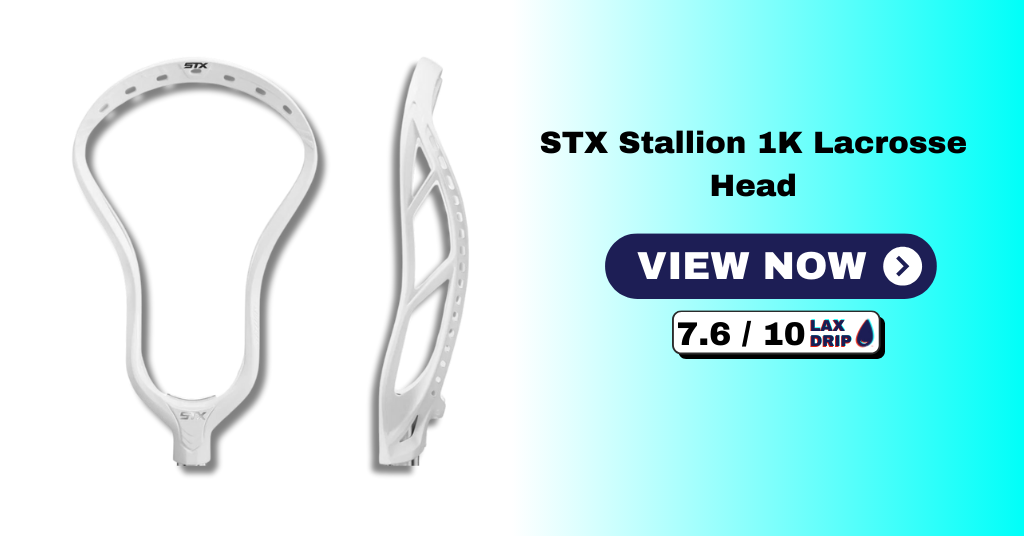
Unlike the older STX Stallion Omega, the 900 is much less prone to breaking and is much lighter—something that is especially noticeable when we tested shooting with the two heads.
In addition, compared to the Stallion 900, the 1K is stiffer and has better shape retention thanks to its improved EnduraForm plastic.
It still has STX’s Speed Scoop which is loved by many players because it’s great for ground balls but also has a slight lip the covers the top string holes so they don’t interfere when you’re scooping.
The Stallion 1K has a great face shape as well. It has a narrow pinch on the bottom half of the head and gradually opens up towards the scoop.
Though it only has an average amount of stringing holes, they’re placed well and you shouldn’t have any trouble getting your ideal pocket in it. It also has Innerlock technology that makes stringing on the inside rail easier and more secure.
The biggest downside of the Stallion 1K is that it’s not great for low or even mid-to-low pockets due to the offset being towards the middle to top of the head. Of course, this is really only a problem if you prefer low pockets.
Overall, the new Stallion 1K is an awesome option for middies, especially those that prefer higher pockets and like to shoot from outside/on the run.
Pros:
-
- Stiff & durable
-
- Speed Scoop is amazing
-
- Lightweight
-
- Great face shape
Cons:
-
- Not great for low pockets
*Video for older STX Stallion 900
3) Nike L3
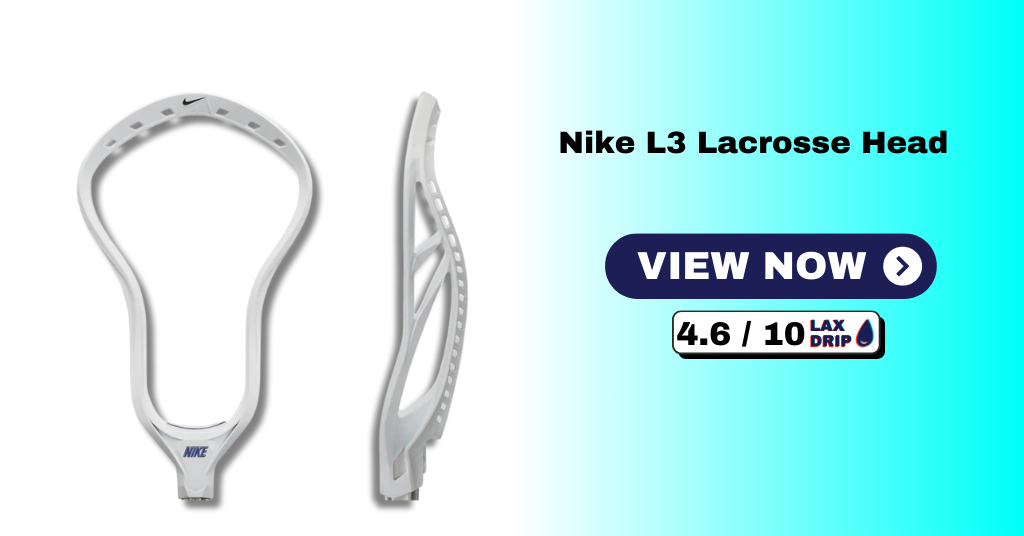
The Nike L3 is the most recently released head on this list and is one of the best. It’s already one of the top choices among college midfielders throughout the nation.
The newest head in the popular Lakota line has a smooth face shape that isn’t too pinched, making it a great option for offensive middies, D middies, and LSMs alike.
We’ve found the L3 to be extremely easy to string up despite it only having an average number of sidewall holes. The wider face shape and smooth flare definitely contribute to this.
In addition, the offset is towards the middle of the head, making it great for anywhere from a mid/low to mid/high pocket.
The only real drawback of this head is that it’s not the best for those who prefer very tight face shapes. If you fall into this boat, you may want to check out the Maverik Kinetik 2.0 (see below) or the ECD Mirage 2.0.
Overall, you won’t be disappointed if you go with the Nike L3. It’s a versatile head and we expect to see if on college lacrosse fields throughout the nation for the 2023 season.
Pros:
-
- Very lightweight
-
- Easy to string
-
- Stiff
-
- Good for a variety of positions
Cons:
-
- Wider face shape than alternatives
>> See all of the Best Middie Heads
4. RC1 Lacrosse Head Review
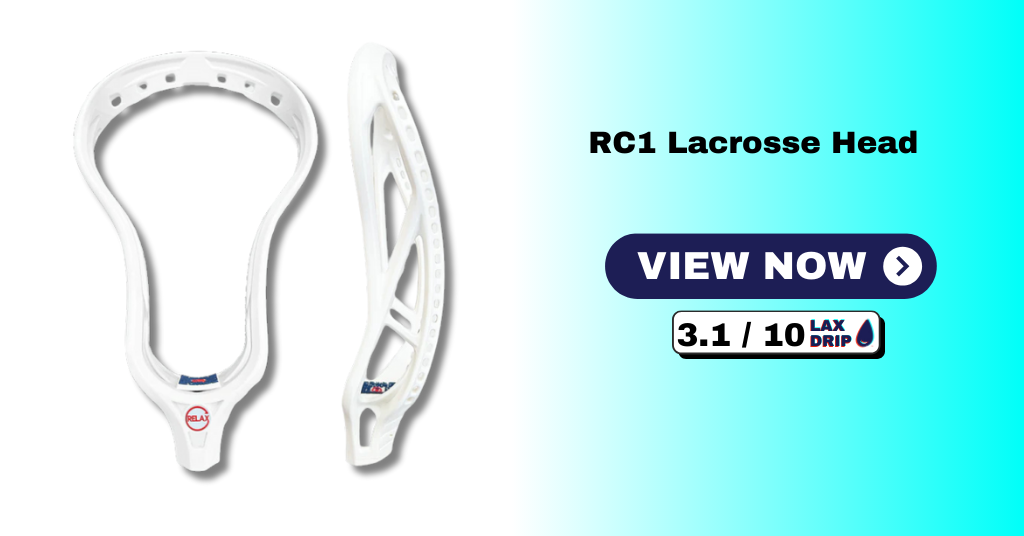
ReLax has made a name for itself by providing lacrosse heads that cater to both elite players and those on a budget. With the launch of the RC1 lacrosse head, they’ve introduced an affordable option that aims to deliver performance without breaking the bank.
Weighing in at 4.9 ounces, the RC1 is designed for transition and offensive midfielders. Its mid pocket location offers a good balance of control and quick ball release, making it suitable for both beginners and advanced beginners.
The average stiffness of the head provides flexibility while maintaining durability, which is essential for players still developing their skills.
With six top string holes and 23 sidewall holes on each side, the RC1 allows for ample customization to suit individual preferences.
In terms of shooting accuracy, the RC1 performs well for short-range passes, but it can struggle with long-distance shots due to its lower speed. The wider face shape helps with catching high-speed passes, making it ideal for players who are still refining their catching skills.
However, cradling can be a bit challenging in tight situations, as the ball can pop out with minor mistakes.
Ground ball pickups are another strong point for the RC1. Its design allows for efficient scooping, though some players may find it less effective during face-offs due to its wider face profile.
The head’s construction is durable enough to withstand checks without losing its shape, making it a reliable choice for players who frequently engage in physical play.
It’s a good option for those looking for an affordable head that doesn’t compromise too much on performance. While it may not be the best choice for advanced players or face-off specialists, it serves as an excellent entry-level option for beginners.
Pros
-
- Budget-friendly price
-
- Suitable for all-rounder positions
-
- Good balance between flexibility and stiffness
-
- Numerous side holes for customized stringing
Cons
-
- Mesh quality could be improved
-
- Average cradling hold
-
- Not ideal for face-offs
5. Nike CEO 3 Lacrosse Head
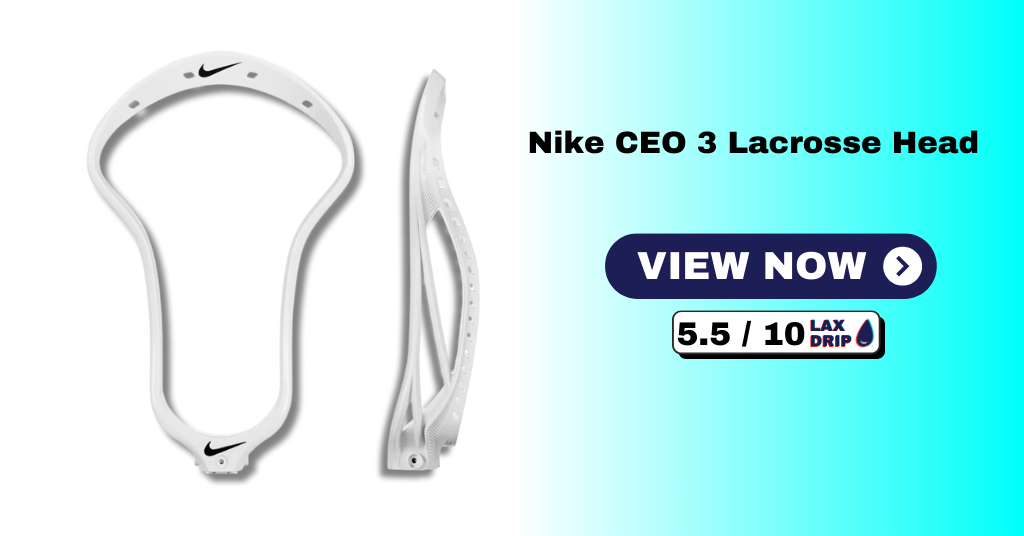
The Nike CEO 3 lacrosse head has made waves in the lacrosse community, touted as the most durable face-off specialist head in 2023. Building on the success of its predecessor, the CEO 2, this head features a stiffer build, a shorter throat, and a zero-friction scoop designed to enhance performance.
After putting it to the test, I’m here to share whether these upgrades translate into improved shooting speed and ground ball pickups or if it’s merely a cosmetic enhancement.
Weighing 4.9 ounces, the CEO 3 is engineered for face-off specialists and midfielders who demand both durability and performance. The mid pocket location allows for quick ball release, while its slightly wide face shape aids in catching and control.
With four top string holes and 16 sidewall holes, customization options are plentiful, making it easier to customize the pocket to individual preferences.
In terms of shooting accuracy, the CEO 3 excels. I found that it delivered impressive passing accuracy for short-range shots, though long-range performance was somewhat compromised.
The stiffer sidewalls provide excellent feedback during shots and passes, ensuring that the ball stays centered and minimizing unwanted movement. This design feature enhances shooting ability under pressure, making it a reliable choice for competitive play.
Catching high-speed passes was also a strong point for this head. The narrow throat design keeps the ball snug during dodges and checks, allowing for secure cradling even in tight situations.
However, I did find the throat edges to be somewhat uncomfortable at times, which could be a drawback for players who prefer a more forgiving feel.
When it comes to checking, the CEO 3 performs exceptionally well. Its durable construction allows for powerful checks without compromising control or stability. I experienced minimal wear and tear after rigorous use, which speaks to its durability in high-contact scenarios.
The zero-friction scoop design aids in ground ball pickups, making it easy to snag loose balls during play.
It’s an excellent choice for face-off specialists and midfielders looking for a balance of durability and performance on the field.
Pros
-
- High durability
-
- Sharp shooting accuracy and speed
-
- Strong side rails with multiple holes for pocket customization
-
- Versatile for midfielders and face-off specialists
Cons
-
- Long break-in period
-
- Uncomfortable throat edges
-
- Less flexible for beginners
Defense
1) STX Hammer 1K
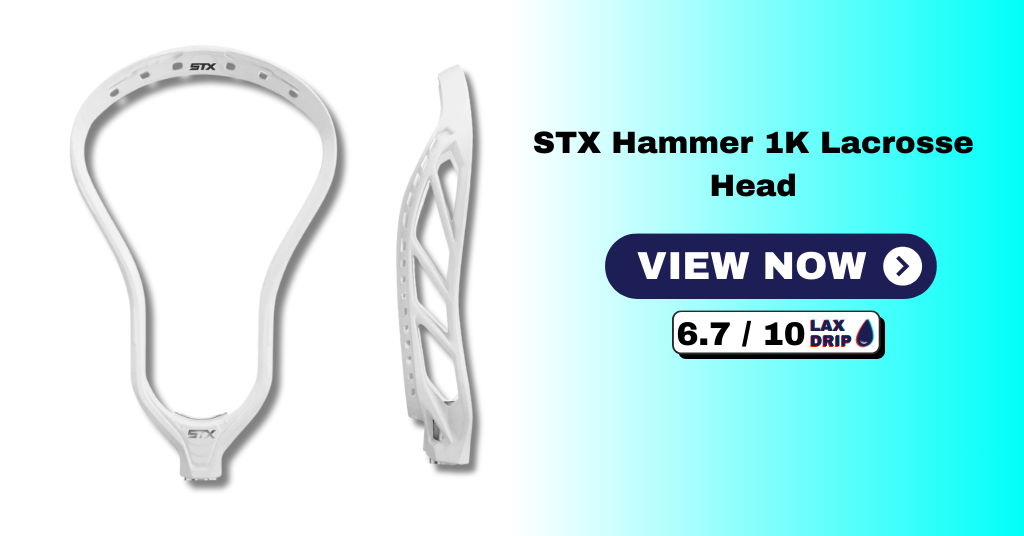
STX’s newest defensive lacrosse head—the Hammer 1K—comes in as the best option on this list due to its unmatched stiffness and durability.
It improved upon our previously top-ranked defense head in the Hammer 900 with its increased stiffness and shape retention thanks to improved EnduraForm plastic.
It also doesn’t seem like it will have any of the same issues with breaking frequently that the older Hammer Omega had.
The STX Hammer 1K has a nice face shape for both defensemen and LSMs. It is pretty pinched towards the throat but gradually widens towards the scoop, giving it good ball control but still being wide for intercepting passes and laying checks.
As far as the offset goes, it is pretty high up on the head, making it great for a mid/high to high pocket, which is typically the preference for defensemen.
The Hammer 1K also has STX amazing Speed Scoop that is specifically designed to perform better on long poles. This makes ground balls a breeze and the InnerLock technology makes stringing easier and keeps your strings tighter.
The biggest downside is that there are only 15 sidewall holes on each side. While I haven’t ran into any issues with stringing it, if you prefer more sidewall holes, you may want to look elsewhere.
Overall, the new STX Hammer 1K is a great option for any D player—including close defenders and LSMs. It should hold up well for even the hardest of checkers and perform well in transition.
Pros:
-
- Very stiff
-
- Durable
-
- Great scoop
-
- Nice face shape
Cons:
-
- Fewer sidewall holes than competitors
2) StringKing Mark 2D
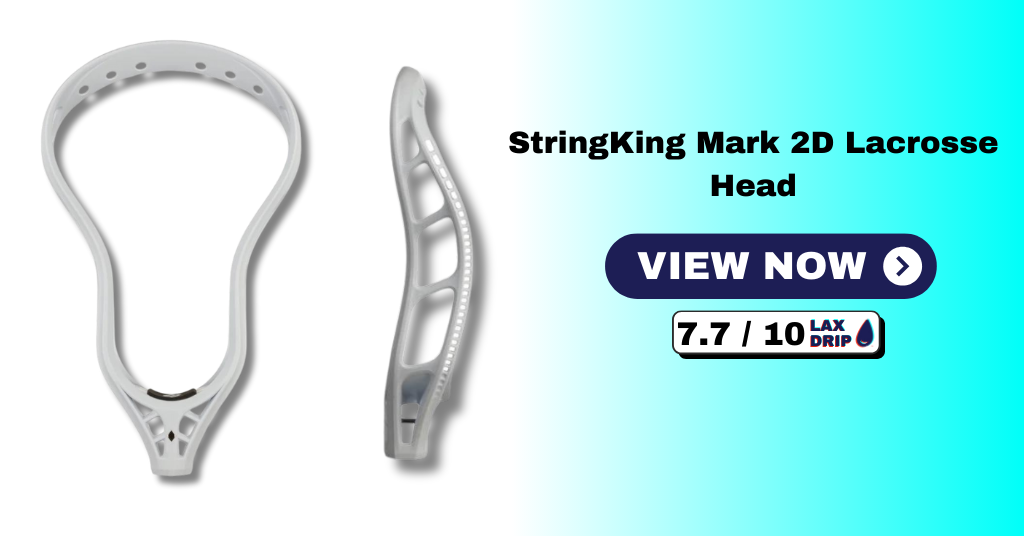
The StringKing Mark 2D checks in as a very close second on our list of the best lacrosse heads for defense—and for very good reason.
It is the lightest head to make this list at an impressive 5.2 oz. Even better, unlike many other light heads, it has above-average stiffness and durability.
We’ve found that the scoop on the Mark 2D is great for ground balls. Its sharp angle, along with the dramatic forward cant shape of the head, allow you to easily scoop balls even when your butt end is still high in the air.
The head shape and numerous stringing holes make it easy to string a high pocket with good hold and smooth release. Like most other StringKing heads, the Mark 2D strings up beautifully and the range of pocket options is limitless.
The Mark 2D also has a locking bolt mechanism in the throat that helps secure your head more than just a traditional screw helping to eliminate head rattle and movement during checks.
Overall, this is a great head for both defensemen and LSMs due to its light weight, stiffness, face shape, and scoop design.
Pros:
-
- Very light
-
- Above-average stiffness
-
- Great scoop design & head shape for ground balls
-
- Tons of stringing holes
Cons:
-
- Hard to string a low pocket in it
3) Maverik Havok
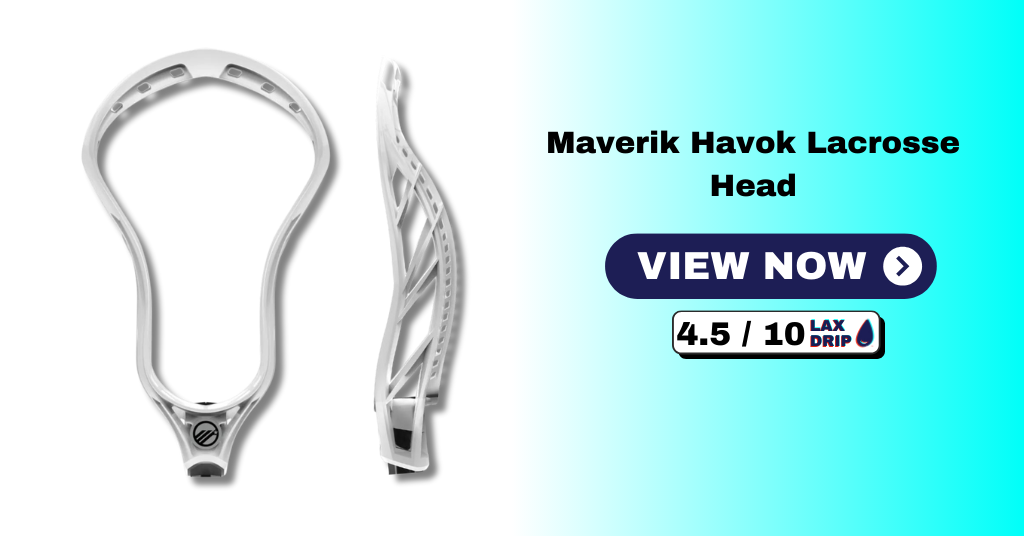
The Maverik Havok is one of the most popular LSM heads on the market today.
It has a tighter pinch towards the throat than many competitors but opens up towards the scoop.
We found a Havok strung up with a nice mid to mid/high pocket with a tight channel gives great hold and a smooth release.
The Havok it decently stiff but not as much as some more traditional defensive heads. It is, however, lighter than a lot of those options since it isn’t as bulky.
The Havok also has the Ground Control scoop that has a sharp angle making it easy to snag ground balls without having to get your butt end close to the ground. The way the top half of the head cants forward also helps with scooping balls.
If you are an LSM, D middie, or defenseman who likes to push transition, the Havok is a great option due to its face shape, light weight, and scoop.
More traditional defensive players who prefer a wider, stiffer head may want to look at other alternatives as the STX X20 or Maverik Tank 2.0.
Pros:
-
- Face shape helps give more control in transition
-
- Great for ground balls
-
- Relatively light
Cons:
-
- May take getting used to for D players used to wide heads
-
- Not as stiff as some D heads
>> See all of the Best Defense Heads
4) ECD Delta Lacrosse Head
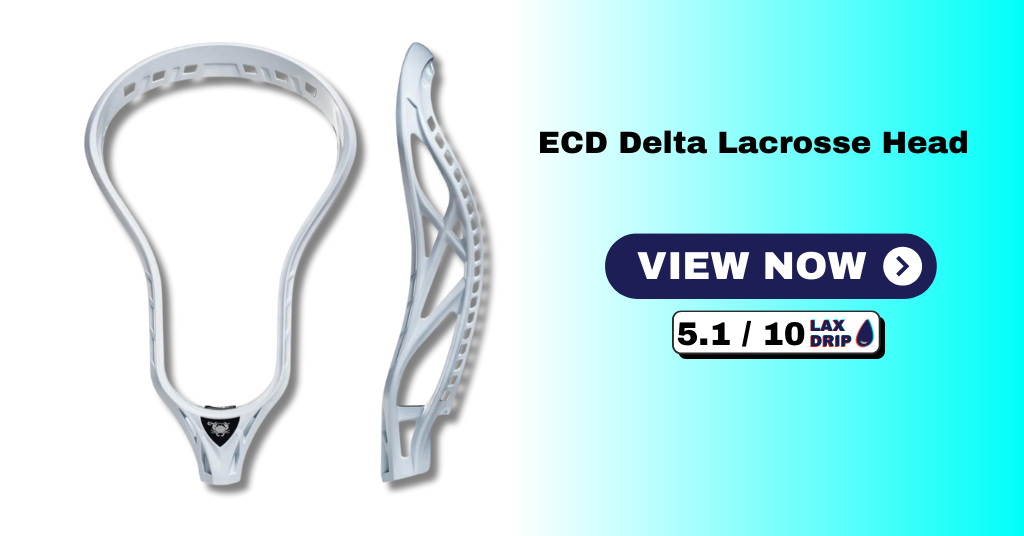
As a close-defense player, I need a head that can withstand the game’s physicality while providing me with the tools to shut down opposing attackers. The ECD Delta lacrosse head has delivered it.
The stiffness of 2024’s ECD Delta is immediately noticeable which provides a solid feel when checking. I delivered powerful checks that consistently popped the ball out of my opponent’s sticks.
The X-shaped sidewall struts add to the durability. Hence, I have had no issues with the head holding up to rough practice and games. They also contain 18 side holes wide enough to customize the pocket with leather strings.
Furthermore, the wider face and tighter throat design allow me to intercept passes, keep the ball secure, and prevent turnovers. I have observed much better control over the ground ball when cradling and passing.
However, the Delta’s stiffness can be a drawback, as it may limit ball control in traffic compared to more flexible heads. Therefore, I needed to be more deliberate with my movements when cradling. Yet, it improved after the break-in period.
Pros
-
- Stiff and durable design
-
- It doesn’t warp on strong checks
-
- Smooth ground ball pickups for get-and-go.
Cons
-
- Minimal spread on long shots
-
- Limited ground ball control in traffic
5) Warrior Burn XP2-D Lacrosse Head
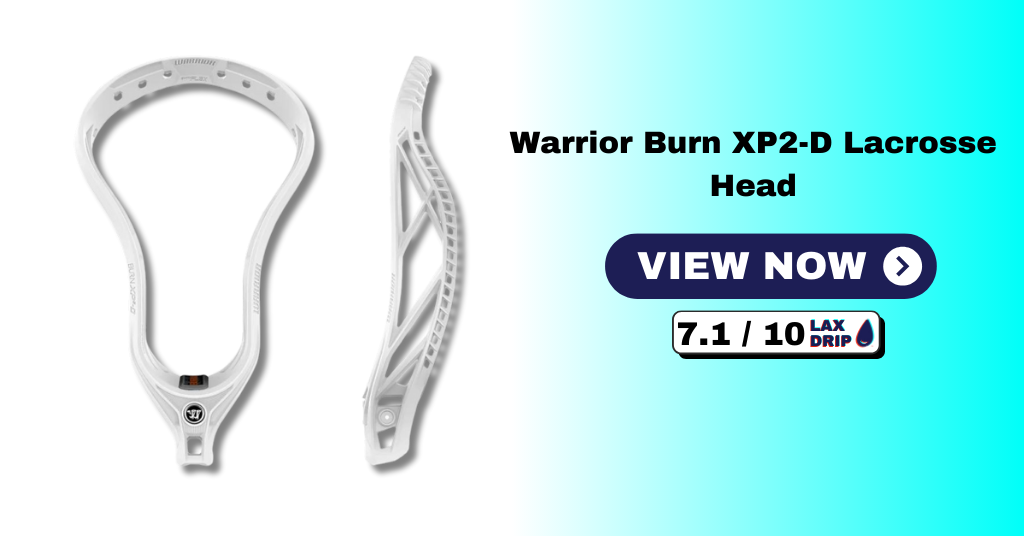
The next best lacrosse head on my list is the Warrior Burn XP2-D. Weighing only 5.6 ounces, XP2-D is a highly stiff and durable lacrosse head of 2024. Thanks to its lightweight yet durable thermalock hybrid build.
The XP2-D’s ability to maintain its shape in intense weather without bending or deforming ensures consistent performance throughout the game.
Its wider throat design improved my checking ability. I can easily deflect shots and clear the ball from the defensive zone. In addition, the steeper face helped me easily cradle after scooping up ground balls.
Compared to XP2-O, the defense version has a deeper pocket, which prevents the ground balls from bouncing out. The recessed stringing holes protect strings from wear and tear while maintaining a stiff pocket.
The only thing that makes it second best is the rounded scoop. I often had to adjust my angle more than I would with a more aggressive scoop design. So, if you transition between offense and defense, ECD Delta would be a better choice.
Pros
-
- Durable and weather-resistant
-
- Perfect Offset for consistent performance
-
- Minimal impact on checking
Cons
-
- The pocket needed minimal break-in time
-
- Scoop design is not good for offensive middies
6) Maverik Tank 2.0
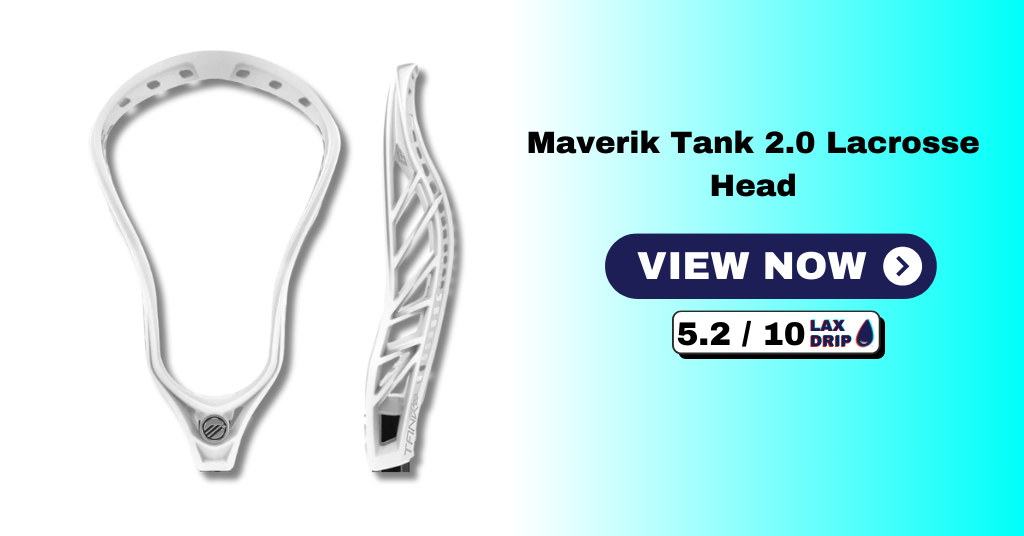
The Maverik Tank 2.0 is a robust addition to the lacrosse gear lineup, specifically designed for defense players who prioritize durability and performance.
Following the success of its predecessor, the Tank 2.0 has been engineered to withstand the rigors of defensive play while providing excellent ball control and ground ball pickups.
Weighing in at 5.5 ounces, the Tank 2.0 is built for defensemen who need a head that can handle aggressive checks and physical play. Its low pocket location allows for quick ball releases, while the moderately stiff construction provides a solid feel during gameplay. The head features six top string holes and 20 sidewall holes, offering ample customization options for stringing preferences.
In terms of shooting accuracy, the Tank 2.0 performs admirably for defensive players. The design allows for precise passes and quick releases, making it effective for clearing the ball and transitioning from defense to offense.
The moderately wide face shape aids in catching and controlling the ball, ensuring that defenders can maintain possession even under pressure.
Catching is another strong point for this head. The Tank 2.0’s design helps secure high-speed passes, providing reliable responsiveness during fast breaks or when receiving feeds from teammates. However, players may find that its stiffness can make cradling a bit challenging in tight situations, especially when dodging opponents.
The checking performance of the Maverik Tank 2.0 is impressive, thanks to its durable construction. The head absorbs impact well during aggressive checks, allowing defenders to maintain control while delivering powerful hits without compromising their grip on the ball. Its sturdy sidewalls help resist wear and tear, ensuring longevity even after extensive use.
Ground ball pickups are smooth and efficient with Tank 2.0. The rounded scoop design allows players to scoop up balls quickly without needing to adjust their angle drastically. This feature is particularly beneficial during scrums or when fighting for possession in crowded areas.
Pros
-
- Durable construction designed for aggressive play
-
- Excellent ball control and quick release
-
- Smooth ground ball pickups
-
- Ample stringing options for customization
Cons
-
- Stiffness may challenge cradling in tight situations
-
- Heavier than some attack-focused heads
-
- Not ideal for offensive play styles
Goalie
1) STX Eclipse 2
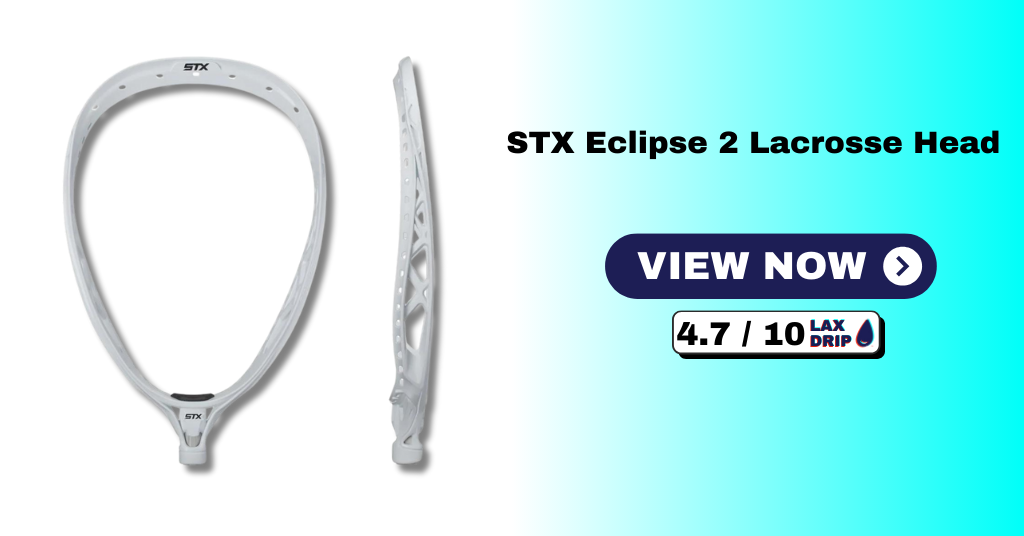
The original STX Eclipse was one of the most popular goalie heads ever made. There’s a reason it was used by goalies of all levels for over 15 years.
The Eclipse 2 is an upgrade on this near-perfect design, and is now the most popular goalie head on the market.
It is used by elite high school and college players as well as countless youth players across the nation.
The Eclipse 2 comes with a new throat that gives players a more comfortable and secure grip. STX also doubled the amount of stringing holes for increased stringing customization.
With its offset design, this head makes quick work of ground balls and throws crisp outlet passes.
The Eclipse 2 is also relatively lightweight but holds its stiffness well over time—even during those hot summer tournaments.
The Eclipse 2 is perfect for goalies of all levels and is our #1 recommended option.
Pros:
-
- Stiffer than the original Eclipse
-
- Upgrade ergonomic throat gives you more control
-
- Plenty of stringing holes so you can customize your pocket
Cons:
-
- Slightly heavier than some alternatives
-
- More expensive than other options
2) StringKing Mark 2G
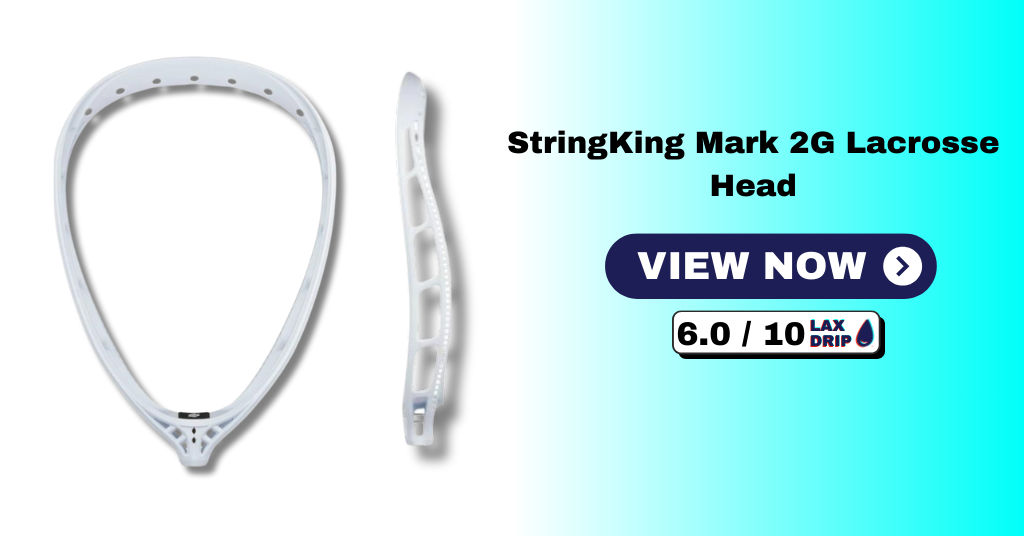
StringKing entered the goalie head arena with the Mark 2G in early 2020—immediately vaulting it to the top of our goalie head rankings.
The Mark 2G is extremely light at under 11 oz but still features plenty of surface area and has good stiffness.
Like many other StringKing heads, the Mark 2G comes equipped with 42 sidewall holes creating limitless stringing options.
The head features a shortened low-profile throat. For players who prefer not to hold the throat of the head, this may be a great fit.
Otherwise, goalies may find themselves using tape to make up for the lack of grip since it’s shorter and doesn’t have as much of an ergonomic design like the Eclipse 2 does.
This head is perfect for goalies who want to branch out from the mainstream goalie head brands and have complete pocket customization. The Mark 2G also comes with a 6-month warranty should it break.
Pros:
-
- Extremely light
-
- TONS of stringing holes
-
- 6-month warranty
Cons:
-
- Not much room for grip on throat
3) Warrior Nemesis 3
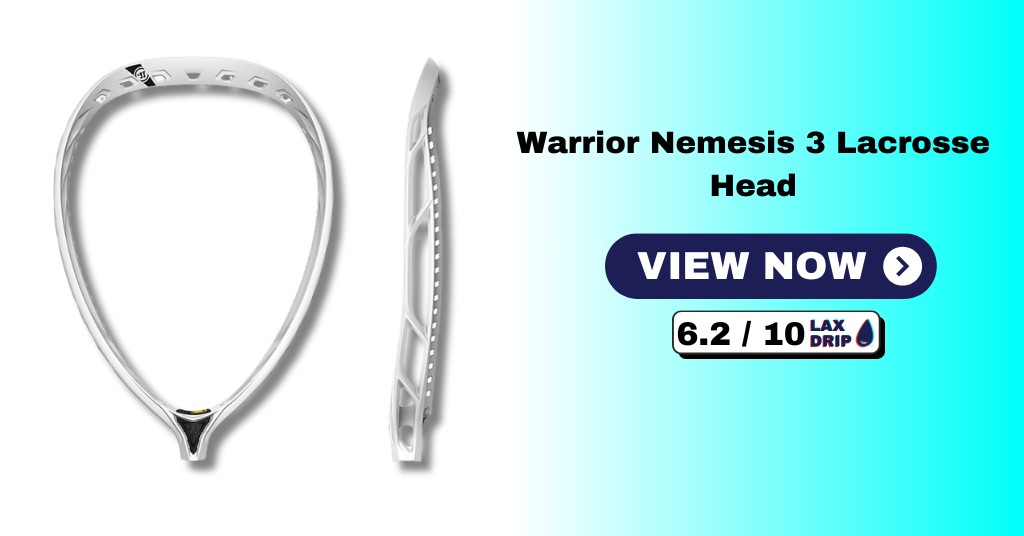
The Nemesis 2 was notorious for breaking on the sidewall.
During my freshman year of college, I went through 3 of them which was extremely frustrating—especially considering how long it took me to get my preferred pocket for outlet passes.
Warrior seems to have addressed this issue by adding more struts along the sidewall of the Nemesis 3.
All of my teammates and friends who use the Nemesis 3 haven’t had any issues with them breaking.
Warrior also shaved off 1.1 ounces on the Nemesis 3 compared to its predecessor, making it one of the lightest goalie heads on the market.
Warrior has done a great job turning what used to be a bulky and brittle head into a lightweight and reliable option for goalies of all levels.
Pros:
-
- Stiff
-
- Many stringing holes
-
- Pretty light
Cons:
-
- No ergonomic throat design
>> See all of the Best Goalie Heads
4) Warrior Nemesis Lite Goalie Lacrosse Head
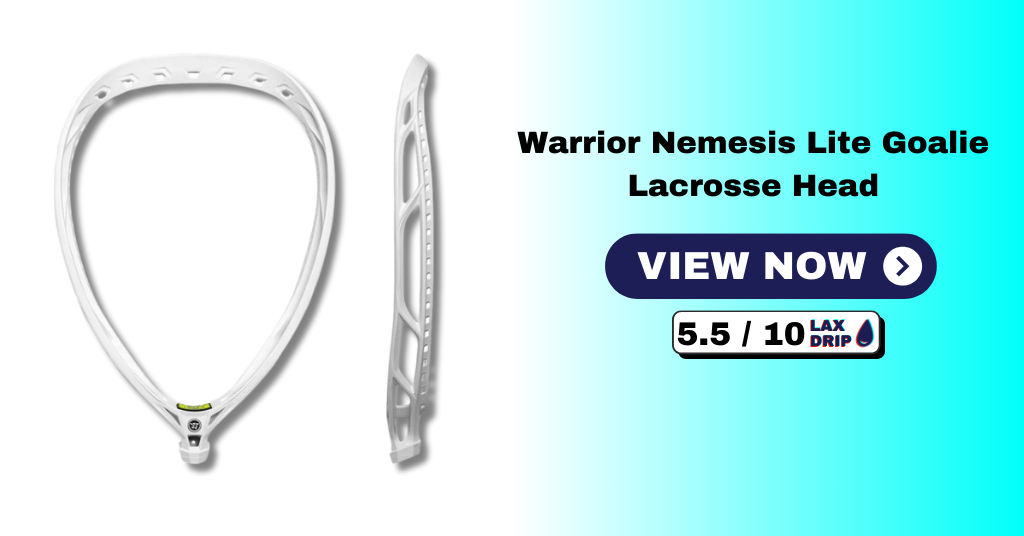
Warrior Nemesis Lite is the most reliable lacrosse head for goalies from my 2023 collection. It weighs only 11.4 ounces but has very stiff rails and a durable design.
The rugged sidewall design maintains its shape even against the fastest shots. These flared sidewalls are designed to channel the ball into the goalie’s pocket. I have saved 85% of shots aimed at the sides of the net.
Moreover, it has a different face shape than the STX Eclipse. The Nemesis Lite is slightly bigger at its widest point but then is much more triangular with a narrower bottom to hold the stick.
Its triangular face shape provides an unobstructed view of the field, allowing for quicker reactions. It also offers an increased catching area that reduces fumbles and dropped balls.
Although the throat is a bit uncomfortable to hold, it has a perfect fix to the shaft. Hence, I didn’t face any rattles after catching a sharp throw. It also helped me improve my reflexes and deliver sharp throws.
Pros
-
- Large catching area
-
- Stiff and lightweight
-
- Flared sidewalls to
Cons
-
- Uncomfortable throat end
5) STX Eclipse 3 Goalie Lacrosse Head
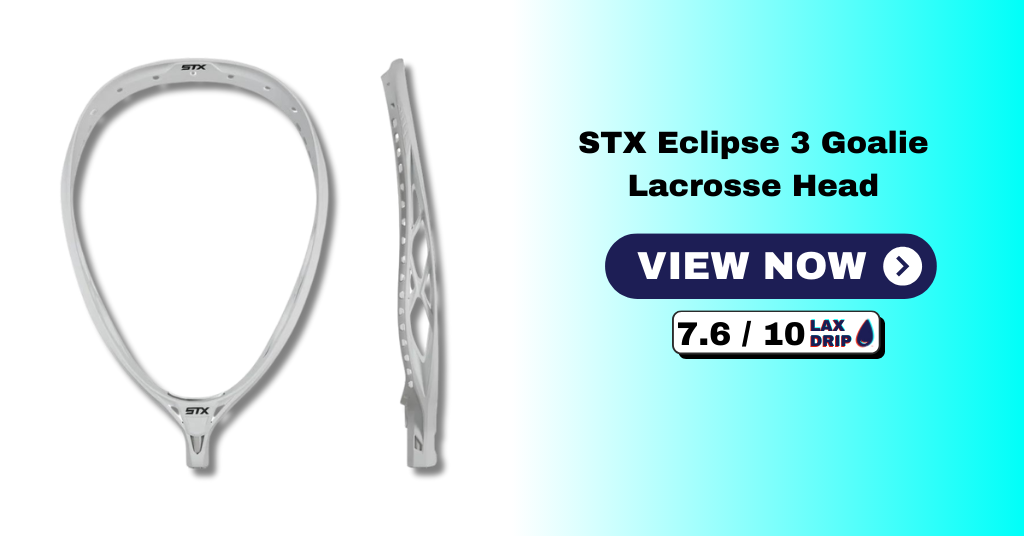
STX Eclipse 3 has been my favorite goalie head of the year after Eclipse 2. After using the Eclipse 3 for several months in Division 1 lacrosse, the head stayed firm and didn’t flex. It results in more consistent saves when part of the head contacts the ball, even in hot conditions.
STX has also refined the throat design, smoothing the little protrusion at the end. It has a narrower grip, allowing me a smooth transition from the shaft to the head. Its wings on the sides lock my hands, preventing the head from spinning when hit with a hard shot.
The strut pattern is similar to the Eclipse 2 but updated. The Eclipse 3 weighs 15 ounces but feels lighter despite being stiffer. Although the bigger surface area and minimal impact simplify the goalie’s job, I would have appreciated it to be lighter.
Moreover, it has an angled scoop that effectively directs the balls into the pocket when hit at the top. There are also two screw holes in the throat, which is small but adds stability. Hence, it’s a perfect combination of quality and performance.
Pros
-
- Weather resistant and doesn’t warp
-
- Enduro Foam construction
-
- Smooth throat for better hand placement
Cons
-
- Bulky design
-
- Stiff pocket
Faceoff
1) StringKing Mark 2F
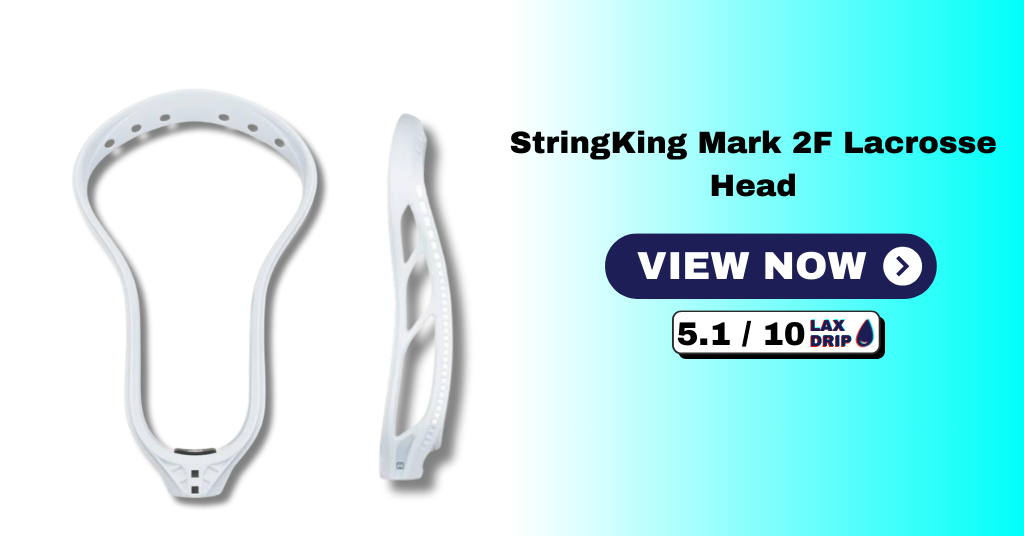
As mentioned above, the StringKing Mark 2F was in my final two choices for which faceoff head to buy. If this head was just slightly more offset, I probably would have gone with it.
The Mark 2F is also what I’ve found most elite college and high school players to be using as of late.
Much like the Weapon X, it has great warp resistance, many stringing holes, and a scoop that makes groundballs a breeze.
One of my favorite features of this head is how thin the plastic is. This makes it really easy to flex your head under your opponent’s sidewall to grab the ball and drag it out.
And even though the plastic is really thin, this head is super durable and warp resistant. Much like the Weapon X, it snaps back into place very well after every faceoff—making it another great option for playing offense after facing off.
When you first get this head, it may take some getting used to and breaking in since it doesn’t crush down on the ball quite as well as the Weapon X and Nike CEO. For some players, it may seem to resist flexing in the way you are used to.
Overall, this is a great choice for both FOGOs and FOSOs, as shown by how many top college faceoff guys use it. I was very close to choosing this head and am sure I would be happy with it if it’s the route I decided to go.
Pros:
-
- Very light
-
- Great warp resistance
-
- Good offensive performance
-
- Many stringing holes
-
- Shortened throat
-
- Thin profile helps it get under other heads while facing off
Cons:
-
- Does not face flex well
-
- Takes time to break in
2) ECD Weapon X
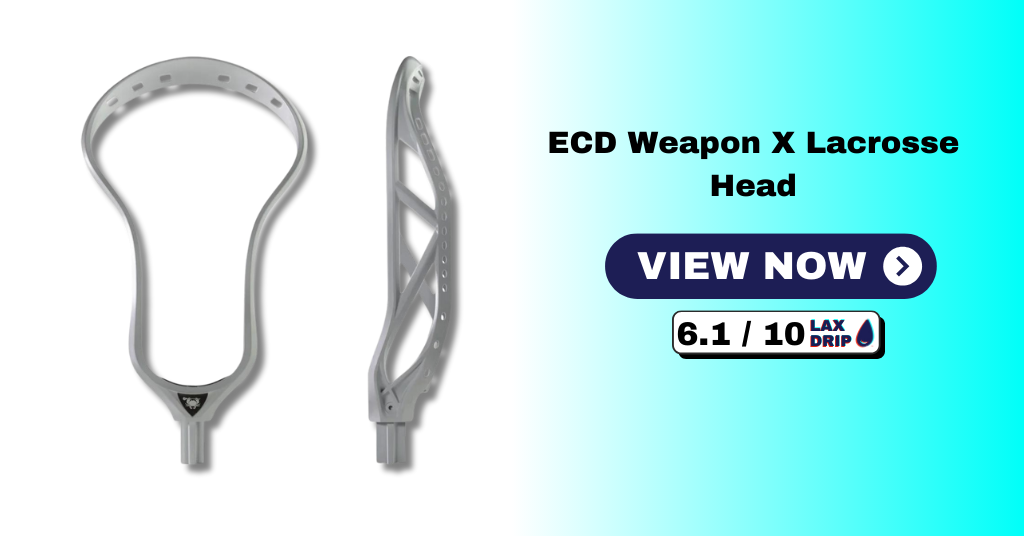
After all of my research, I ended up buying the ECD Weapon X primarily due to its performance on offense and warp resistance.
My final two were the Weapon X and the StringKing Mark 2F, but the Weapon X’s full offset was the deciding factor. I carry the ball a lot for my teams and regularly initiate the offense, so having a head with a full offset gives me better hold and a release that I’m used to.
It’s worth noting that the offset may take some getting used to when facing off if you are used to faceoff heads that have little-to-no offset.
Aside from the offensive capabilities, this is an amazing head for faceoffs. It does take some time to break in, but once you do, it will flex in almost any way you want.
A lot of this, as well as the warp resistance, can be attributed to the asymmetrical sidewalls which help the bottom sidewall flex up into the ball while the top collapses down.
The FlexForm plastic helps the head snap back into shape after every faceoff. Compared some other options such as the CEO and Burn FO, this head doesn’t warp easily and is much more durable over time.
You won’t have to worry about trying to pass and shoot with a crooked head which is really important.
Pros:
-
- Great for offense
-
- Full offset
-
- Great warp resistance
-
- Has throat plug
-
- Many stringing holes
-
- Amazing scoop
Cons:
-
- Heavier than some alternatives
-
- Takes time to break in
>> Read full ECD Weapon X Review
3) Nike CEO
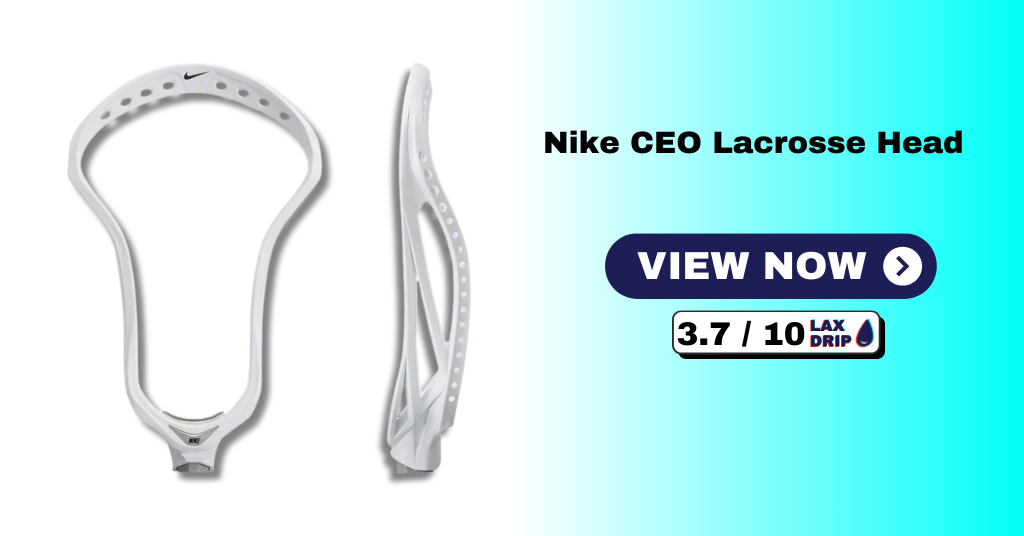
The Nike CEO wasn’t designed to be a faceoff head. Originally Nike designed it to be used by attackmen who prefer a very tight pinch. It just turned out that the sidewall design made this an amazing head for facing off, and since it came out, it has been the most popular faceoff head since the OG Blade.
The design of the sidewall struts allows this head to collapse down on itself, creating great face flex allowing faceoff men to securely pinch the ball in the throat even if the rest of the head bends backwards.
If you are a pure FOGO who doesn’t have to worry about playing much offense, this is one of the best options. The way the head flexes and grabs the ball is unmatched—and is the reason why it has become one of the most popular faceoff heads of all time.
On the downside, this head warps… A LOT and isn’t very durable. The top of the head will quickly start bending forward (meaning the scoop will be more forward than the throat) and to the side. This makes it really hard to use on offense and you may have to worry about it being illegal.
Overall, if you are just looking for a head to faceoff with, the CEO is undoubtedly one of the best choices. Just be prepared to constantly bend the head back into shape and buy replacements once the head inevitably breaks or becomes warped beyond use.
Pros:
-
- One of the most popular faceoff heads of all time
-
- Very flexible
-
- Best face flex of any head
-
- Great for “grabbing” balls in 50/50s
Cons:
-
- Warps very easily, making it hard to use on offense
-
- Breaks easily
-
- Doesn’t have shortened throat
>> See all of the Best Faceoff Heads
4) Warrior Burn Formula Lacrosse Head
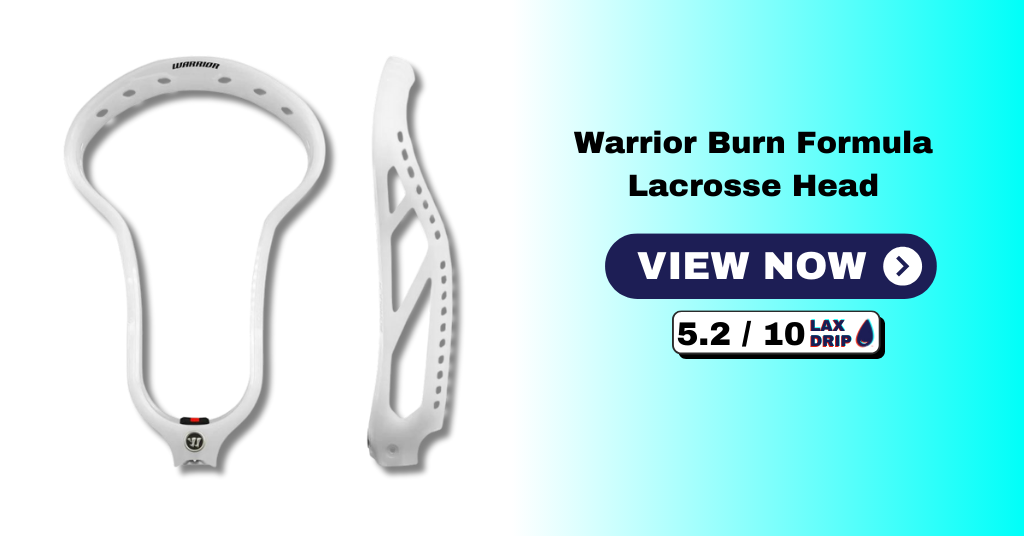
Released in 2024, Warrior Burn Formula is one of the best lacrosse heads for faceoff and offense. I have been using it for a while and this head offers the smoothest exits during the draws.
Although the sidewalls are flexible, the scoop is pretty stiff. The slightly curved scoop keeps the ball tight when pulling from the scrum. The ball rolls smoothly into the pocket without any awkward bobbles.
On the other hand, the shorter throat design keeps the ball secure while cradling until I am ready to attack. Thus, it gave me an edge around strong forward opponents and scrappy ground ball battles.
Sidewalls also have plenty of holes to create a mid-low pocket. The grip on the pocket area provides an extra sense of control. When the ball is pinched inside, it doesn’t feel like wobbling or at risk of getting checked out.
However, the material is completely similar to its predecessor. So, you will face some wear and tears at the top string region. Shooting speed is also average compared to other attack heads.
Pros
-
- Flexible sidewalls to win loose draws
-
- Aggressive scoop design for easy ground ball pick-ups
-
- Pocket friendly
Cons
-
- The top strings were torn out early
-
- Average shooting speed
5. STX X-IT Flex Lacrosse Head Review
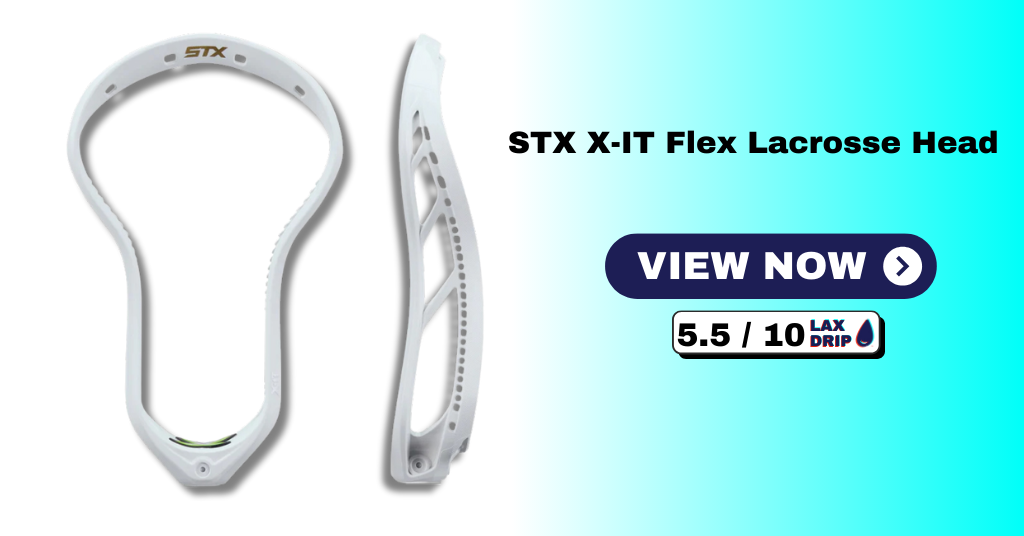
STX has taken a unique approach with the X-IT Flex lacrosse head, specifically designed to meet the demands of face-off specialists. With few options on the market that balance flexibility and warp resistance, I was eager to put this head to the test after using it for over a month.
The question remains: does the X-IT Flex deliver quick and controlled exits as STX claims? Let’s dive into the details.
Weighing in at an undisclosed weight, the X-IT Flex is tailored for face-off and stay-on midfielders. Its mid-pocket location allows for quick ball release, while the extremely flexible design offers a unique feel that sets it apart from traditional heads.
With four top string holes and an impressive 28 sidewall holes, this head provides ample customization options to suit individual preferences.
In terms of shooting accuracy, the X-IT Flex performs admirably. The mid pocket and angled sidewalls enable precise ball release without spreading on passes, making it effective for short-range shots.
However, its flexible build does limit its effectiveness during checking situations; the head often loses shape under intense pressure, which can be a drawback for players who rely on strong checks.
Ball security is a strong point for the X-IT Flex. The mid-pocket design locks the ball in place, providing excellent control during dodging and close cradling. Catching quick feeds is also reliable, especially after the break-in period, as the flexible design helps secure the ball effectively.
Ground ball pickups are smooth thanks to the rounded scoop design, which guides the ball cleanly into the pocket without requiring extreme angle adjustments. This feature is particularly beneficial during face-offs, where control and quick retrieval are essential. The X-IT Flex excels in this area, offering impressive performance for face-off specialists.
It’s a good option for face-off specialists and stay-on midfielders, providing a great balance of accuracy, durability, and control.
Pros
-
- Shorter throat design for better control
-
- Multi-angle flexibility for quicker break-in
-
- Lightweight and highly durable reflex plastic
-
- Ample stringing options for customization
Cons
-
- Uneven string hole patterns
-
- Less effective for delivering strong checks
6. ECD Weapon X 2.0 Lacrosse Head
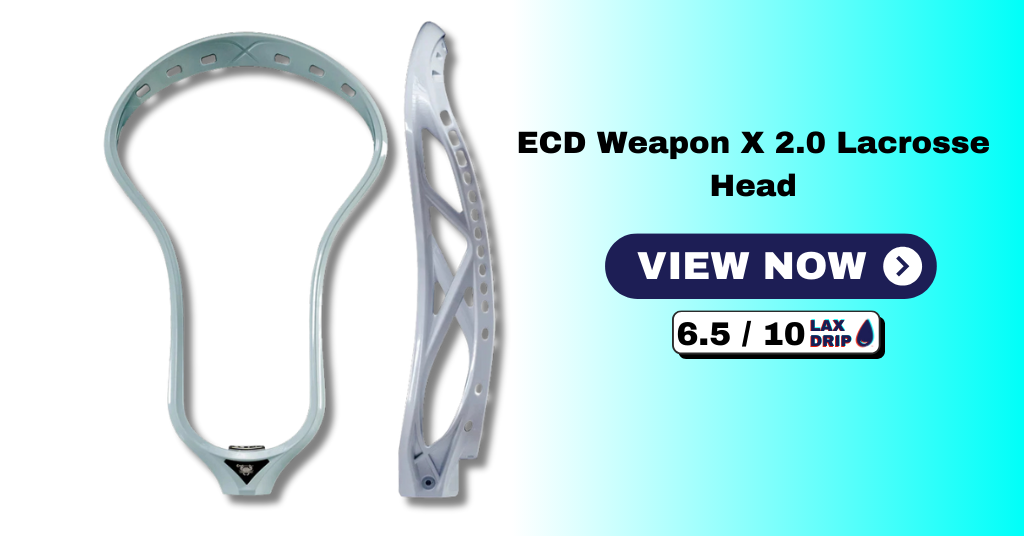
The ECD Weapon X 2.0 marks the second iteration of the Weapon X series, following its predecessor from 2019. ECD has consistently focused on performance when engineering their heads, so I was eager to add this model to my collection and provide an in-depth review.
Face-off heads often struggle with balancing flexibility and durability, so I tested the Weapon X 2.0 rigorously over two weeks to see if it truly delivers on both fronts.
Weighing in at 5.15 ounces, the Weapon X 2.0 is designed specifically for face-off players. Its low to mid-low pocket location allows for quick ball releases, while its flexible design aims to enhance performance during clamps.
With six top string holes and 14 sidewall holes, the head offers a decent range of customization options for pocket setups.
In terms of shooting accuracy, the Weapon X 2.0 performs well, particularly with its hybrid-flex design that supports quick and accurate ball releases. The head’s profile aids in maintaining solid shooting performance for mid-low pocket setups, although some hooking can occur on hard outside shots.
While it excels in face-off scenarios, it may not be the best choice for players focused on long-distance shooting due to its average shooting speed.
Catching and cradling are also strong points for this head. The rounded scoop improves catching consistency, even under defensive pressure, while the flexible design allows for a secure hold during transitions.
However, players may find it challenging to cradle securely immediately after winning a face-off, especially with a loose or low pocket setup.
The checking performance of the Weapon X 2.0 is decent but not exceptional. Its lightweight construction allows for agility, but it lacks the stiffness needed for delivering powerful checks effectively. The flexible sidewalls absorb some impact but may not provide enough resistance during aggressive defensive plays.
Ground ball pickups are where the Weapon X 2.0 truly shines. The rounded scoop design allows for smooth and quick pickups from various angles, minimizing drag during scrums. This feature is particularly beneficial during face-offs, where control and speed are crucial.
It’s a good choice for face-off specialists looking for a head that balances flexibility and durability while providing optimal ground pickup performance.
Pros
-
- Durable flex foam construction
-
- Lightweight design
-
- Engineered flex points for better control during clamps
-
- Two variants available for different flexibility needs
Cons
Spread on long-distance shots
Average shooting speed
Not stiff enough for powerful checks
How to Choose a Lacrosse Head
Having a hard time deciding what to look for in a lacrosse head? It’s definitely a difficult decision to make, but if you know what to look for, it’s not impossible.
Finding a head designed for your position is a great starting point. You can also narrow down your selection based on your budget. While many of the heads listed on this page are on the expensive side, we also have a cheap lacrosse heads guide that may be helpful if you are looking for a more affordable option.
From there, you really just have to figure out your preferences to find a head that matches them.
What kind of preferences am I talking about?
Let’s explore a little further. Here are 7 things to consider that can help you find the best lacrosse head for you.
1) Face Shape
The face shape of your head is what it looks like when looking at it straight on. If you’ve ever heard someone talk about how pinched (or wide) a head is, they’re talking about the face shape.
Deciding what kind of face shape you want is the easiest way to eliminate many options from your consideration.
Generally, wider heads are easier to catch with but have less control and accuracy. More pinched heads, on the other hand, hold onto the ball better and are more accurate, but are harder to catch with.
Here is what face shape each position typically looks for in a head:
-
- Attack: Pinched heads, especially towards the throat. Help with control when dodging and accuracy with passing and shooting.
-
- Midfield: Anywhere from a very narrow face shape to a wide face shape. Middies use the widest range of heads since they are involved in all parts of the game. If you are an advanced player or play primarily offense, a more pinched head is a good choice. If you play a lot of D middie or are just starting out, consider a wider head.
-
- Defense: Wide heads that help with intercepting passes and have more surface area for laying checks. Some advanced defenders prefer narrow heads to help with control in transition.
-
- Long Stick Middie (LSM): Slightly more pinched heads than the average defenseman uses to help with control in transition and accuracy when passing and shooting.
-
- Faceoff: A pinched head that requires less movement in order to pinch or clamp the ball. The head can’t be so pinched that it regularly gets caught in the back of the throat, though.
2) Weight
Some players consider weight the most important factor when choosing heads while others don’t care as much. It really depends on how sensitive you are to changes in the weight distribution of your stick.
For example, I don’t mind a heavier head too much. Now don’t get me wrong, I’m not running out onto the field with a metal head or anything like that—I just find that a slightly heavier head doesn’t noticeably affect my game.
Typically, offensive players prefer lighter heads that help them move and shoot faster since it requires less effort to move the head.
Defensive players, on the other hand, often opt for a heavier head that is stiffer and more durable than lighter options.
3) Stiffness & Durability
As hinted at above, stiffness and durability often have a direct relationship with the weight of the head.
Typically, as weight goes up, so does stiffness and durability. Heavier heads have more material, which in turn makes them stiffer and more durable.
I say “typically” because there are some companies using advanced plastics and other materials to increase stiffness while keeping weight consistent or even reducing it.
Throughout this guide and my position-specific head guides, you’ll see me reference stiffness-to-weight ratios. When all else is equal, finding the head with the highest stiffness-to-weight ratio—or the head with the highest stiffness and lightest weight—is the best option.
Defensemen especially should worry about finding a stiff and durable head since they are laying checks constantly throughout the game. Having a super flexible head lowers the impact of checks, making it harder to take the ball away.
As far as other positions go, most players prefer stiffer heads that won’t bend when scooping the ball and getting checked. The only exception is faceoff men who often need a flexible head for pinch and pops and other moves that require them to flex their heads.
>> Check this out: Best Lacrosse Bags
4) Ideal Pocket Placement
Finding a head that is designed to have your preferred pocket placement is also very important, though it is often overlooked by players.
How do you tell where the ideal pocket placement is for a head?
The easiest way is by locating the maximum offset. This is where the bottom sidewall rail is the lowest on the head when looking at it from the side.
If that max offset is towards the throat of the head, for example, a low pocket would be ideal. Offsets closer to the scoop, alternatively, lend themselves to higher pockets.
Here is what each position typically prefers in terms of pocket placement:
-
- Attackmen: Typically prefer lower pockets that are good for one-handed cradling and smooth releases.
-
- Midfielders: Preferred pocket placement varies a lot based on the type of player. On the run shooters and outside shooters may prefer a higher pocket that gives them more whip and hold. Middies that dodge from X or carry the ball a lot may like lower pockets to help with one-handed cradling.
-
- Defensemen: Often go for a higher pocket that gives them a bit more whip and more control immediately after scooping a ground ball.
5) Scoop
If you’ve ever used a head with a poor scoop, you know how frustrating it can be.
Poor scoops make it hard to pick up ground balls, often slowing you down or causing you to miss the ball altogether.
The best scoops allow you to pick up balls from a variety of angles and almost always feel smooth when doing so.
Scoops that are more angled/curved when looking down your stick allow you to pick up balls at a higher angle in relation to the ground. If your scoop is more angled/curved, you won’t have to get the butt end of your shaft as low to the ground as you would if your scoop was completely flat.
This is especially important for defensemen and LSMs since it’s harder to get the shaft’s butt end close to the ground since it’s so long.
6) Stringing Holes
The more stringing holes a stick has, the more you can customize your pocket to fit your needs.
While most heads nowadays come with plenty of stringing holes, it’s important to check to make sure you’ll be able to string your ideal pocket based on the holes.
Besides the number of stringing holes, you’ll also want to make sure they are big enough for your stringing style. For example, if you like to loop your top string around the first diamond of mesh a few times, you’ll need a large top sidewall hole.
7) Strung vs. Unstrung
As you can tell above, you usually have the option of buying a strung or unstrung head.
In most cases, I recommend buying an unstrung head and either stringing it yourself or getting a friend to do it. This allows you to string your ideal pocket instead of being stuck with whatever the company selling the head decides to go with.
There are exceptions to this idea, though. Some companies—such as East Coast Dyes and StringKing—offer great prestrung pockets that you can customize based on your preferences.
Before going with a strung head, check to see if the company allows you to choose your preferred pocket style and read some customer reviews to see if they were satisfied with the string job that came with the head.
>> Read More: Best Lacrosse Shafts
High School & College Head Rules
NFHS (high school) rules for lacrosse head dimensions started to match NCAA (college) rules starting in 2018. Previously, high school heads could be narrower towards the throat but had to be wider towards the scoop, and vice-versa for college heads.
Now that both organizations have the same set of rules, any head that meets NCAA rules is legal for NFHS as well. Here are the rules for heads:
-
- Minimum width of 6″ at the widest part of the head
-
- Minimum width of 3.5″ on front and back of the head at 5″ up from throat of the head
-
- Minimum width of 3″ at 3″ up from throat of the head
-
- Minimum width of 3″ at 1.25″ up from throat of the head
The following diagram from makes the rules a little easier to visualize:

If you are buying a head that was released in the past 2 years, you shouldn’t have to worry about it meeting these regulations.
If you are buying a head from 2017 or before, you should check to see if it meets NCAA specs. If it does, it should also meet current NFHS rules. If not, then it is likely illegal for both high school and college since the new NFHS rules went into effect in 2018.
>> Read More: What Makes a Lacrosse Stick Illegal
How We Choose the Best Lacrosse Heads
We take our ratings seriously and only recommend products that we would use ourselves.
To come up with our ratings for each product, we test the product ourselves whenever possible, review product specifications (weight, number of stringing holes, etc.), and read customer reviews/talk to lacrosse players we know that use the product.
When testing heads, we bring them to a field and test for passing, catching, shooting, scooping ground balls, and checking—all with a standard pocket to reduce the number of variables. When it’s not possible to extensively test a product ourselves, we spend extra time talking to real customers who have used the product for a while themselves.
If you ever have any feedback for any of the products listed on this page or have a recommended addition, please contact us and let us know!
Choosing Mesh for Your Lacrosse Head
If you end up going with an unstrung head, you’ll need to buy mesh and strings in order to get your head ready for action. Below you can find some of my top choices for both full string kits as well as just mesh. You can also check out our Best Lacrosse Mesh Guide to learn more.
What Is the Best Shooting Head for Lacrosse?
Does a Lacrosse Head Make a Difference?
What Is the Best LSM Head for Lacrosse?
How Tall Is a Lacrosse Head?
What Should I Consider When Buying a Lacrosse Head?
Photo credit: Flickr