

Most advanced lacrosse players buy separate heads and shafts so they can fully customize their sticks to their liking. There are way more individual head and shaft combinations than there are complete sticks—which are often targeted more at beginner-to-intermediate players.
The problem is, having so many options can make it difficult to decide which option is the best. Especially when it comes to lacrosse shafts that are all generally the same shape.
To help, I created this guide covering what I think are the best lacrosse shafts available today for all positions. You can also learn more about what to look for in a shaft later in the guide.

Note: This guide covers men’s shafts. If you need one for the girls’ game, check out our guide to the best women’s lacrosse shafts.
Keep reading to see our top 4 picks for each category or click to one of our full guides:
Best Lacrosse Shafts
To find the best lacrosse shafts, I created a database of all shafts on the market today and researched information—such as weight, material, and durability—to find pros and cons for each.
I did this by reading customer reviews, watching videos, and visiting the manufacturers’ websites. I then traveled to my local sporting goods stores to feel as many in my own hands as I could.
From there, I narrowed down my list to the best 10 shafts for each position. In this guide, you can see the top 4 attack/middie shafts, defense shafts, and goalie shafts. Soon I’ll be publishing shaft guides by position with all of my top picks for each.
Click here to jump down to a section:
Attack & Midfield Shafts
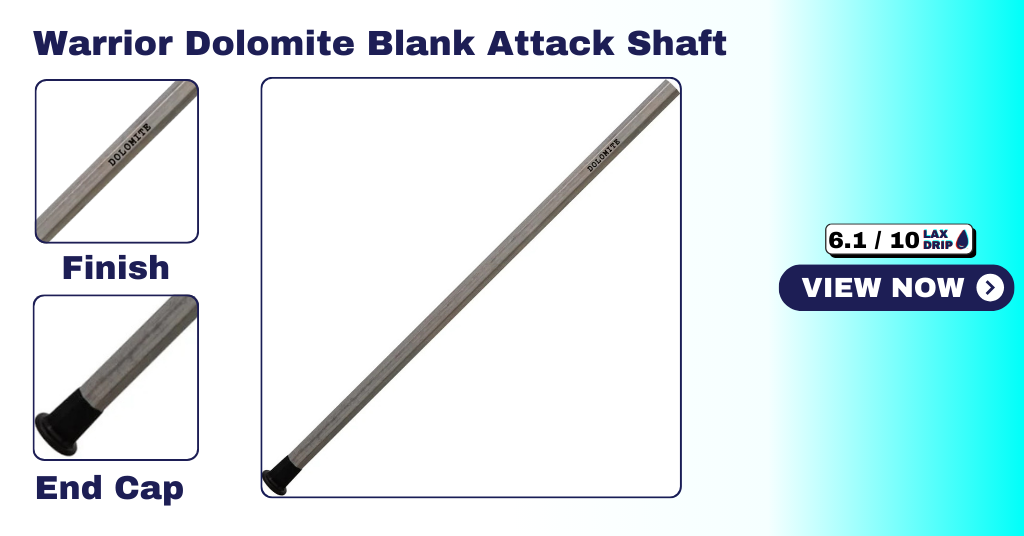
1. Warrior Dolomite Blank Attack Lacrosse Shaft
| Material | Altium alloy |
| Weight (oz) | 6.1 ounces |
| Shape | Octagonal |
| Grip/Finish | N/A |
| Colors | Gunmetal |
| Flex | Minimal |
| Warranty | 6 months |
I have been testing the new Warrior Dolomite shaft for a few months, and I would say it’s built for players who value strength without sacrificing speed. Warrior designed it with Altium alloy, which is new in the market but provides similar titanium-level strength.
However, at 6.1 ounces (without the end cap), it’s 50% stronger than the Krypto Pro and feels lightweight and responsive during long games. The weight is well-distributed, offering a solid balance between speed and control. I found it easy to maneuver during fast dodges and cuts.
Moreover, the shaft responds well when absorbing checks or dodging defenders. Its stiffness is ideal for hard shots as there’s no flex. As a result, I could easily deliver quick feeds in tight spaces without losing power on release.
Besides, the Altium alloy offers an elite level of durability, as it didn’t feel flimsy after a few games. Even after intense checks over the crease and repeated ground-ball battles, the shaft remained impressively dent-free, showing its elite durability.
The finish has a smooth yet slightly rough texture. It provides a slip-free grip during rain, but I was upset by the shift due to the simple end cap. Thus, I recommend taping it for a secure fit, reducing shift during intense play.
Regardless, it’s one of the best lacrosse shafts for attack players who need a reliable handle for quick moves and speedy shots.
Other Buying Option
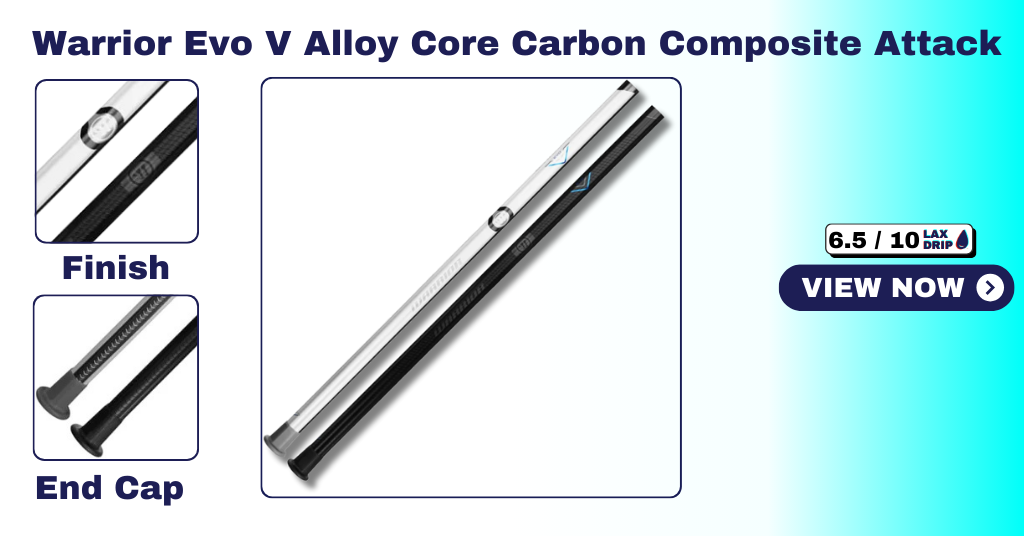
2. Warrior Evo V Alloy Core Carbon Composite Attack Lacrosse Shaft
| Material | Carbon Composite Material with Alloy Core |
| Weight (oz) | 6.0 |
| Shape | Extreme Octagonal Shape |
| Grip/Finish | Lined Grip Finish |
| Colors | White | Black |
| Flex | Average |
| Warranty | 6 months |
The Warrior Evo V Alloy Core Carbon Composite Attack Lacrosse Shaft is a game-changer for serious players. Combining the durability of an alloy core with the lightweight feel of carbon, this shaft weighs in at just 6.0 ounces.
It’s designed specifically for attack and offensive midfielders, making it an ideal choice for those requiring field performance. The lined grip finish provides excellent control, allowing me to handle the stick confidently even in challenging weather conditions.
I found that the extreme octagonal shape enhances my grip during fast-paced plays, ensuring I can cradle ground balls without hesitation. While its stiffness may present a learning curve for beginners, I appreciated the balance it struck between flexibility and rigidity.
This design allowed for quick releases on shots while maintaining a controlled feel when dodging defenders.
The Warrior Evo V is good for intermediate and advanced players looking to improve their game. Its durability and performance make it a standout option among attack lacrosse shafts.
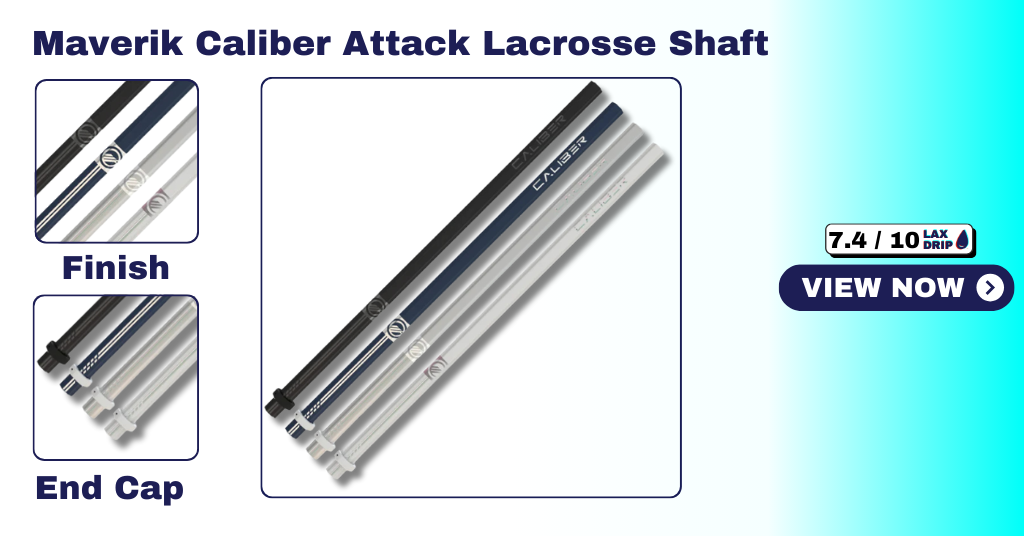
3. Maverik Caliber Attack Lacrosse Shaft
| Material | Scandium Titanium Alloy |
| Weight (oz) | 6.5 |
| Shape | Concave Shape |
| Grip/Finish | Bead-blasted finish |
| Colors | Navy | Black | White | Silver |
| Flex | Stiff |
| Warranty | 6 months |
The Maverik Caliber Attack Lacrosse Shaft is an excellent option for players looking for elite-level durability and performance. Inspired by previous models, I put this shaft to the test against a high school team while using the latest Nike Surge Elite.
The scandium-titanium alloy construction held up impressively, enduring hard checks and allowing me to score two goals. However, one game isn’t enough to evaluate a lacrosse shaft thoroughly, so I used it for a month to assess its capabilities.
Weighing 6.5 ounces, the Caliber is on the heavier side compared to other attack shafts but compensates with exceptional sturdiness. Its bead-blasted finish provides a reliable grip, even in wet conditions.
The concave shape feels comfortable during long practices, and I appreciated the shooting speed it offered. While its stiffness may deter beginners, experienced players will benefit from its strength and control during intense gameplay.
The Maverik Caliber is an excellent choice for intermediate and advanced players looking for a dependable attack lacrosse shaft that can withstand rigorous play.
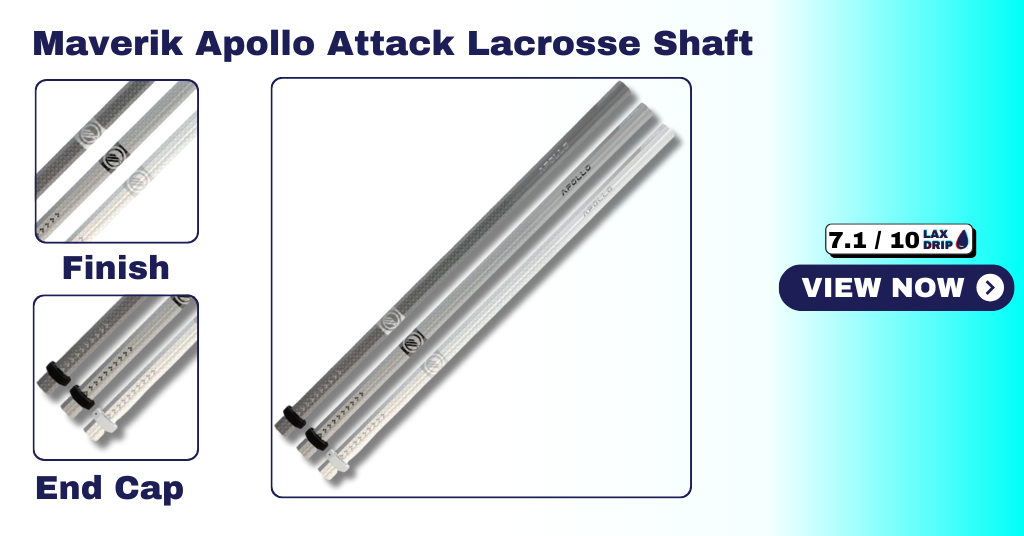
4. Maverik Apollo Attack Lacrosse Shaft
| Material | Scandium Titanium alloy |
| Weight (oz) | 5.2 |
| Shape | Smooth Concave Shape |
| Grip/Finish | Tactile Grip |
| Colors | White | Silver | Gunmetal |
| Flex | Average |
| Warranty | 6 months |
The Maverik Apollo Attack Lacrosse Shaft is an impressive addition to the 2025 lineup, designed for players who prioritize speed and accuracy. I hadn’t previously tried the Apollo range, so I was curious to see how its smooth concave shape with flat knurls compared to traditional models.
After testing it extensively, I found the tactile grip and lightweight design to be standout features. Weighing just 5.2 ounces, the scandium-titanium alloy construction provides excellent durability without feeling cumbersome.
The dynamic wall tapering improves strength while reducing weight at critical breakpoints, allowing for quick direction changes and fast shots. While it excels in delivering high shooting speed, I did notice that it may not absorb impacts as well as some heavier shafts.
The lack of flex means that while power transfers efficiently during shots, it can lead to vibrations on hard checks.
The Maverik Apollo is perfect for offensive players seeking a lightweight shaft that facilitates quick movements and precise shots on goal.
Other Buying Option
5. Maverik Range Attack Lacrosse Shaft
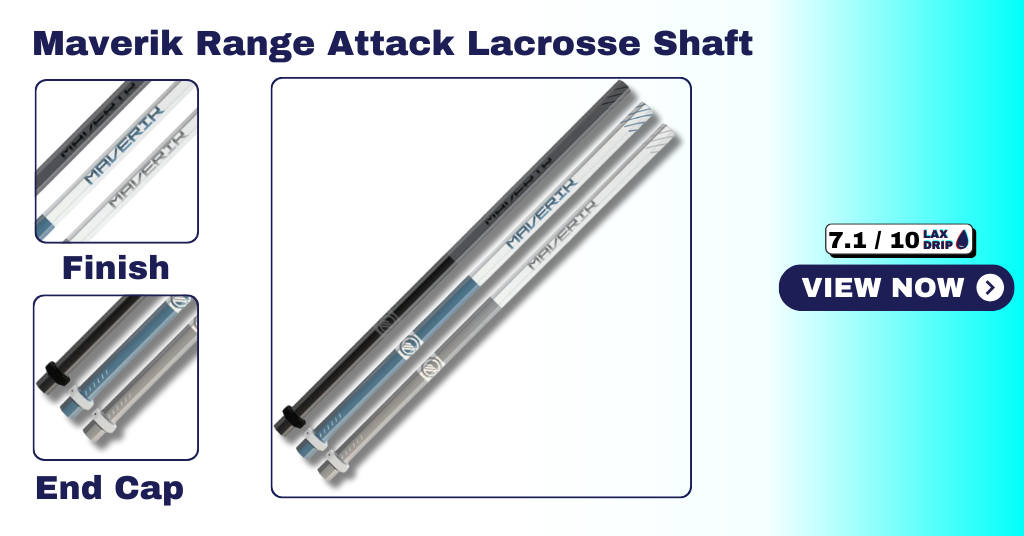
| Material | 8000 Series Alloy |
| Weight (oz) | 6.5 |
| Shape | Traditional Shape |
| Grip/Finish | Grid Grip finish |
| Colors | White | Black | Silver |
| Flex | Average |
| Warranty | 6 months |
The Maverik Range Attack Lacrosse Shaft has established itself as a reliable option since its release, built with Maverik’s 8000 Series alloy for a mix of durability and performance.
After testing it for over six months, I can confirm that it lives up to its reputation. Weighing in at 6.5 ounces, it strikes a balance between sturdiness and control, making it suitable for both offensive midfielders and two-way players.
The Grid Grip finish provides excellent slip resistance, allowing for confident handling even in wet conditions. While the traditional octagonal shape may not be everyone’s preference, it offers a solid grip during play.
I found that the shaft absorbs impacts well, enabling me to withstand checks while maintaining control of the ball. Although slightly heavier than some alternatives, the Range excels in shooting speed and accuracy, making it a practical choice for players who value reliability.
The Maverik Range is an excellent investment for those looking for a durable and effective attack shaft.
Other Buying Option
6. Mercury Carbon Shaft Lacrosse Shaft
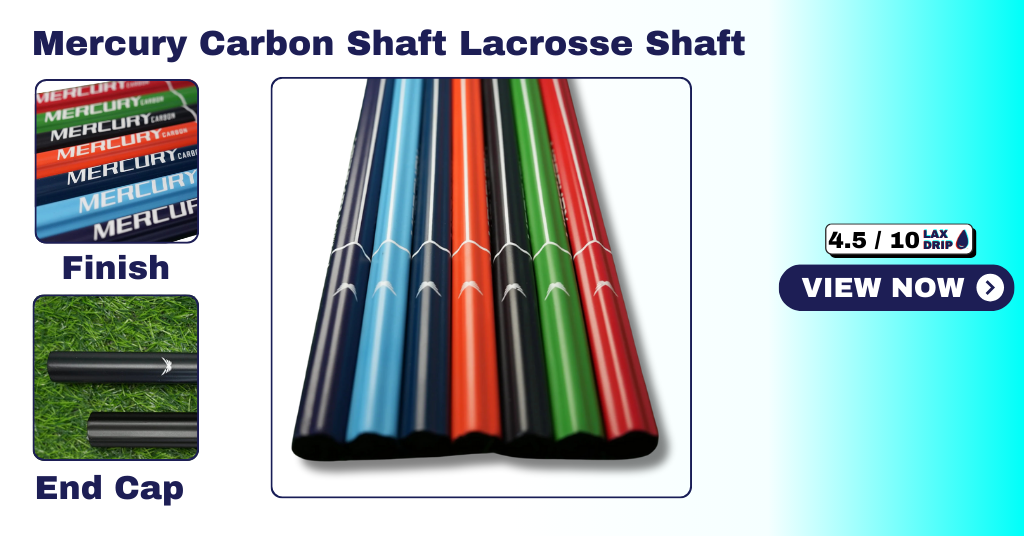
| Material | Carbon Fiber and Kevlar |
| Weight (oz) | 7 |
| Shape | Aggressive Concave Shape |
| Grip/Finish | Rubberized Grip |
| Colors | White | Black | Red | Yellow | Blue | Purple | Green |
| Flex | Minimal |
| Warranty | 6 months |
The Mercury Carbon Lacrosse Shaft is an excellent budget-friendly option for players looking for quality and durability. With a construction that combines six layers of carbon fiber reinforced with a Kevlar layer, this shaft promises impressive performance on the field.
Weighing in at 7 ounces, it does feel heavier than some other options, but once I adjusted to its weight during practice, I found it manageable. The aggressive concave shape provided solid control, making it suitable for attack and offensive midfielders.
During my testing, the Mercury Carbon absorbed checks remarkably well without showing signs of damage. The rubberized grip offered a reliable hold, even in wet conditions, although it did lose some tackiness after several games.
The minimal flex allowed for exceptional shooting accuracy, which I appreciated when paired with a quick-release head like the Nike Surge Elite.
The Mercury Carbon is a strong option for intermediate and advanced players looking for a durable shaft that will deliver reliable performance.
7. Gait Carbon GCX-SSDM Composite Short Stick D Middie Lacrosse Shaft
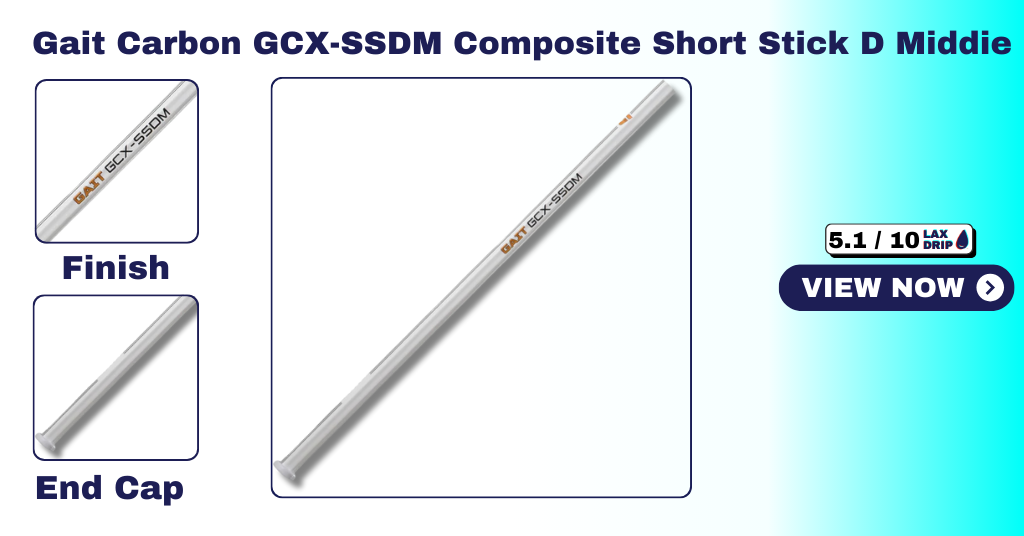
| Material | Carbon Composite |
| Weight (oz) | 7.3 ounces |
| Shape | Moderately Concave |
| Grip/Finish | Sandblast Finish |
| Colors | White |
| Flex | Moderate |
| Warranty | 6 months |
I bought my friend the Gait Carbon GCX-SSDM Composite lacrosse shaft, and it’s safe to say he is a big fan now. It has a less aggressive concave shape than ECD yet feels secure in hand, perfect for smooth handling.
At 7.3 ounces, it felt slightly heavy during quick transitions. Young players, especially those who prioritize speed, might need time to adjust. Otherwise, the added weight has enough strength to deliver powerful checks, smoothly disrupting the opponent’s cradling.
Moreover, the shaft offers excellent control when jamming a dodging attacker or contesting ground balls for D-middies. Its moderate flex profile strikes a good balance between stiffness and responsiveness.
It gives enough hard shots to add extra pop without losing accuracy when transitioning into offensive plays. The thick walls also make it durable enough to absorb check. It’s not the carbon shaft that snaps within a few months.
Furthermore, the gritty texture of fine sandpaper eliminates the need for excessive tape, even in the rain. The slipless grip aids in scooping ground ball in traffic, ensuring better control while making quick clears.
Still, it can wear down glove palms faster over time. So, if you plan to invest in a Gait Carbon lacrosse shaft, don’t forget to invest in high-quality gloves.
Otherwise, it’s a durable shaft for hard-hitting defensive plays and responsive enough for fast transitions into offense.
8. STX Sc-Ti Series (Multiple Options)
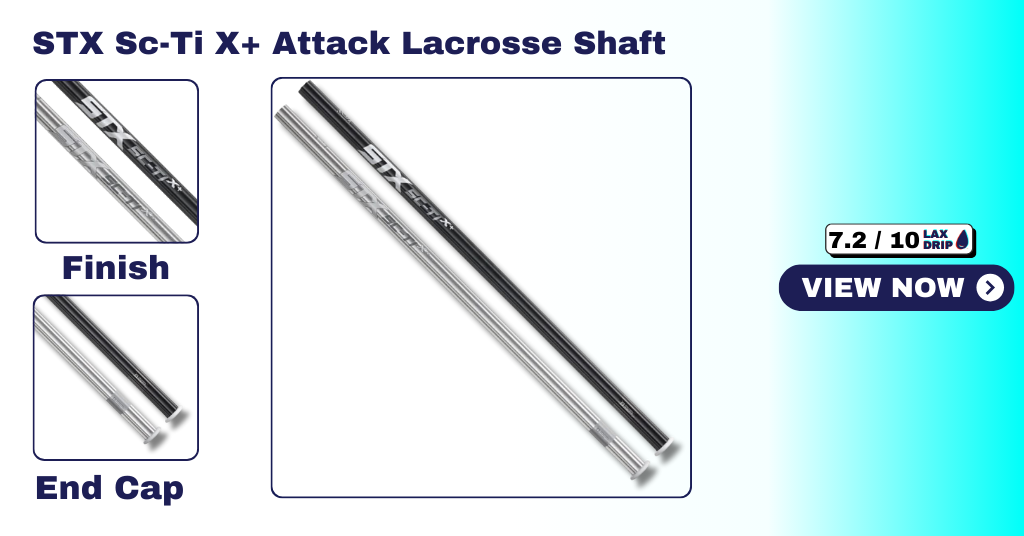
| Material | Scandium/Titanium alloy |
| Weight | 4.94 – 6.7 oz |
| Shape | Varies based on choice |
| Grip/Finish | 2 mil steel shot grip finish |
| Colors | Platinum, Black, Gunmetal, Blue |
| Flex | None |
| Warranty | 6 months |
Throughout my high school and college lacrosse career, I almost always used an STX Sc-Ti Pro. They were lightweight and held up extremely well. I actually don’t think I ever broke one or even had any major dents or dings in them.
Now, STX offers 5 different versions of the Sc-Ti shafts which all vary based on shape and weight. The variety of offerings helps STX take the top spot on our list because you can find a shaft that fits your preferences while knowing it’s going to perform well.
STX’s Sc-Ti shafts are the company’s top-tier metal shafts and are made of a scandium/titanium alloy. They come with a 2 mil steel shot finish to give you better grip and control.
If you prefer metal over composite shafts, you’d have a hard time finding a better option than an STX Sc-Ti shaft.
Here is an overview of each of the 5 shapes:
1. X: Extreme concave shape
2. X+: Extreme concave grip with extra thickness
3. O: Concave octagonal (traditional feel)
4. R: Ridge profile for extra feel and grip
5. S: Asymmetrical design that is octagonal on one side and concave on the other
9. ECD Carbon Pro 3.0 (2 Shafts – Speed & Power)
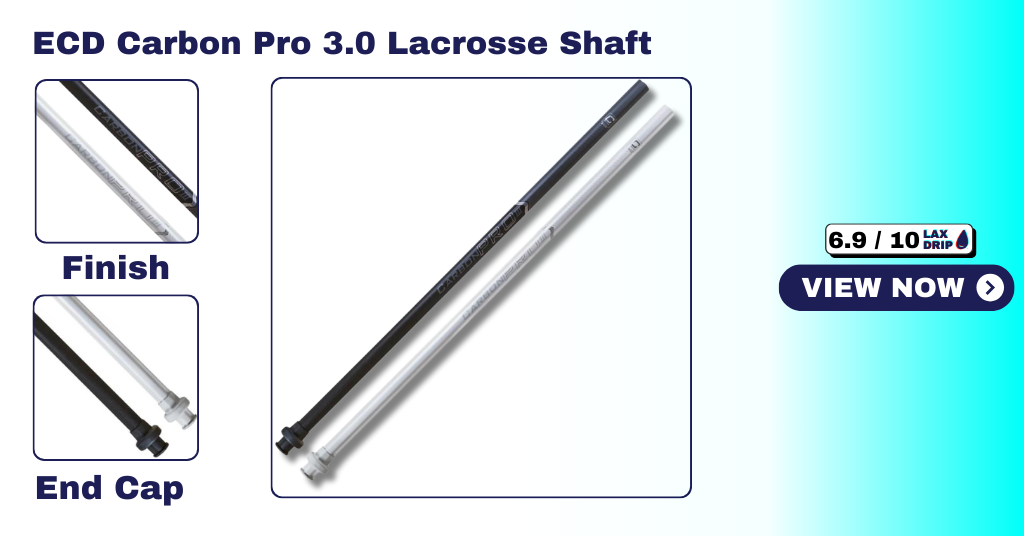
| Material | Carbon fiber + Kevlar |
| Weight | 5.29 oz (Speed), 5.82 (Power) |
| Shape | Extreme Concave |
| Grip/Finish | Raised texture at top of shaft (Speed) & bottom of shaft (Power) |
| Colors | Black, White |
| Flex | Moderate to High |
| Warranty | 6 months |
ECD took the best features of the Carbon Pro 2.0 shaft and implemented new features to make the 3.0 even better.
It comes in two variations: Speed and Power.
The Speed version—mainly tailored for attackmen—has a higher flex point allowing for a quicker release. It also features a raised texture grip towards the top of the shaft to give you better control with one-handed cradling.
The Power version—mainly tailored for middies/outside shooters—has a lower flex point allowing for more power on outside shots. Its raised texture is towards the bottom of the shaft to give you more control during those outside bombs.
Both shafts are now reinforced with Kevlar, making them even stronger while maintaining a good strength-to-weight ratio. Something else new in the 3.0, they come with a sliding end cap that allows you to move it to where you’re most comfortable.
The Carbon Pro 3.0 shafts also come with a new, more concave shape. In my opinion, this gives a much better grip as compared to the 2.0 and most other shafts.
Both versions have clean designs featuring some text and logos that are barely noticeable on the shaft, in a good way.
On the downside, the Carbon Pro 3.0 shafts are a bit heavier than some other attack and middie shafts. While this helps them hold up over time, you may want to look elsewhere if you have a strong preference for extremely light shafts.
10. Maverik Hyperlite
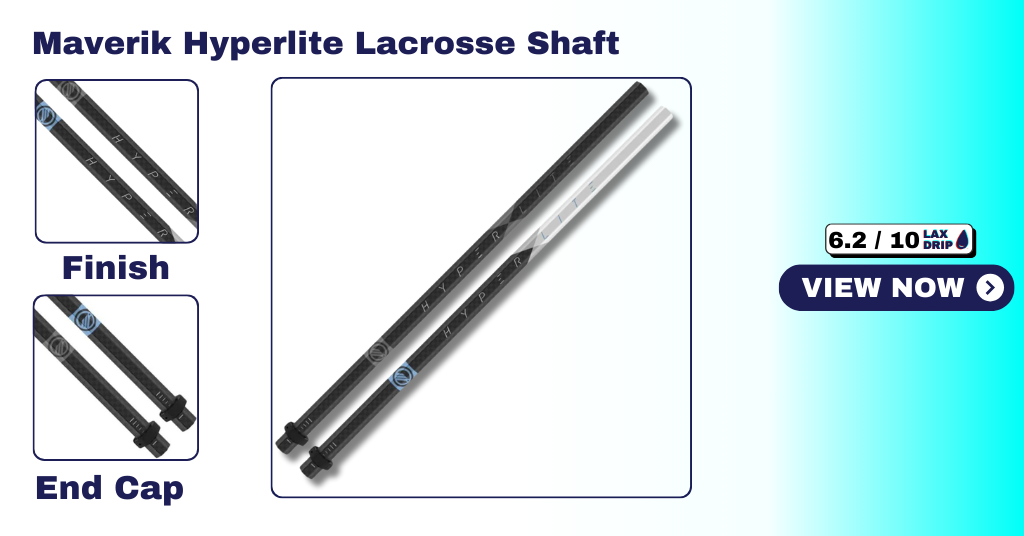
| Material | Carbon fiber |
| Weight | 4.8 oz |
| Shape | Slight concave |
| Grip/Finish | Smooth matte finish |
| Colors | White/Black, Black |
| Flex | None |
| Warranty | 6 months |
The second carbon fiber shaft on our list of the best attack shafts is the Maverik Hyperlite. It’s one of the lightest shafts on the market today (and the lightest shaft Maverik has ever created), weighing in at only 4.8 oz.
Maverik just released the newest version of the Hyperlite in October 2022. It comes with an updated design and the same great performance as past models.
Unlike some other carbon fiber shafts, the Hyperlite is designed not to flex. If you are used to metal shafts but want to try out a carbon fiber shaft, this may be a good option instead of jumping straight to a shaft designed to flex.
The Hyperlite has a slight concave shape and a matte finish for a smooth feel. It comes in black and white/black, both of which have blue accents and a clean design.
One of my favorite parts of the Hyperlite is the adjustable butt end that you can move on the shaft depending on where you prefer it.
If you are looking for a lightweight carbon fiber attack shaft, look no further than the Maverik Hyperlite. It checks all of the boxes when it comes to a great shaft and there’s a reason it’s used by countless pro and collegiate players.
11. StringKing Composite 2 Pro
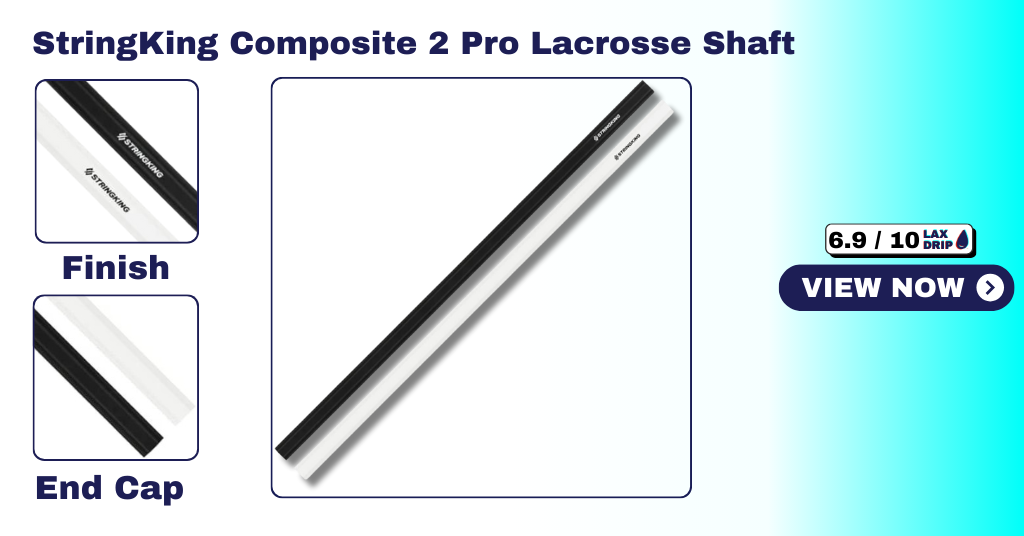
| Material | Carbon fiber |
| Weight | 4.76 – 6.88 oz |
| Shape | Slight concave |
| Grip/Finish | Smooth matte finish |
| Colors | Black, White |
| Flex | None |
| Warranty | 6 months |
Another carbon fiber shaft makes our list of the best lacrosse shafts with the newly released (October 2022) StringKing Composite 2 Pro.
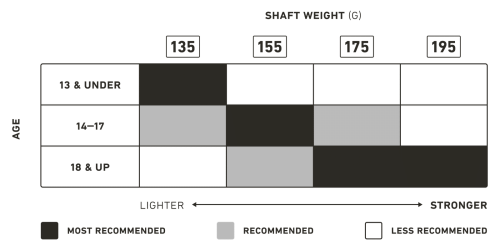
Like past models, it comes in 4 different variations which differ in weight. The table below can help you decide which option is best for you.
The new Composite 2 Pro comes with Smart Taper technology that adds extra material where shafts are typically the most prone to breaking. In our testing, we’ve found this shaft to be very strong.
The biggest downside of this shaft is the weight of the versions designed for more advanced players (175 g and 195 g). While these aren’t super heavy, there are lighter carbon fiber shafts available.
If you’re looking for a great carbon fiber shaft that will last for a long time, the new StringKing Composite 2 Pro is a great option to consider—especially if you don’t mind the extra weight of the more advanced shafts.

12. Warrior Burn XP Carbon
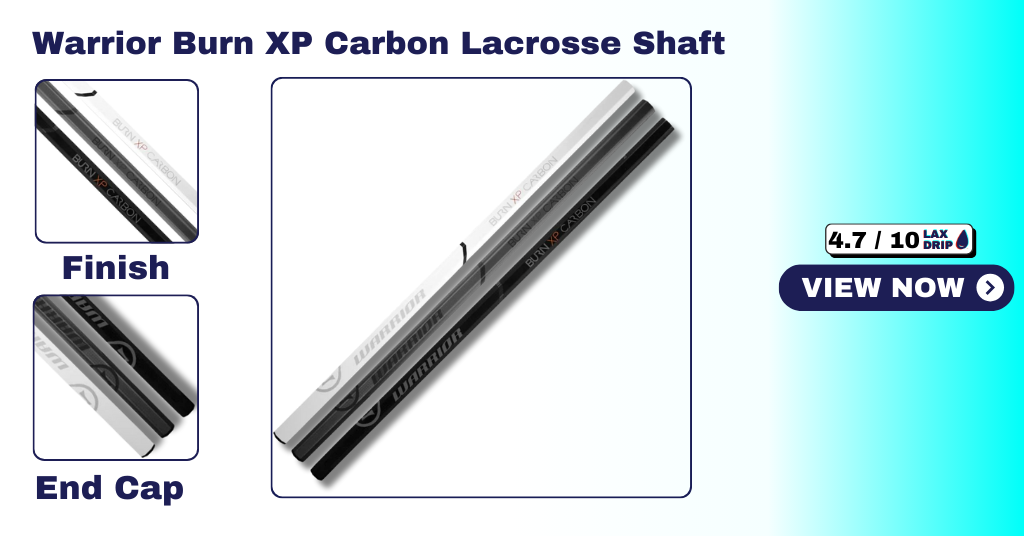
| Material | Carbon composite |
| Shape | Octagonal |
| Grip/Finish | Dot matrix on bottom half |
| Colors | White |
| Flex | High |
| Warranty | 6 months |
The Warrior Burn XP Carbon Shaft is the second composite attack shaft on our list due to its durability, light weight, and great feel.
If you like flexible shafts, then the Burn XP Carbon is arguably your best bet. The XP stands for “extreme power” and you can really feel it when shooting. Compared to stiffer shafts, you can really feel this shaft flexing as you shoot, helping increase shot power.
There is a dot matrix grip on the bottom half of the shaft that helps reduce the need for tape. Many players have to tape up other to add grip but this makes them much heavier. This makes the Burn XP Carbon’s natural grip a huge plus.
The shaft comes with two end caps: a Warp end cap that provides more leverage when shooting (my personal preference) and a normal end plug that is smaller and lighter.
Overall, if you are a fan of lightweight and flexible carbon shafts, the Warrior Burn XP Carbon is a phenomenal choice.
>> Read More: Best Attack Lacrosse Shafts
13. Warrior Burn XP2 Carbon Composite Attack Lacrosse Shaft
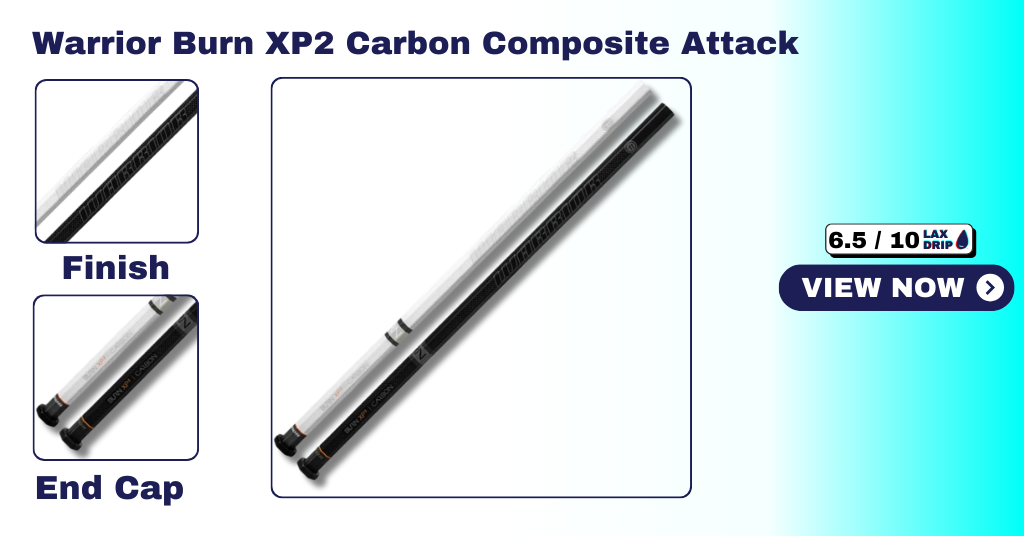
| Material | Composite |
| Weight | 4.4 oz |
| Shape | Octagonal |
| Grip/Finish | Dot Matrix Grip |
| Colors | White, Black |
| Flex | Engineered flex |
| Warranty | 2 months |
The Warrior Burn XP2 attack shaft felt amazing the first time I picked it up in 2023. It has an octagonal shape with a star matrix grip. However, the points are not aggressive, and they have a subtle texture that provides a strong grip.
I loved the feel of its rubberized surface, which was perfect for cradling the ball in tight spaces. The grip gave me excellent control, even without gloves. The shaft never slipped off my sweaty hands, whether feeding from X or snapping off a quick inside finish.
I’m not a huge fan of overly flexible sticks, but the XP2 has minimal flex. Although I didn’t feel any unnecessary flex when throwing hard checks, it vibrates when I receive checks. Yet, it delivers a clean, snappy release on shots.
Moreover, it’s stiffer than previous models and strong enough to handle strong checks. It’s a lightweight handle with a carbon-fiber build and weighs only 4.4 ounces.
Another cool feature is the option to customize your endcap. You can switch between the insert and cap, depending on your playstyle. I went with the cap for better control, and it felt great during ground ball scrambles.
14. Nike Surge Elite Composite Attack Lacrosse Shaft
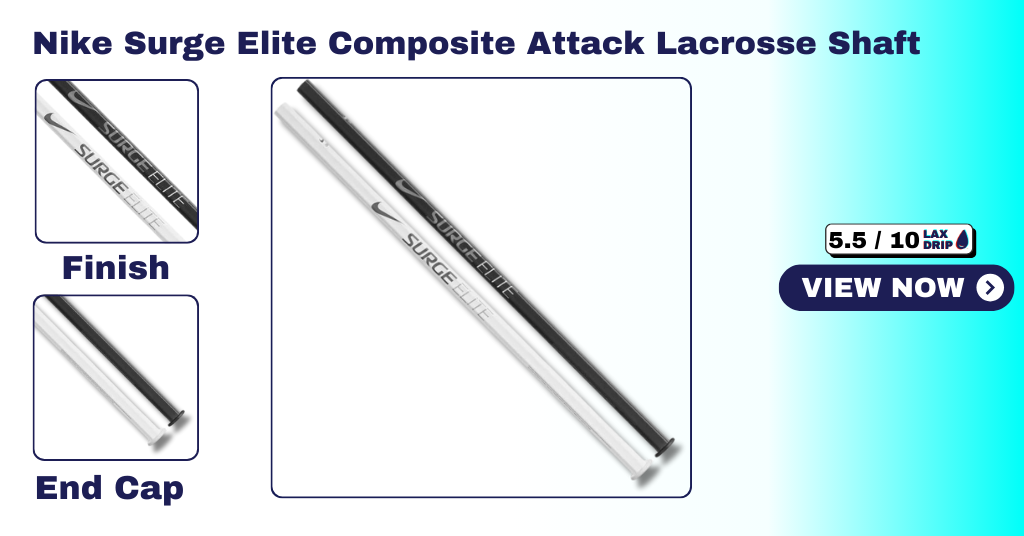
| Material | Composite |
| Weight | 4.8 oz |
| Shape | Octagonal shape with sharp angles |
| Grip/Finish | Textured Grip |
| Colors | White, Black |
| Flex | Minimal flex |
| Warranty | 2 months |
The Nike Surge Elite is one of the best lacrosse shafts for attacks. This 4.8-ounce shaft was released in 2023 and has supported me well on the field. Its lightweight and long-lasting carbon build has been amazing during fast-paced D1 lacrosse.
This shaft is designed with a combination of stiffness and flex points for high-velocity plays. It’s so light that I don’t have to put too much power behind my shots. However, the shooting speed remains the same. I loved the quick passes on the run.
Moreover, it’s a durable shaft. I have taken some pretty hard checks with this shaft, and surprisingly, it holds up extremely well. The composite material absorbs the impact and doesn’t strain my arms even after long practice hours.
Although it has a nice grip and a textured feel, I wouldn’t say I liked the end cap. The edge of the cap pressed against the side of my palm, and over time, it started to wear down my glove. Otherwise, it provides excellent grip in all weathers and doesn’t show any wear and tear.
15. ECD Focus Attack Lacrosse Shaft
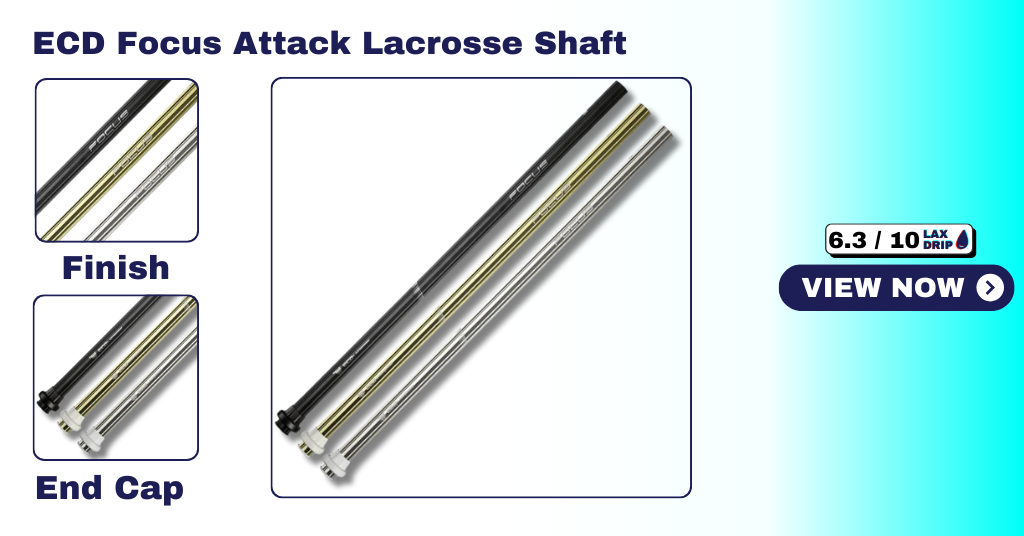
| Material | Scandium Titanium alloy |
| Weight (oz) | 5.7 ounces |
| Shape | Control Shape (extremely concave) |
| Grip/Finish | Sandblast Finish |
| Colors | Black, Silver, and Gold |
| Flex | Minimal |
| Warranty | 6 months |
ECD Focus attack lacrosse shaft marked ECD’s return to metal handles after an eight-year hiatus. Unlike their original Focus shaft, pure scandium, the new Focus blends scandium and titanium (Sc-Ti). Hence, it provides a nice balance between lightweight handling and durability.
At 5.35 oz with just the end cap insert and 5.7 oz with the full sliding end cap, it’s light. I have always appreciated a lightweight shaft for quick cuts and fast releases, and this is one of the best attack lacrosse shafts.
It’s designed specifically for attack and midfield players, so it’s only available in 30-inch lengths. Players who prefer shafts with no flex for more consistent and accurate shots will find this appealing. However, if you’re used to carbon shafts with a touch of flex, adjusting to the rigid feel might take time.
Moreover, the sandblasted grip feels smooth and subtle, offering suitable texture and reducing abrasiveness. It’s not as gritty as an Epoch shaft’s full sandpaper-like grip, but I found it comfortable even in wet conditions.
The control shape is another highlight of the ECD Focus attack lacrosse shaft. It has subtle finger indents that enhance grip and hand placement. I got a nice grip for shooting high-speed passes and cradling in traffic.
The shape reminded me of ECD’s Carbon 3.0 Speed. Thus, you can shift from ECD speed to Focus if you want a similar feel with no flex and better durability.
Defense Shafts
1) Maverik Caliber Defense Lacrosse Shaft
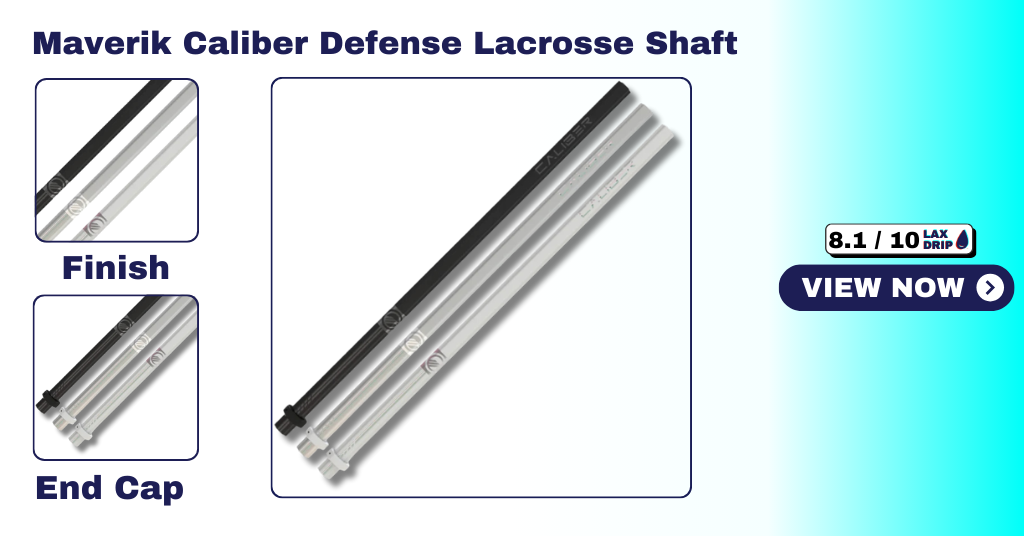
| Material | Scandium Titanium Alloy |
| Weight (oz) | 12.6 |
| Shape | Extreme Concave Shape |
| Grip/Finish | Bead-blasted Matte Finish |
| Colors | White | Black | Silver |
| Flex | Minimal |
| Warranty | 6 months |
The Maverik Caliber Defense Lacrosse Shaft has made significant strides in durability and performance with its 2024 upgrade. Constructed from scandium-titanium alloy, it weighs 12.6 ounces, which is relatively light for a defensive shaft.
I tested this model extensively, and its thicker walls compared to the previous Caliber S23 model provided excellent resistance to bends and dents, making it a reliable choice for defenders.
The bead-blasted matte finish offers a slipless grip, which I found particularly beneficial during intense gameplay. The extreme concave shape allows for controlled cradling and shooting, although new players may need some time to adjust to its aggressive design.
Despite its minimal flex, which can cause slight jitters upon impact, the shaft absorbs checks effectively, reducing strain on my hands during long games.
The Maverik Caliber Defense shaft is a solid investment for intermediate and advanced players looking for a durable and high-performing option that excels in defensive situations.
2) STX Sc-Ti Defense Series (Multiple Options)
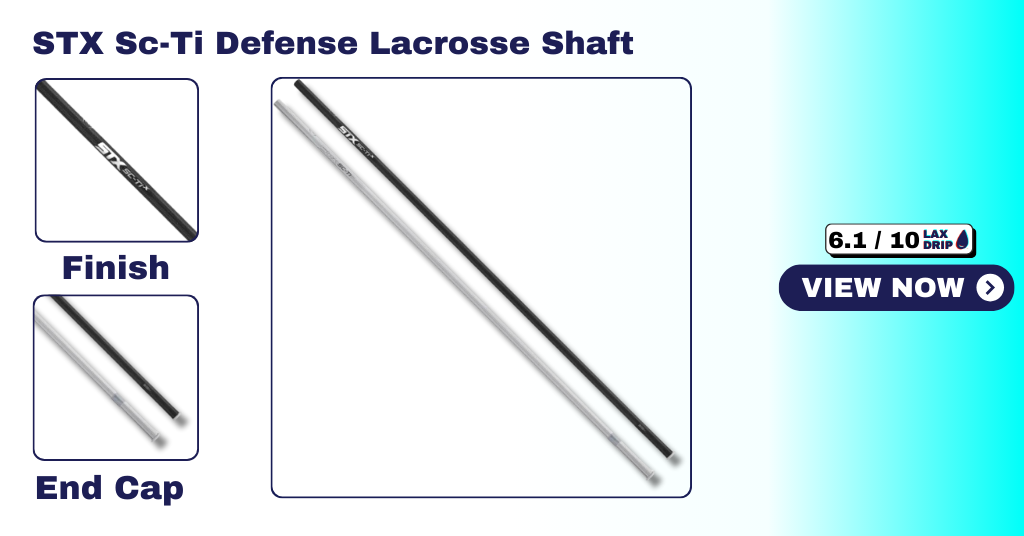
| Material: | Scandium/Titanium alloy |
| Weight: | 13.4 – 14.11 oz |
| Shape: | Varies based on choice (see below) |
| Grip/Finish: | 2 mil steel shot grip finish |
| Colors: | Platinum, Black, Gunmetal, Blue Steel |
| Warranty: | 6 months |
If you prefer a metal shaft, you can’t go wrong with an STX Sc-Ti Defense shaft thanks to their durability and relatively light weight.
The STX Sc-Ti shaft line has been around for 10+ years and remains one of the best and most popular options today thanks to their light weight and high strength.
There are 4 different weights/shapes to choose from depending on your play style, including the X (extreme concave, 13.4 oz), R (ridge, 13.76 oz), S (shift, 14.11 oz), and O (octagon, 14.11 oz).
Here is an overview of each of the 5 shapes:
X: Extreme concave shape
R: Ridge profile for extra feel and grip
S: Asymmetrical design that is octagonal on one side and concave on the other
O: Concave octagonal (traditional feel)
The STX Sc-Ti Defense shafts have a clean, minimalistic design and come in a variety of colors. There is a thin butt end that attaches on the inside of the shaft.
3) Warrior Burn XP Carbon Defense
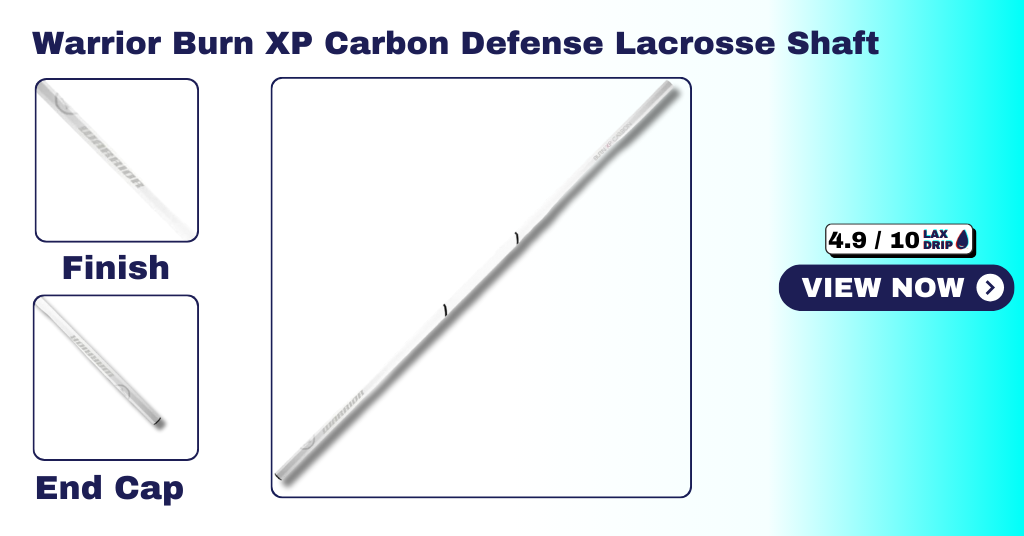
| Material: | Carbon composite |
| Shape | Traditional octagonal |
| Grip/Finish | Matte finish |
| Colors | White |
| Warranty | 6 months |
Recently released in October 2021, the Warrior Burn XP Carbon Defense is one of the best shafts for both defensemen and LSMs currently available.
It is designed to strategically flex to provide more power on shots and long passes as well as checks. If you like how it feels when your pole flexes (which typically only happens with carbon fiber shafts), then you’ll definitely like the Burn XP Carbon.
Another great thing is the dot matrix grip that gives you a good feel of the shaft in your gloves but won’t tear them up like many other shafts with rougher grips. This reduces the need for tape which can weigh your shaft down.
The Burn XP Carbon Defense comes with two end caps which you can switch out based on your preference—a larger one that provides more leverage for checks, passes, and shots, and a lighter one if you don’t want the extra weight.
Overall, if you are a fan of lightweight and flexible carbon D poles, the Warrior Burn XP Carbon is a phenomenal choice.
4) ECD Carbon Pro 3.0 Defense
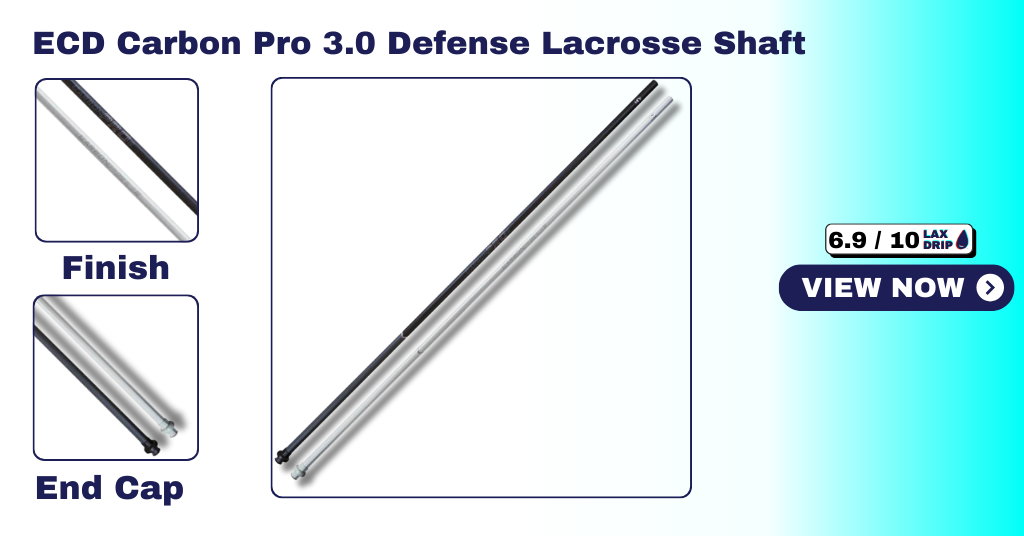
| Material: | Carbon fiber + Kevlar |
| Shape: | Concave |
| Grip/Finish: | Matte finish + raised texture |
| Colors: | White, Black |
| Warranty: | 6 months |
ECD took the best features of the Carbon Pro 2.0 shaft and implemented new features to make the 3.0 even better.
The Carbon Pro 3.0 Defense is now reinforced with Kevlar, making them even stronger while maintaining an excellent strength-to-weight ratio. Something else new in the 3.0 is that it comes with a sliding end cap that allows you to move it to where you’re most comfortable.
The Carbon Pro 3.0 Defense features a low-kick point that gives an extra bit of flex on shafts and shots—a great feature that not many D shafts have.
Both the white and black versions have clean designs featuring some text and logos that are barely noticeable on the shaft, in a good way. There is also a raised texture towards the bottom of the shaft to give you some extra grip while eliminating the need for tape which can weigh your stick down.
Overall, the ECD Carbon Pro 3.0 Defense is a great, durable shaft that is great for any defenseman or LSM that prefers carbon fiber shafts. There’s a reason it has been used by elite pro players like Matt Dunn over the summer before it was released to the public.
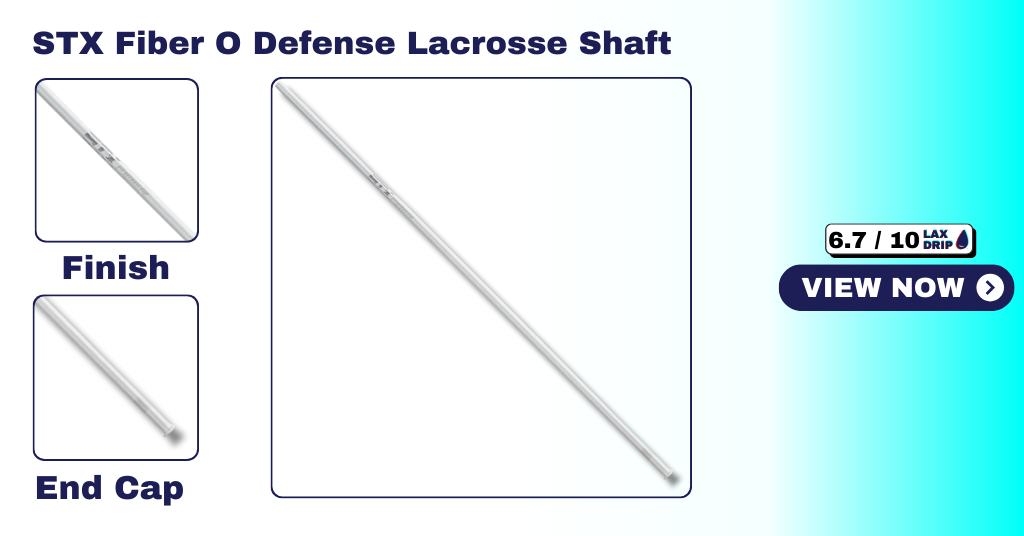
5) STX Fiber O Defense
| Material | Carbon composite |
| Shape | Octagonal (traditional) |
| Grip/Finish | Targeted grip zones |
| Colors | White, Black |
| Warranty | 6 months |
STX makes a second appearance on our list of D shafts with its elite carbon shaft: the Fiber O Defense.
The Fiber O shaft has a more-traditional octagonal shape with targeted grip zones that give you a better feel of the shaft and reduce the need for tape.
While the STX Fiber O Defense shaft isn’t the lightest available, it holds up very well over time and isn’t prone to splintering like other carbon fiber shafts. This makes it a great option for both defensemen who are constantly laying checks as well as LSMs who carry the ball in transition.
The Fiber shafts have a moderate amount of flex. It’s not as noticeable as the Warrior Burn XP Carbon but you can definitely feel it a bit on hard passes and shots.
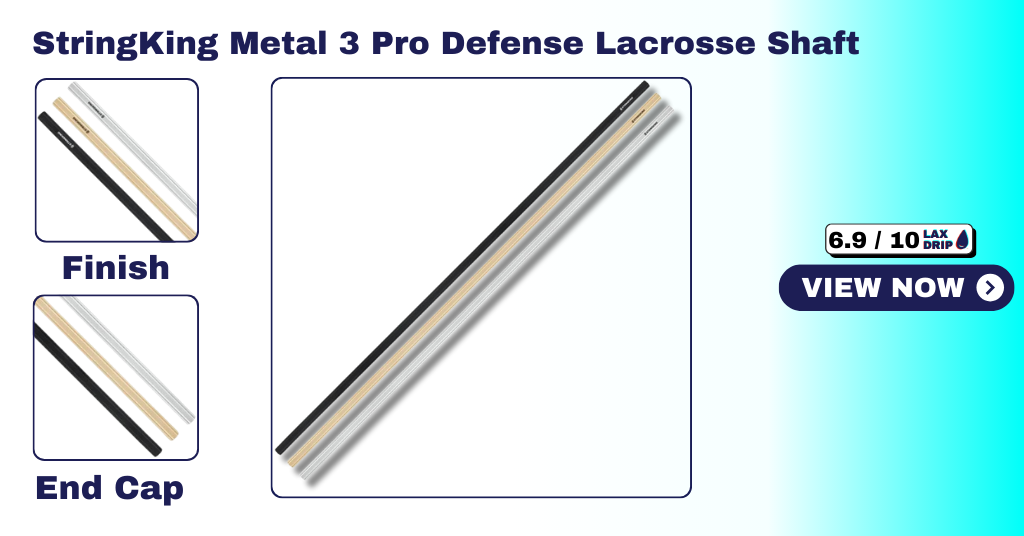
6) StringKing Metal 3 Pro Defense (2 Shafts)
| Material | Metal alloy |
| Weight | 12.7 or 14.11 oz |
| Shape | Slight concave |
| Grip/Finish | Sandblasted finish |
| Colors | Silver, Black |
| Warranty | 6 months |
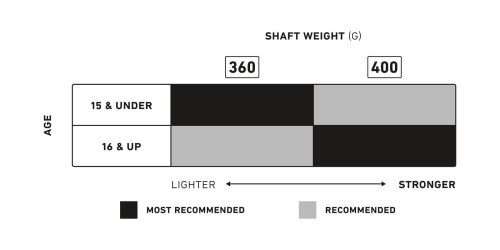
The StringKing Metal 3 Pro Defense comes in two weights/strengths to best suit your age and skill level. Check out the chart below to determine which makes the most sense for you.
Both options are relatively light and durable. To achieve this, StringKing analyzed warranty claims from their older metal shafts to find the specific spots that needed reinforcement.
In addition, StringKing also offers a 6-month warranty should your shaft break, bend, or develop any major dents or cracks.
The shafts have a slight concave shape that gives good feed in gloves as well as a sandblasted finish that gives a better grip than a completely smooth shaft.
The Metal 3 Pro Defense, which comes in silver and black, is one of the best-looking shafts available today with a small logo on one side and info about the shaft on the other.
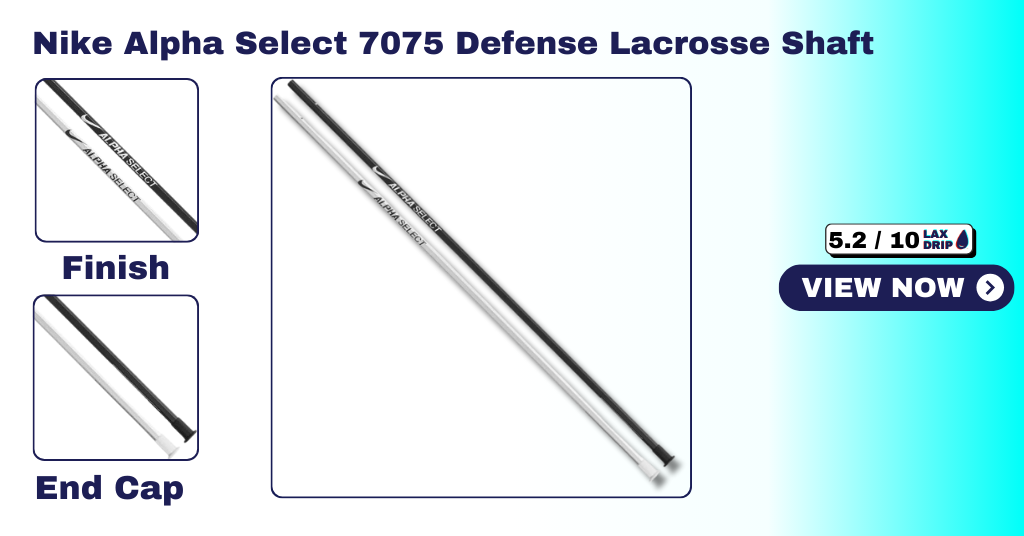
7) Nike Alpha Select 7075 Defense Lacrosse Shaft
| Material | Scandium + Titanium alloy |
| Weight | 15.8 oz |
| Shape | Octagonal shape |
| Grip/Finish | Textured finish |
| Colors | Black, Platinum |
| Flex | No flex |
| Warranty | 6 months |
Nike Alpha 7075 is one of the best lacrosse shafts for defensive middies. Its traditional design and durable Sci-ti built makes it a reliable choice.
It is a bit heavier than some other shafts, especially compared to carbon options, but that weight gives it a solid, substantial feel on the field. The extra weight is beneficial for defensive middies during ground ball battles.
Nike Alpha Select weighs 15.8 ounces, perfect for withstanding rough games and powerful checks. Its traditional shape offers a strong hold. I could throw hard checks, affecting the opponents and popping the ball out several times.
This Nike Alpha 7075 fixes almost all heads and doesn’t loosen up. So, I didn’t have to worry about missed ground balls while catching or picking up on the run. It just fixed into my hand, offering a comfortable hand placement.
The control on this shaft is also a big plus. I liked the low-profile end cap—it’s one of those little details that makes a difference. It gives me better ball control and cuts down on the wear and tear on my gloves.
>> Read More: Best Defense Lacrosse Shafts
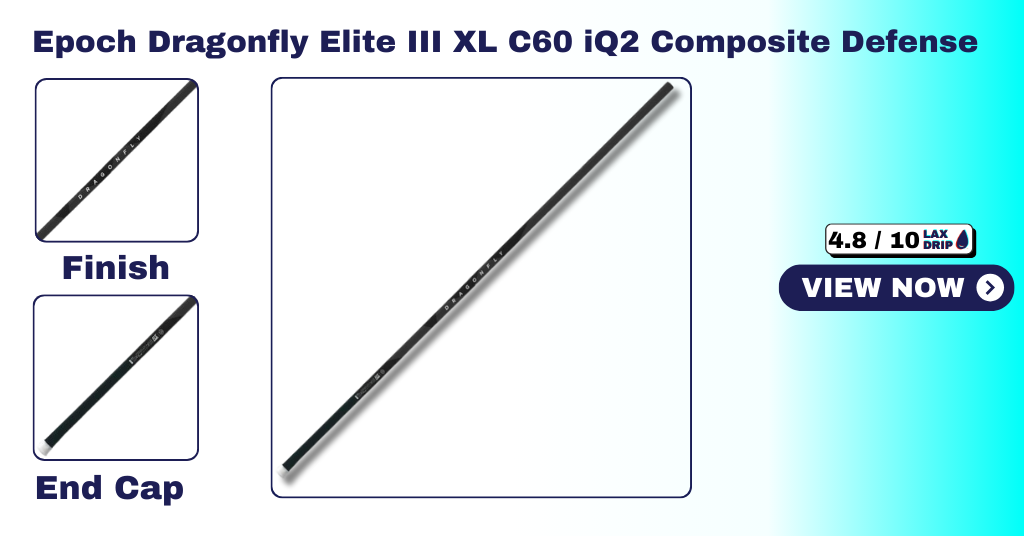
8) Epoch Dragonfly Elite III XL C60 iQ2 Composite Defense Lacrosse Shaft
| Material | Composite |
| Weight | 15.8 oz |
| Shape | C Geometry(Concave Octagon) |
| Grip/Finish | Pro Grip |
| Colors | Carbon Black |
| Flex | IQ2 |
| Warranty | 12 months |
I picked up the Epoch Dragonfly Elite III XL C60 iQ2 because I liked its balance between flexibility and stiffness. After testing it for about six months, it’s perfect for D-middies, D-pole players, and LSM. It comes with a one-year warranty.
The extra material in the XL version helps with durability, easily absorbing impact from a hard check. Despite being 60 inches long, it only weighs 15.8 ounces. I also noticed that reactive technology improves shot power during quick adjustments, such as cutting off a lane or making fast passes.
The Pro Grip coating gives elite-level control without feeling overly sticky on the field. So, I could easily shift my hands even in the rain. On the other hand, the Hyperlite offers a smoother, more natural feel that alloy lovers prefer. So, it’s the best lacrosse shaft if you want to shift from alloy shafts to composite ones.
Moreover, the iQ2 flex rating is stiffer than the iQ8, perfect for hard checks. However, it can feel slightly rigid when cradling or passing. So, if you transition between defensive middie and attack, try Epoch’s Dragonfly Integra X Transition shaft.
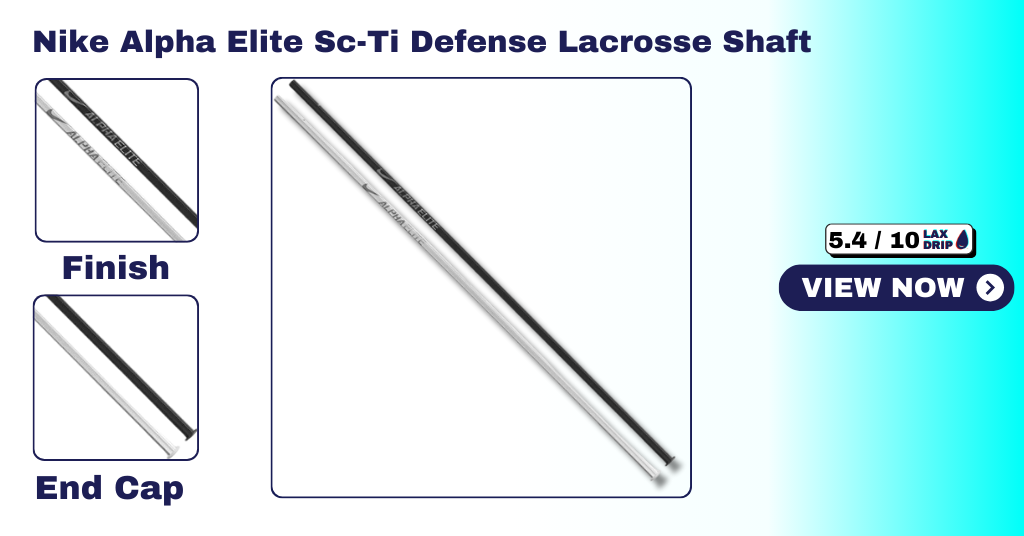
9) Nike Alpha Elite Sc-Ti Defense Lacrosse Shaft
| Material | Scandium + Titanium alloy |
| Weight | 15.1 oz |
| Shape | Edged |
| Grip/Finish | Mild sandblast finish |
| Colors | Black, Platinum |
| Flex | No flex |
| Warranty | 6 months |
The Nike Alpha Elite Sc-Ti defense is my go-to lacrosse shaft for rough practices. Although it’s the newest addition to my collection, it has been the best lacrosse shaft for defense.
Despite a year of extended practice in rough weather, this shaft shows no signs of damage other than a few scratches. Its scandium alloy construction makes it incredibly durable and lightweight at just 15.1 ounces.
While the lighter build doesn’t compromise impact or checking effectiveness, the thicker walls easily absorb impact and prevent arm strain. However, due to its stiffness, I initially struggled with high-speed shots.
Furthermore, the sandblast finish provides exceptional grip, even in wet or muddy conditions. It helped me with quick passes in tight spaces and teammate feeding on the run. The shot speed is lower than Epoch Dragonfly Elite III, but it performs well on short-range shots.
Otherwise, its stiffness is ideal for close-range shooting. The middle flex point creates an impressive whip that helps in ground ball pickups. Hence, It offers a good balance between stiffness and flexibility.
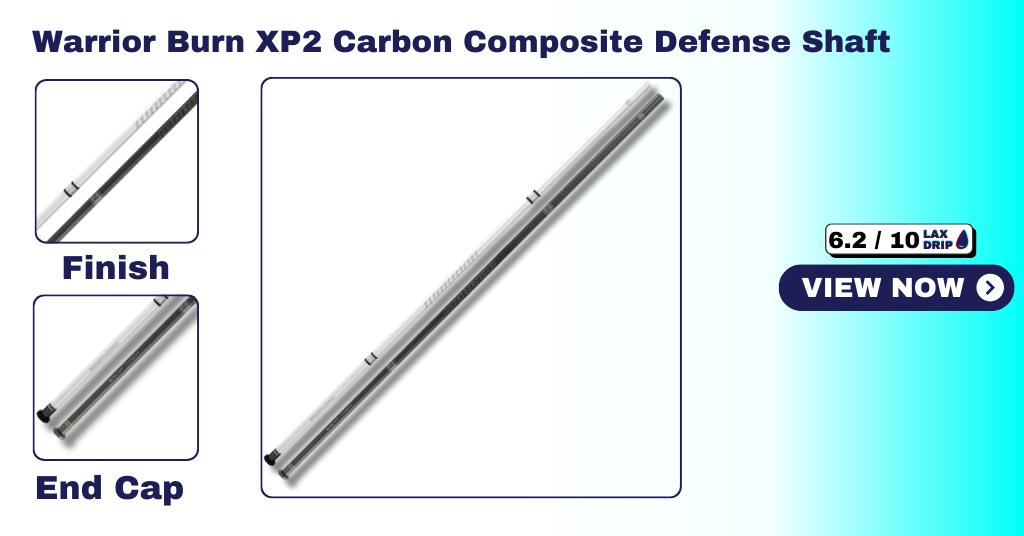
10) Warrior Burn XP2 Carbon Composite defense lacrosse shaft
| Material | Composite |
| Weight | 12.3 oz |
| Shape | Octagonal shape |
| Grip/Finish | Star Matrix Grip |
| Colors | White, Black |
| Flex | Engineered flex |
| Warranty | 2 months |
The Warrior Burn XP2 Carbon Composite defense lacrosse shaft delivers the same quality experience as its attack counterpart. However, the design is tailored for defensive players.
From the start, I appreciated its lightweight feel for a defense shaft, coming in at just 12.3 ounces. Thanks to its dotted grip, which eliminates the need for taping, it’s impressively light.
Moreover, the octagonal shape and Star Matrix grip provide excellent control with no palm abrasion. My hands neither slipped nor felt too stiff while dodging opponents.
Despite concerns about composite shaft durability, this one has held up through intense cross-checking without damage. Its balance of strength and weight allows for hard checks without weighing me down.
Furthermore, the slight flexibility in its carbon-fiber construction absorbs impact and reduces arm fatigue during long games. The shaft’s responsiveness during ground ball scrambles is also impressive. I got quicker reaction times when scooping under pressure.
However, the shaft’s reduced stiffness leads to unwanted give when shooting long-range passes. So, if you prefer high-shooting accuracy, try ECD Lacrosse Carbon Pro 3 Defense Lacrosse Shaft.
Goalie Shafts
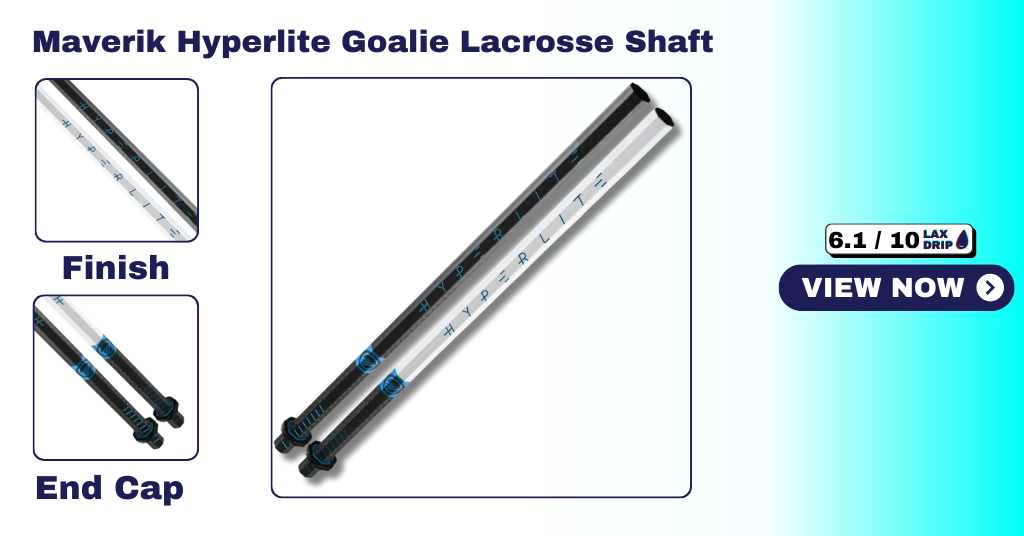
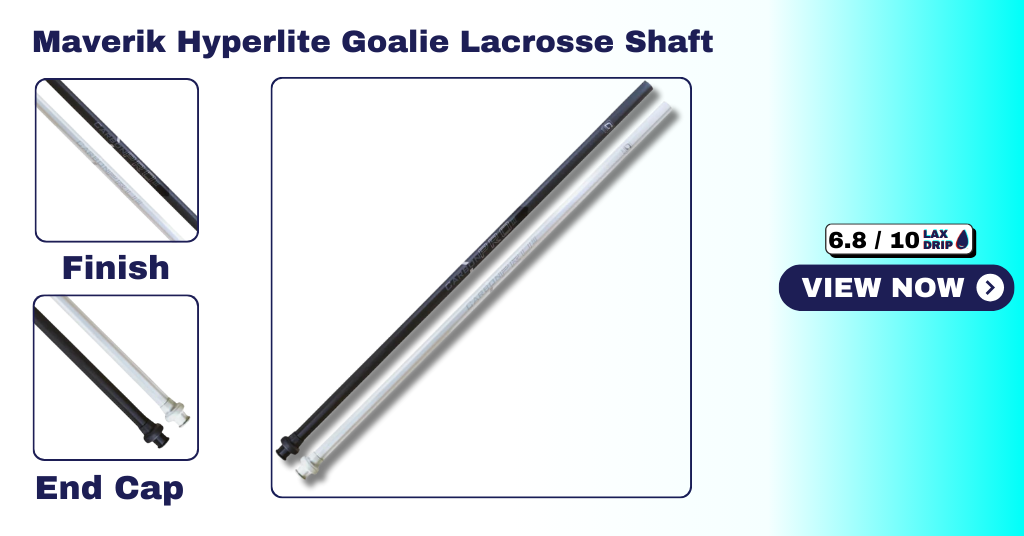
1) Maverik Hyperlite Goalie Shaft
| Material | Carbon fiber |
| Shape | Slight concave |
| Grip/Finish | Smooth matte finish |
| Colors | Black, White |
| Flex | None |
| Warranty | 6 months |
We start off our list of the best lacrosse shafts specific for goalies with the Maverik Hyperlite. It’s one of the lightest shafts on the market today and the lightest shaft Maverik has ever created.
Having a light shaft is essential for goalies. The lighter your shaft, the faster you can move your hands to make saves. This—combined with its strength—makes the Hyperlite our top shaft for goalies.
Unlike some other carbon fiber shafts, the Hyperlite is designed not to flex. If you are used to metal shafts but want to try out a carbon fiber shaft, this may be a good option instead of jumping straight to a shaft designed to flex.
The Hyperlite has a slight concave shape and a matte finish for a smooth feel. It comes in black and white, both of which have blue accents and a checkered pattern on some (white) or all parts (black) of the shaft.
One of my favorite parts of the Hyperlite is the adjustable butt end that you can move on the shaft depending on where you prefer it.
If you are looking for a lightweight carbon fiber goalie shaft, look no further than the Maverik Hyperlite. It checks all of the boxes when it comes to a great shaft and there’s a reason it’s used by countless pro and collegiate players.
2) ECD Carbon Pro 3.0 Goalie
| Material | Carbon fiber composite |
| Length | 36" |
| Weight | 5.64 oz |
| Shape | Concave |
| Grip/Finish | Raised texture top third of shaft |
| Colors | White, Black |
| Warranty | 6 months |
If you are a goalie that prefers composite shafts, you can’t go wrong with the Carbon Pro 3.0 Goalie shaft from ECD—a new release for 2022.
It is very light and should have no problem holding up even when deflecting the hardest of shots. If for some reason it does break, there is also a 6-month warranty allowing you to get a replacement.
The Carbon Pro 3.0 Goalie features a mid kick point and Flex8 technology to allow you to effortlessly make outlet passes.
It also has a textured grip on the top third of the shaft to give you better control when trying to make saves. We’ve found this to be one of the best parts about the Carbon Pro 3.0 Goalie as compared to other shafts. You won’t need any tape when using this shaft thanks to the built-in grip for your top hand.
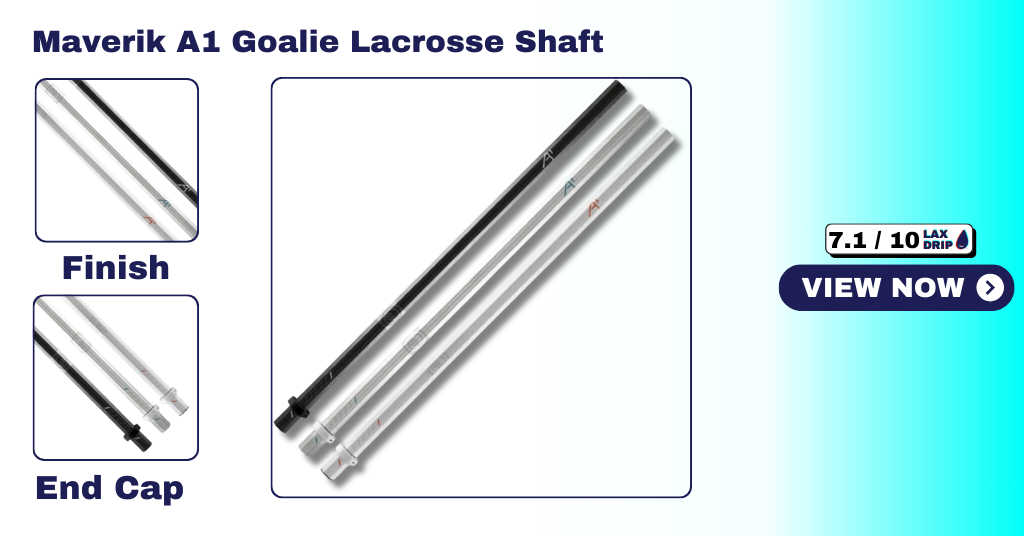
3) Maverik A1 Goalie Shaft
| Material: | Scandium alloy |
| Length: | 36" |
| Shape: | Concave |
| Grip/Finish: | GritGrip |
| Colors: | Black, White, Silver |
| Warranty: | 6 months |
It’s rare that a company produces two elite shafts for a single position—especially when it comes to goalies—but the Maverik A1 shaft is another great option for the guys between the pipes.
If you prefer metal over carbon fiber for your goalie shaft, the Maverik A1 is our top recommendation. It uses a Scandium alloy that provides great durability without adding a lot of weight.
In addition, the A1 uses a GritGrip finish that gives you a great feel of the shaft regardless of the weather conditions. We’ve tested the A1 shaft in the rain and found that it was still easy to control and there was no slippage.
Like the Hyperlite, the A1 has Maverik’s popular adjustable butt end that allows you to move the end cap to where you prefer.
Overall, if you are a fan of metal goalie shafts, the Maverik A1 makes a strong case for being the best option currently available.
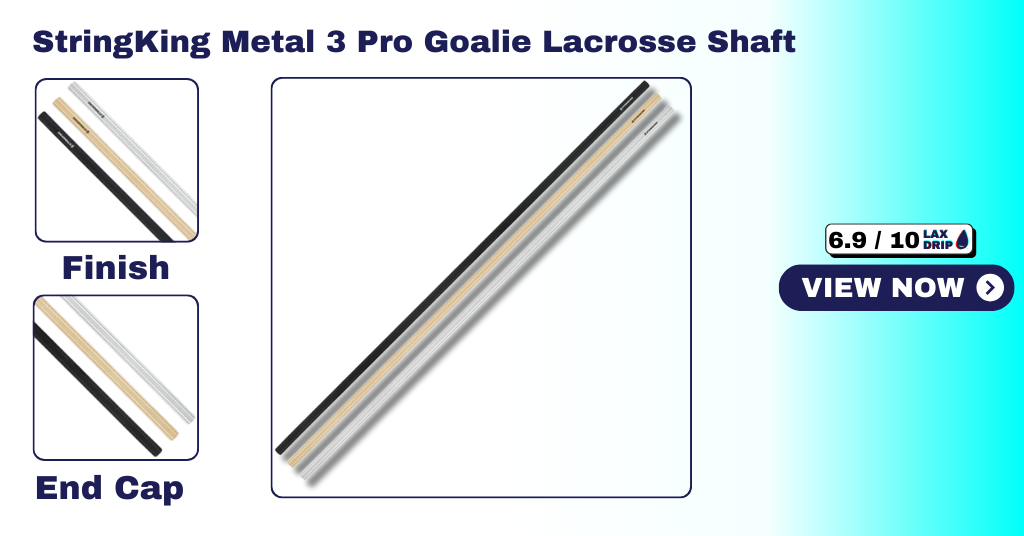
4) StringKing Metal 3 Pro Goalie
| Material | Metal alloy |
| Length | 36" |
| Weight | 5.01 or 5.71 oz |
| Shape | Slight concave |
| Grip/Finish | Sandblasted finish |
| Colors | Silver, Black |
| Warranty | 6 months |
Another great metal goalie shaft is the StringKing Metal 3 Pro. StringKing has really made a push to be one of the best shaft makers in the game and this product is a strong reflection of that.
There are two different weights based on your level of play. StringKing recommends that those 15 and under go with the 142-gram option while older players go with the 162-gram option.
Both options have great durability and are lighter than many other goalie shafts. They also have a nice concave shape that provides for a great grip on the shaft plus a sandblasted finish to provide a bit of grit.
Besides the performance, my favorite thing about StringKing’s shafts are their clean, minimalistic appearance. They have small logos on one side of the shaft and subtle logos on the other side giving information about the shaft.
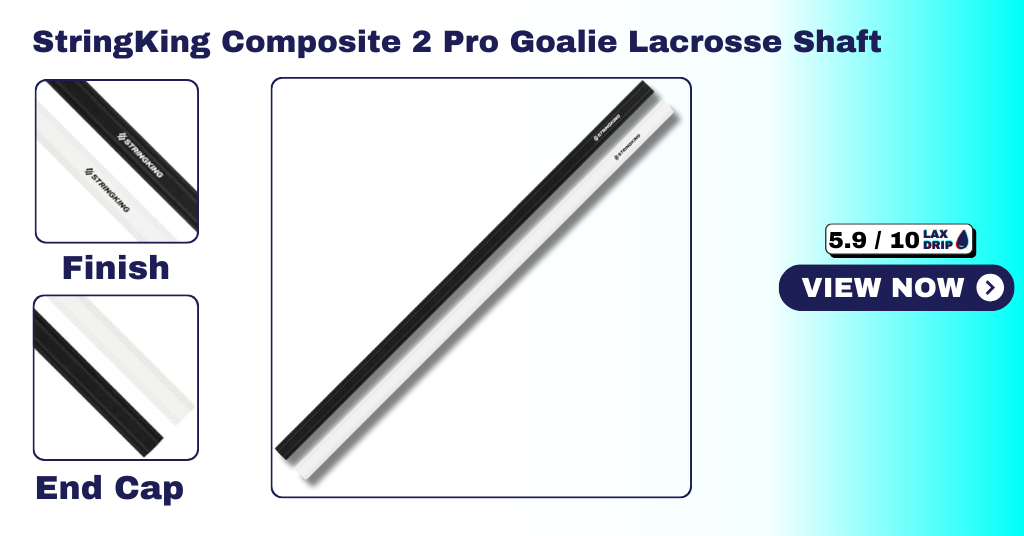
5) String King Composite 2 Pro Goalie Lacrosse Shaft
| Material | Composite |
| Weight | 15 and 15.8 oz |
| Shape | Octagonal |
| Grip/Finish | Smooth Finish |
| Colors | White, Black |
| Flex | No flex |
| Warranty | 6 months |
String King Composite 2 Pro is the most recent addition to my collection of goalie shafts. I liked its Smart Taper technology that keeps the shaft strong in high-impact areas while minimizing vibration at the head end. I have taken some hard shotand it nicely withstood the pressure.
Moreover, its uniform stiffness with no weird flex zones is perfect for goalies. As a result, it allowed me to react quickly to shots from all angles. I felt confident making saves, even when a player was shooting from the corner of the crease.
The ultra-stiff construction also helped me with accurate passes and clears, even under pressure. Every throw was directed to my teammates with perfect speed without any spread on shot.
Although it lacks an extreme concave surface, the traditional smooth finish performs consistently. I didn’t experience any slipping or grip loss, especially during those sweaty summer sessions. However, the shaft itself is not weather-resistant.
All in all, the String King Composite 2 Pro is a highly durable and the best lacrosse shaft. It offers a good combination of stiffness and responsiveness to save maximum passes.
>> Read More: Best Goalie Lacrosse Shafts
How to Choose the Best Lacrosse Shaft
Not sure what to consider when buying a lacrosse shaft? Here are 7 of the most important things to think about that can help you find your best fit.
1) Size/Position
The first step in choosing a lacrosse shaft is figuring out what size you need, which is mainly based on your position and (possibly) age.
Let’s start with position.
Attackmen and midfielders (excluding LSMs) always use 30-inch shafts. Defense shafts are always 60 inches long when bought new, but some players may elect to cut a few inches off to get better control. Finally, goalie shafts can be anywhere from 30 to 40 inches depending on your preferences. If you like a 30-inch shaft as a goalie, you can use any attack shaft.
If you or you child is younger (around 12 or under), you may elect to go with an even shorter shaft than the above sizes. You’ll find that many “youth” shafts are a few inches shorter and sometimes have a smaller diameter to help younger players control them better.
Young defensemen, especially, often use shorter shafts than the standard 60-inch pole. A good rule of thumb is to not use a stick that is any taller than you. So, for example, if you or your child is 5 feet tall, you shouldn’t use a shaft that is any longer than 4’2″ since most heads are around 10 inches long.
2) Durability
Though durability is hard to judge just by looking at a picture of a shaft or even feeling it in your hands, it is important to consider.
The best way to do this, in my opinion, is by reading customer reviews and watching YouTube videos created by players after they’ve used the shaft for awhile.
This can help you get an idea of how well the shaft holds up over time. If you see that a shaft has a lot of complaints about breaking, dents, bending, etc., then you may want to look for a different option.
3) Weight
Almost as important as durability is weight. Having a lightweight shaft allows you to move your stick faster, improving your shot speed, quickness, dodging, checking, and more.
Unfortunately, weight and durability work against each other for many shafts. Typically, the lighter a shaft, the less durable and strong it is.
In the past decade, however, lacrosse companies have developed advanced metals and composite materials that provide great strength while still being light.
This is often the biggest difference between the best lacrosse shafts (like those listed above) and cheaper shafts that are either light and weak or strong but very heavy.
4) Material
There are two main types of lacrosse shafts available: metal and composite. Historically, most shafts were made of metal (besides the OG wooden shafts, of course).
In the past decade or so, companies have started developing composite shafts, often made of carbon fiber, that perform just as well and, in a lot of cases, better than metal shafts.
So which is better?
There’s no right answer. It really depends on your personal preference.
Carbon fiber shafts typically have a higher strength-to-weight ratio and flex more than metal shafts. The flex especially can take some getting used to when switching to a carbon fiber/composite shaft. Many companies even offer shafts with different flex points allowing you to find a shaft tailored to your game.
Metal shafts, on the other hand, don’t flex much and switching from one metal shaft to another should feel pretty natural. Metal shafts get dings and dents in them more easily than composite shafts—but these don’t make them unusable like composite shafts are once they crack.
Composite shafts are more prone to catastrophic failure than metal shafts because they shatter instead of just getting a few small dings. So while an average carbon fiber shaft may hold up better, once they break, they are pretty much useless.
5) Shape
There are a few common shaft shapes including concave, rounded, and rigid. The STX Sc-Ti series, for example, includes 5 versions: concave (Sc-Ti X), rigid (Sc-Ti R), shift (Sc-Ti S), octagon (Sc-Ti O), and extreme concave (Sc-Ti X+).
Like the metal vs. composite debate, there is no “best” shape for a lacrosse shaft. I recommend feeling a few different shafts—either in a store of by testing out some of your teammates’ shafts—to see which feels the best to you.
Be sure to feel the shafts with your gloves on as this is what you’ll be playing with in a game.
6) Finish/Grip
You should also consider the finish of your lacrosse shaft. By finish, I mean the grip or what the outer material of the shaft feels like.
Most shafts aren’t perfectly smooth—and that’s a good thing. You want some kind of texture on the shaft so you have a better grip on them. For example, some shafts have a sand blasted finish that give you some traction while others use a rubber grip.
This is something else that you’ll have to test out for yourself to figure out what you prefer. Try different shafts to see which feels the best in your gloves to decide which to go with.
7) Cost
Which lacrosse shaft is best for you also depends on how much you want to spend. Top-of-the-line shafts can cost well over $100—especially for d poles which start to push $200.
There are many quality shafts for all positions, however, that cost under $100.
If you are trying to save on your lacrosse stick, I actually recommend going with a cheaper shaft and more expensive head. I think there’s a larger difference between the best lacrosse heads and cheaper/less advanced options than shafts.
In my career, I think I’ve only broken one shaft, and I don’t find that a slightly heavier shaft makes much of a difference. At the end of the day, all shafts have the same basic shape and weight doesn’t fluctuate that much compared to heads.
In the future, I hope to make an article highlighting my favorite cheap lacrosse shafts to help players looking for more affordable options.
Standard Lacrosse Shaft Sizes
Here are the most common regulation shaft sizes by level of play and position. Note that “Adult” refers to high school and higher.
Position | Youth | Adult |
|---|---|---|
Attack/Middie | 28" – 30" | 30" |
Defense | 28" – 60" | 30" – 60" |
Goalie | 28" – 40" | 30" – 40" |
>> Read More: Lacrosse Shaft Lengths or What Makes a Lacrosse Stick Legal?
How We Rate Lacrosse Shafts
We take our ratings seriously and only recommend products that we would use ourselves.
To come up with our ratings for each product, we test the product ourselves whenever possible, review product specifications (weight, strength, material, grip, etc.), and read customer reviews/talk to lacrosse players we know that use the product.
When testing lacrosse shafts, specifically, we weigh the shafts, feel them in gloves (for both grip from the shape of the shaft as well as the texture of the finish), shoot with them to understand how they flex, and check them with another stick to see how they hold up.
When it’s not possible to extensively test a product ourselves, we spend extra time talking to real customers who have used the product for a while themselves.
If you ever have any feedback for any of the products listed on this page or have a recommended addition, please contact us and let us know!
People Also Ask
How Do You Play Better Defense in Lacrosse?
Improve your positioning, maintain a strong defensive stance, communicate with teammates, use effective stick checks, and anticipate the opponent’s moves. Practice footwork and agility regularly.
What Is a D Pole in Lacrosse?
A D pole, or defensive pole, is a long lacrosse stick used by defensemen and long-stick midfielders (LSMs). It typically measures 60 inches in length, offering extended reach for checks and interceptions.
What Is Different About a Defensive Stick in Boys Lacrosse?
Defensive sticks in boys’ lacrosse are longer (60 inches) than offensive sticks (30 inches), providing greater reach for checks and increased leverage for defensive maneuvers.
What Is Flex iQ in a Lacrosse Shaft?
Flex iQ refers to the shaft’s flexibility rating, indicating how much it bends under pressure. Higher Flex iQ values mean more flexibility, enhancing power and accuracy in shots and checks.
Complete Your Stick
Need a new head to go with your shiny new shaft or a nice bag to put it in? Check out our other guides that can help you find your perfect fit:
Photo credit: Flickr




This Post Has 2 Comments
I feel like I would get a better idea about these shafts if you included the weights like you did with your best heads section
Hi Jake,
Great idea—thanks for the suggestion! As I go through and update the guides for 2022, I’ll add in the weights.
Best,
Dave